Updated October 2026
ASTM F1346 Pool Safety Cover
A missing year suffix on an ASTM F1346 claim fails the check you can make from the public catalog. The ASTM store page for F1346-23 is marked Active, and the store page for F1346-91R18 is marked Historical. Both pages use one title: Standard Performance Specification for Safety Covers and Labeling Requirements for All Covers for Swimming Pools, Spas and Hot Tubs.
ASTM F1346 is that safety-cover performance specification, and its scope also includes marking requirements for all covers. In the ASTM standards catalog, F1346-23 is the Active listing, last updated Jul 13, 2023, from Subcommittee F15.28, Book of Standards Volume 15.11, 7 pages, ICS 97.220.10, DOI 10.1520/F1346-23. F1346-91R18 is marked Historical, DOI 10.1520/F1346-91R18, with the same last-updated date. Both catalog pages print scope sections 1.1 through 1.5. Section 1.4 names Section 9 as the test-methods section. Section 9 itself is not on those pages, and this guide adds no load, no opening size, and no gap.
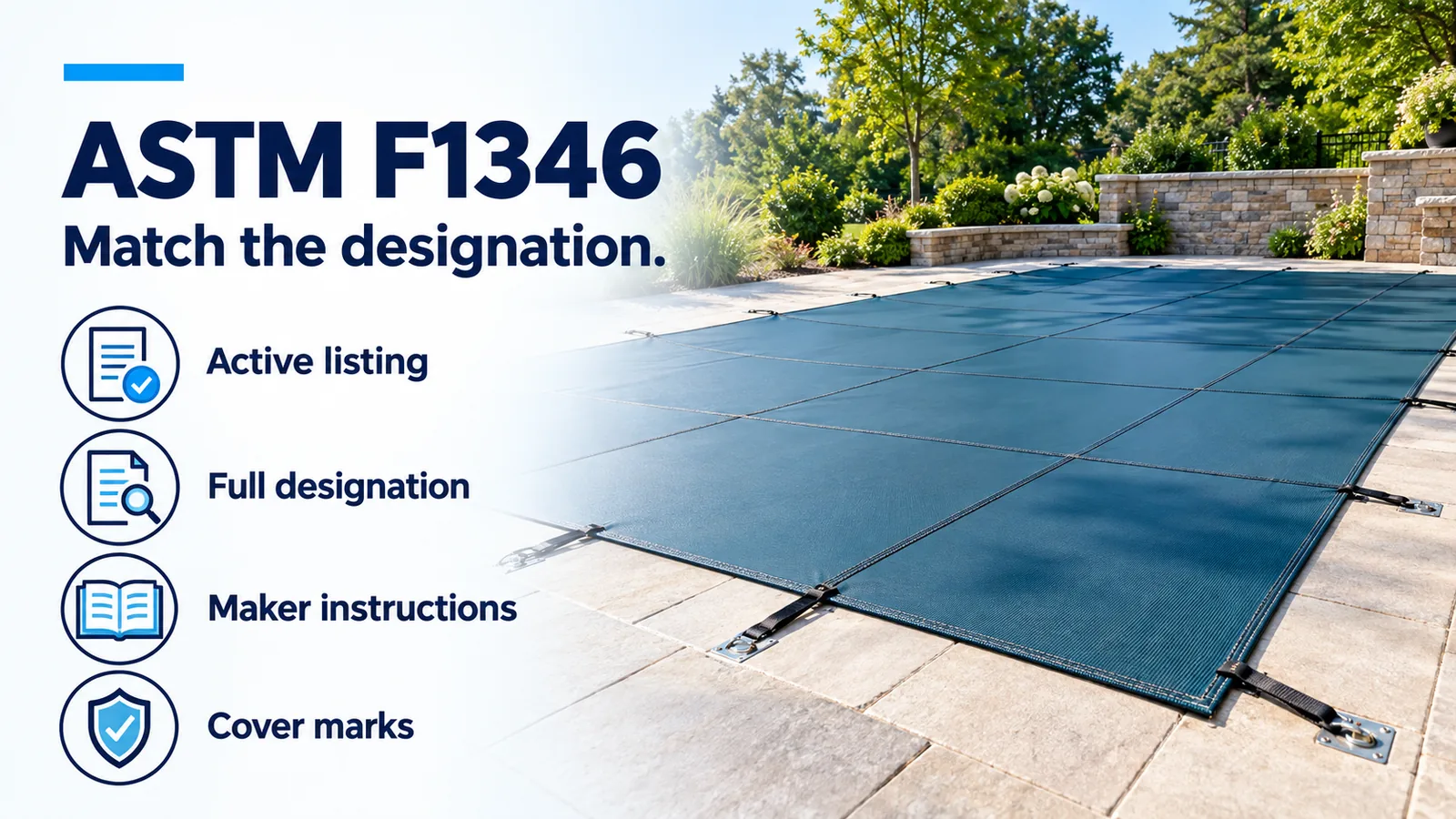
- Record the full designation, suffix included, before you accept a safety-cover claim.
- The store marks F1346-23 Active.
- The same version menu lists F1346-91R18, F1346-91R10, F1346-91R03, and F1346-91R96, and those rows are not marked Active on that page.
- Scope 1.1 ties the drowning-risk purpose to correct installation and use under the manufacturer's instructions.
- The saved catalog pages do not print a walk-on load or an opening size.
What does the ASTM store publish?
The product page is the public catalog record. These fields are on the pages saved for this guide.
| Field | F1346-23 | F1346-91R18 |
|---|---|---|
| Store status | Standard Active | Standard Historical |
| Title | Standard Performance Specification for Safety Covers and Labeling Requirements for All Covers for Swimming Pools, Spas and Hot Tubs | Same title |
| Last updated | Jul 13, 2023 | Jul 13, 2023 |
| Committee | F15 | F15 |
| Subcommittee | F15.28 | F15.28 |
| Book of Standards | Volume 15.11 | Volume 15.11 |
| Pages | 7 | 7 |
| ICS code | 97.220.10 | 97.220.10 |
| DOI | 10.1520/F1346-23 | 10.1520/F1346-91R18 |
The Active page's version menu lists F1346-23 with the word Active, then F1346-91R18, F1346-91R10, F1346-91R03, and F1346-91R96. A generic store note says a redline compares the current active standard with the previous version. That note does not list which sentences changed.
Takeaway: Keep the status word next to the full designation. Active and Historical are different labels on these two pages.
How do you read the designation F1346-23?
The F1346-23 catalog page says: "An ASTM designation number identifies a unique version of an ASTM standard." It then splits this designation into three parts.
full designation = letter + sequential number + year suffix
Worked example: F1346-23. F means Materials for Specific Applications. 1346 means the assigned sequential number. 23 means the year of original adoption (or, in the case of revision, the last year of last revision). That parenthetical is the store's own wording.
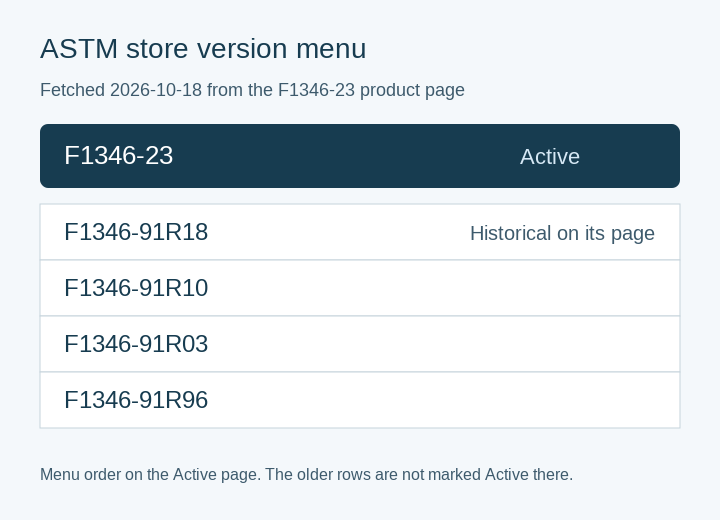
A quote that prints only "ASTM F1346" drops the suffix the store uses to separate those rows. Ask the seller for the designation on the listing for this cover, then match that string to the menu.
Rule of thumb: If the paperwork names F1346 and the suffix is missing, or the suffix is 91R18, 91R10, 91R03, or 91R96, hold the safety-cover claim until the paperwork names the listing this job is supposed to follow. The store places the Active label on F1346-23.
What do scope sections 1.1 through 1.5 say?
Both saved catalog pages print the scope. Sections 1.1, 1.2, 1.4, and 1.5 use the same sentences. Section 1.3 does not.
Section 1.1 says this specification establishes requirements for safety covers for swimming pools, spas, hot tubs, and wading pools. When the cover is correctly installed and used in accordance with the manufacturer's instructions, the specification is intended to reduce the risk of drowning by inhibiting access of children under five years of age to the water.
Section 1.2 says the specification includes performance tests to demonstrate compliance or noncompliance with the requirements stated for safety covers. The same section says it also includes marking requirements for all covers. The mark wording and the test steps are not on these catalog pages.
Section 1.3 is the units sentence, and the two designations differ. On F1346-23, inch-pound values are regarded as standard, and values in parentheses are mathematical conversions to SI units, for information only, and are not considered standard. On F1346-91R18, inch-pound values are regarded as the standard, and values in parentheses are given for information only. That is the difference those two pages show in the scope.
Section 1.4 says its safety caveat applies only to the test methods section, Section 9. The caveat says the standard does not purport to address all of the safety concerns associated with its use, and that the user of the standard establishes appropriate safety, health, and environmental practices and the applicability of regulatory limitations before use. Section 9 is not printed on the catalog pages.
Section 1.5 says this international standard was developed in accordance with the World Trade Organization Technical Barriers to Trade decision on principles for international standards.
Where does the safety-cover claim fail on paper?
The dominant failure mode is a safety-cover claim whose paperwork never names a designation the store can mark Active or Historical. The prevention is to write down the full designation and the manufacturer's instructions before you treat the installed sheet as the safety cover in section 1.1.
| What you were given | Dominant failure mode | Prevention |
|---|---|---|
| The word safety, and no standard name | The claim never reaches the F1346 title | Ask which full designation the listing uses |
| ASTM F1346 and no suffix | The version menu has nothing to match | Ask for the suffix the store prints, such as 23 or 91R18 |
| F1346-91R18, F1346-91R10, F1346-91R03, or F1346-91R96 | That row is not the row marked Active | Ask whether this job is supposed to follow the Active listing, F1346-23 |
| A debris or solar sheet described as comparable | Section 1.2 places performance tests on safety covers and marking requirements on all covers | Ask which of those two jobs this sheet is sold to do |
The hidden cost sits in that last row. A household that accepts a debris sheet in place of a safety cover still has the safety-cover decision in front of it, and the first cover's price does not retire that decision. Pricing depends on the pool dimensions, cover type, and deck anchoring scope.
Which statute is about drain covers?
15 U.S.C. § 8003, on the Cornell Law School page fetched 2026-10-18, is titled Federal swimming pool and spa drain cover standard. Effective one year after December 19, 2007, each swimming pool or spa drain cover manufactured, distributed, or entered into commerce in the United States shall conform to the entrapment protection standards of ASME/ANSI A112.19.8, or any successor standard regulating such a swimming pool or drain cover. A text search of that saved page found ASME/ANSI A112.19.8 and found no F1346. Drain-cover hardware follows that statute. The safety-cover specification is the ASTM store listing above.
What does correct installation mean here?
Section 1.1 ties the drowning-risk purpose to a cover that is correctly installed and used in accordance with the manufacturer's instructions. The catalog pages do not print anchor spacing, a spring count, or a deck gap. Use the manufacturer's instructions for the cover in the quote when you need those figures. Section 9 is the test-methods section named in section 1.4, and these catalog pages do not print it.
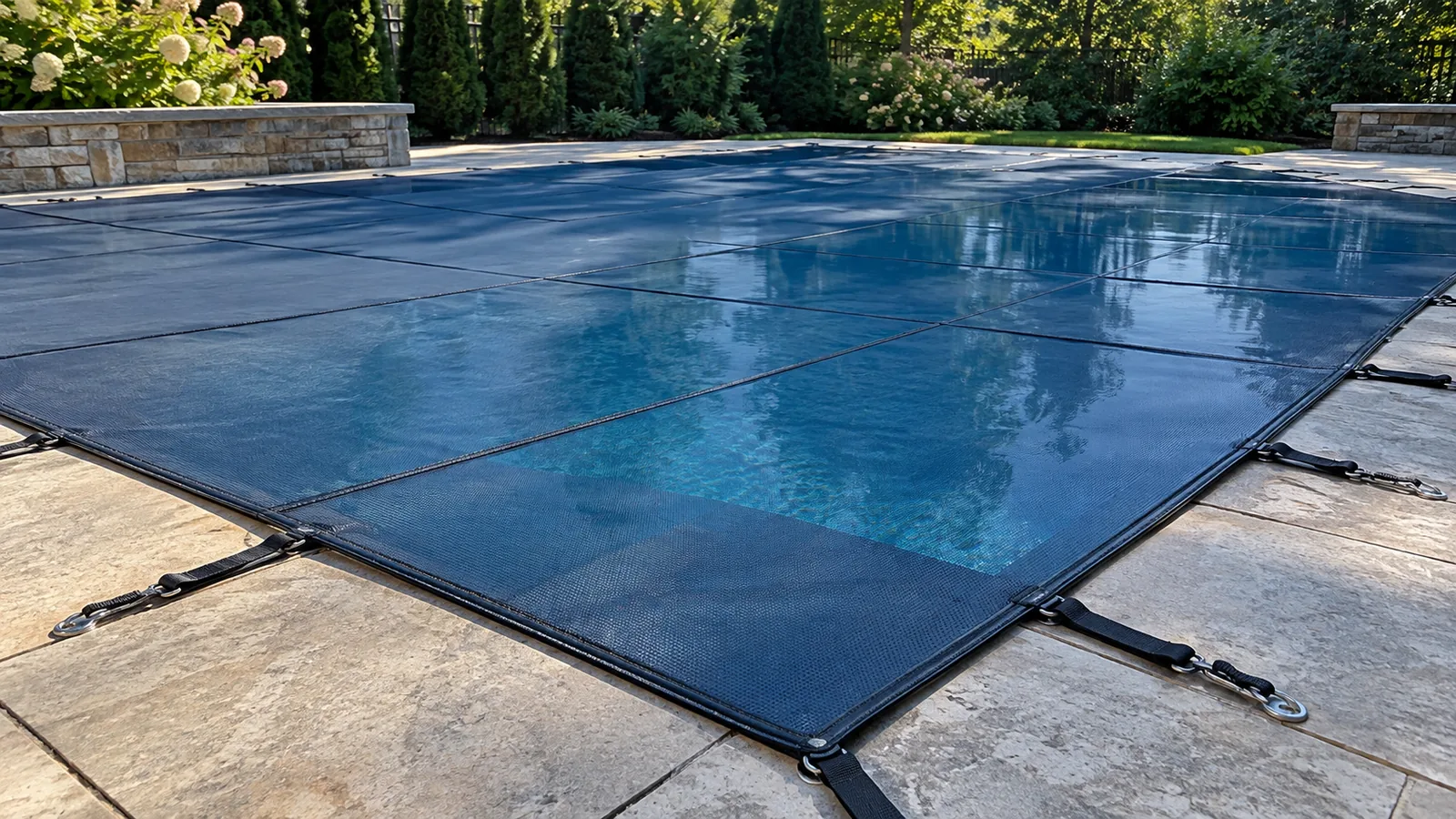
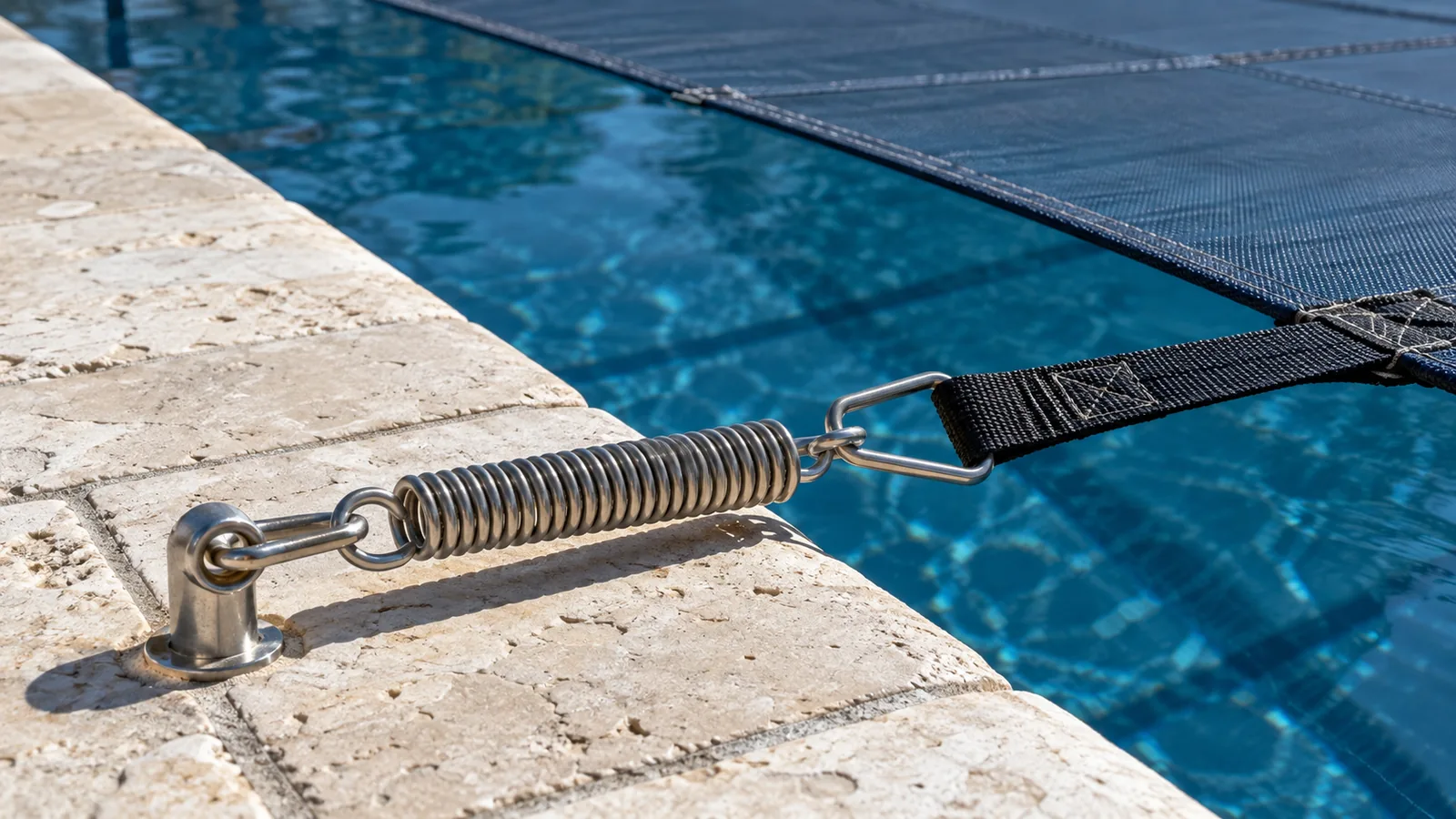
Standing on the fabric is a separate question. The saved scope grants no such permission and prints no load. For the way this site treats that question on an automatic cover, read whether you can walk on an automatic pool cover. When you still need the product class rather than the designation check, start with pool safety covers.
Mesh and solid are different products on this site. Read mesh pool safety covers, solid pool safety covers, and mesh versus solid for that choice. The ASTM catalog pages do not rank the weaves.
Automatic names the travel mechanism. The F1346 title names a performance specification and labeling requirements. Compare those jobs on automatic versus manual safety covers. A sheet sold for the off-season belongs with winter pool covers. A cover that already travels, and now has to face cold weather, belongs with an automatic cover in winter.
Scope: ASTM Designation and Local Barrier Codes
Use it to match a designation and to read the scope the store prints. It does not replace the 7-page standard, a local barrier code, or the manufacturer's instructions. Committee F15 and Subcommittee F15.28 are the catalog's credit line for who developed the standard. The pages do not describe a stamp ASTM places on each dealer site.
A quote that already names another document, including the drain-cover statute above, stays with that document. A figure you remember from a brochure stays out of this page unless it is on the saved catalog pages.
Method and sources
Updated October 2026. Status words, designation parts, scope sentences, and the table fields were read from the ASTM store pages saved for this guide. Section 9 is named in section 1.4 and is not printed on those pages, so no test figure from outside them is used here. No cover was loaded for this page.
- ASTM store, F1346-23, marked Active, last updated Jul 13, 2023. Fetched 2026-10-18. Product page.
- ASTM store, F1346-91R18, marked Historical, last updated Jul 13, 2023. Fetched 2026-10-18. Product page.
- 15 U.S.C. § 8003 as presented by Cornell Law School. Drain-cover standard under ASME/ANSI A112.19.8. Section.
Related guides
- Pool safety covers: the parent guide for the product class, once the designation is written down.
- Whether you can walk on an automatic pool cover: the separate question the catalog scope does not answer with a load.
- Automatic versus manual safety covers: mechanism on one side, the safety-cover claim on the other.