Updated August 2026
How to Choose a Pool Cover
Choosing a pool cover is a sequence of jobs: safety versus solar, automatic versus manual, new build versus retrofit, then drive and track. Start with the job the cover must do every week, not with a brand. This guide is the buying hub for those forks and the questions to send a supplier.
Decision order
If the cover must be a tested safety barrier, drop solar blankets immediately. If you will open it daily, automatic beats a winter mesh you fight twice a year. If the deck is finished, top track is usually the honest retrofit. If the pool is still on paper, undertrack is still available.
| Question | If yes | Go to |
|---|---|---|
| Do you need a tested safety barrier? | Verify the standard, not the photo | Safety covers hub |
| Will you open it most swim days? | Automatic fabric system | Automatic covers hub |
| Is the deck already finished? | Plan a retrofit track | Installation hub |
| Do you want the motor off the pool end? | Hydraulic review | Hydraulic pillar |
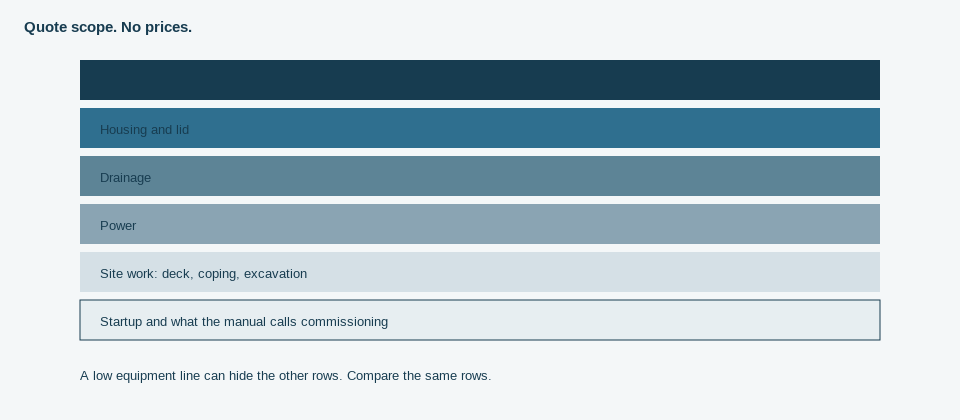
Questions to ask a supplier
Ask for the track type in writing, the housing size, drainage, who supplies electrical, warranty documents you can read before deposit, and whether the quote includes commissioning and owner training.
- Exact track and lid specification
- Who owns electrical or hydraulic provision
- What happens if the pool is out of square
- How to verify a safety-cover claim
When not to buy an automatic cover
Skip automatic tracks if the outline cannot take a straight leading edge, if the owner will only close the pool twice a year, or if the deck cannot accept a housing and a drain. Those jobs belong to a manual safety cover or a documented custom review.
Shape vetoes live on the freeform and infinity pages. A discount automatic on leftover water is not a safety plan.
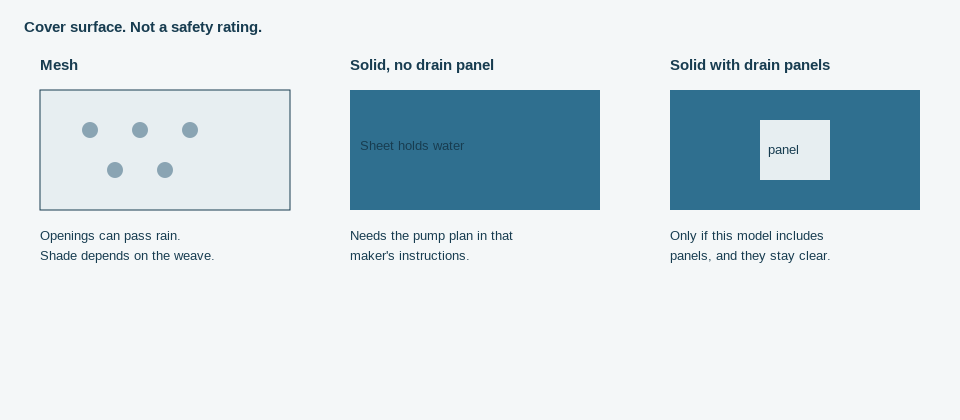
Papers to read before deposit
Ask for the warranty booklet, the safety-cover evidence if that word is on the quote, and the commissioning list. The warranty guide is the reading method. The supplier page is the bid-comparison method.
When a floating solar cover fits instead of a safety cover
When the primary job is cutting evaporation and retaining water heat rather than creating a tested child-access barrier, a floating bubble cover handles up to 95 percent of evaporation loss at far lower hardware complexity. Real heat-gain limits, cloudy-day and shade performance, liquid-cover comparisons, and ASTM F1346 safety boundaries are detailed in our guide on whether solar pool covers work.
Choosing between a blue and clear solar pool cover
Once you decide on a floating bubble blanket for evaporation and heat control, tint and sheet gauge shift the balance between daytime solar gain, overnight retention, and UV chlorine protection. Detailed tradeoffs across clear, light blue, dark blue, multi-layer covers, and 8 to 16 mil tiers are compared in our blue vs clear solar pool cover guide.
Value, life, and paperwork
Worth is a use test, not a sticker. Read are automatic pool covers worth it, then how long they last as parts, not one year for the whole pool.
Ask for the warranty documents before deposit. The warranty guide is the reading method. Cost factors live on the cost hub.
Questions
- Are automatic covers worth it?
- They are worth it when daily use, heat or debris load, or a safety barrier is part of the ownership plan. They are a poor buy if the pool shape cannot take tracks honestly.
- Should I pick a brand first?
- No. Lock the job, the construction stage, the track, and the drive. Then compare brands on the same written scope.
- Is a winter mesh cheaper than automatic the right save?
- It is the right save if you will not open the water most swim days. It is the wrong save if you need a daily barrier and will leave a mesh stacked in the garage.
Parent hub: Automatic Pool Covers