Updated October 2026
Pool Cover Pump Freezing and Winter Storage
Ice can leave a cover pump unable to remove the next round of meltwater. Plan winter storage around the instructions for your exact pump, then assign someone to keep checking the cover while that pump is out of service.
This guide is for a portable pool cover drainage pump that removes rain or snowmelt from the top of a cover. The circulation pump connected to the pool's filter and plumbing has a different winterization procedure. For choosing and placing a cover pump, start with the pool cover pump guide; this page covers the seasonal handover.
Before a freeze: identify the pump and check the whole discharge route
Record the manufacturer, full model and matching manual before deciding whether to leave the pump installed or bring it indoors. An automatic switch tells you how pumping starts and stops; it does not establish permission to leave that unit exposed to freezing.
Read the pump manual's freezing, storage and electrical sections together with the cover manufacturer's winter instructions. If the cover paperwork says to keep a pump available but the installed pump's instructions require removal, ask the equipment manufacturer or qualified service technician to resolve that combination before cold weather arrives. A replacement pump may differ from the one supplied with the original cover.
Our recommended pre-freeze walk-round is to look from a safe, dry deck position at the hose connection, its route and its outlet. Record visible splits, flattened sections, debris and places where water collects. Do not assume a clear outlet proves the entire hose is open. Leave exact drainage and disconnection procedures to the matching equipment instructions.
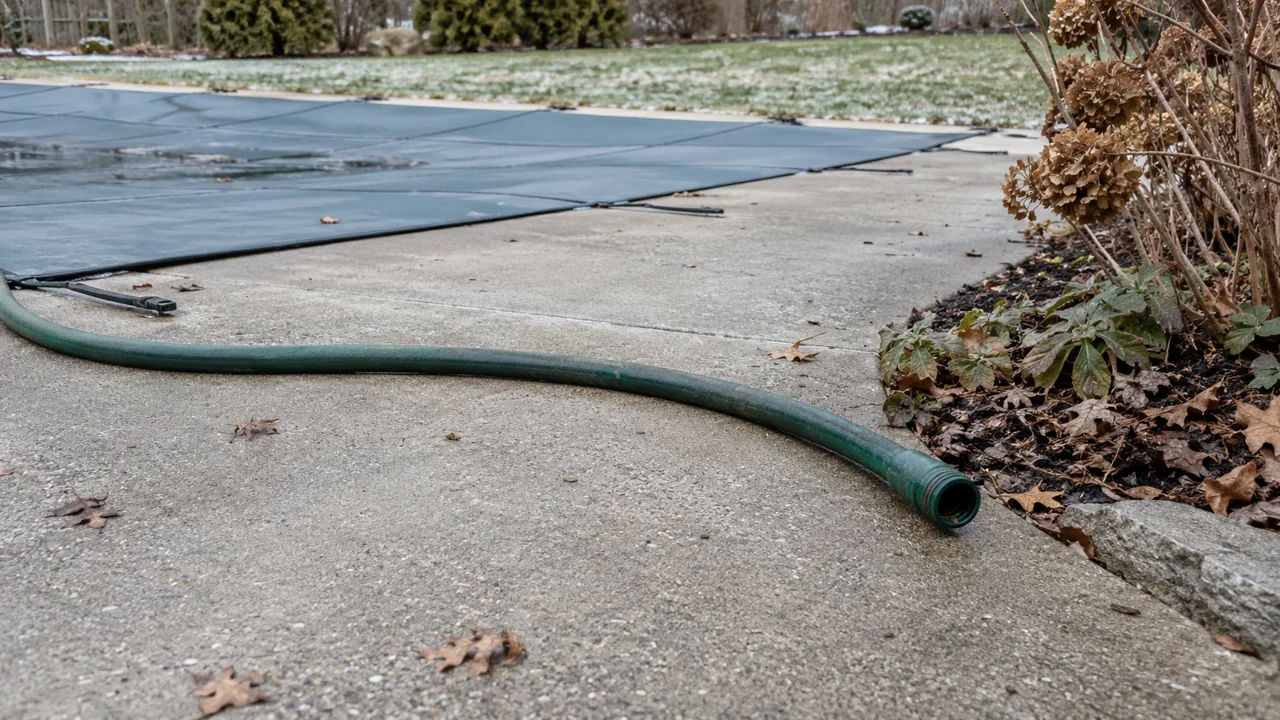
Before the season changes, make these decisions explicit:
| Record | Where to confirm it | If the answer is missing |
|---|---|---|
| Exact pump and manual revision | Accessible nameplate and manufacturer's document | Unknown / verify on the unit |
| Installed use during freezing weather | Pump instructions, including all conditions | Ask the manufacturer before relying on installed operation |
| Storage preparation and location | Storage and maintenance sections | Confirm cleaning, draining and permitted storage conditions |
| Discharge route after the next thaw | Hose inspection and local discharge requirements | Arrange a usable route before restarting |
| Who checks the cover while the pump is stored | Owner's winter plan | Name a person and a way to reach them |
During freezing weather: a float switch is not a winter guarantee
The Little Giant APCP-1700 provides a useful example of why the whole manual matters. Its owner manual identifies a float-controlled pump. Printed pages 3–5 warn against allowing the unit to freeze because cracking or distortion may destroy it. The Maintenance section on page 5 also requires its power cord to remain connected if the pump is left installed during freezing conditions. Read those conditions together in the APCP-1700 manual.
That conditional power instruction is not a promise that the pump can survive being frozen solid, and it is not an instruction for every cover pump. Equally, unplugging an installed APCP-1700 for the entire cold period would omit a condition its manual states. Resolve any uncertainty about your setup with the manufacturer; use its current instructions for the unit you own.
| Observation | What it establishes | What it does not establish |
|---|---|---|
| The float moved or the pump ran before winter | It operated at that observation | Freeze tolerance or future reliability |
| Liquid water is visible around the pump | Water is present at that spot | A thawed, unobstructed discharge hose |
| The pump is silent | An observation to record | Whether the cause is water level, power, obstruction or a fault |
If the pump or hose is trapped in ice, do not pull it free by the cord, pry it from the cover or keep restarting it to force a result. Keep people away and obtain model-specific advice about isolation and recovery. This is not a de-icing or electrical repair procedure.
For storage: prepare the pump without losing the drainage plan
Storing the pump does not end the cover's drainage job.
Before handling, cleaning or moving the pump, disconnect power as its manual directs and work from a dry, safe position. For the APCP-1700, page 5 requires thorough cleaning before storage and disconnecting electrical power before pump or switch service. The motor housing is sealed and does not require owner servicing. Those instructions do not authorize opening the motor to empty it.
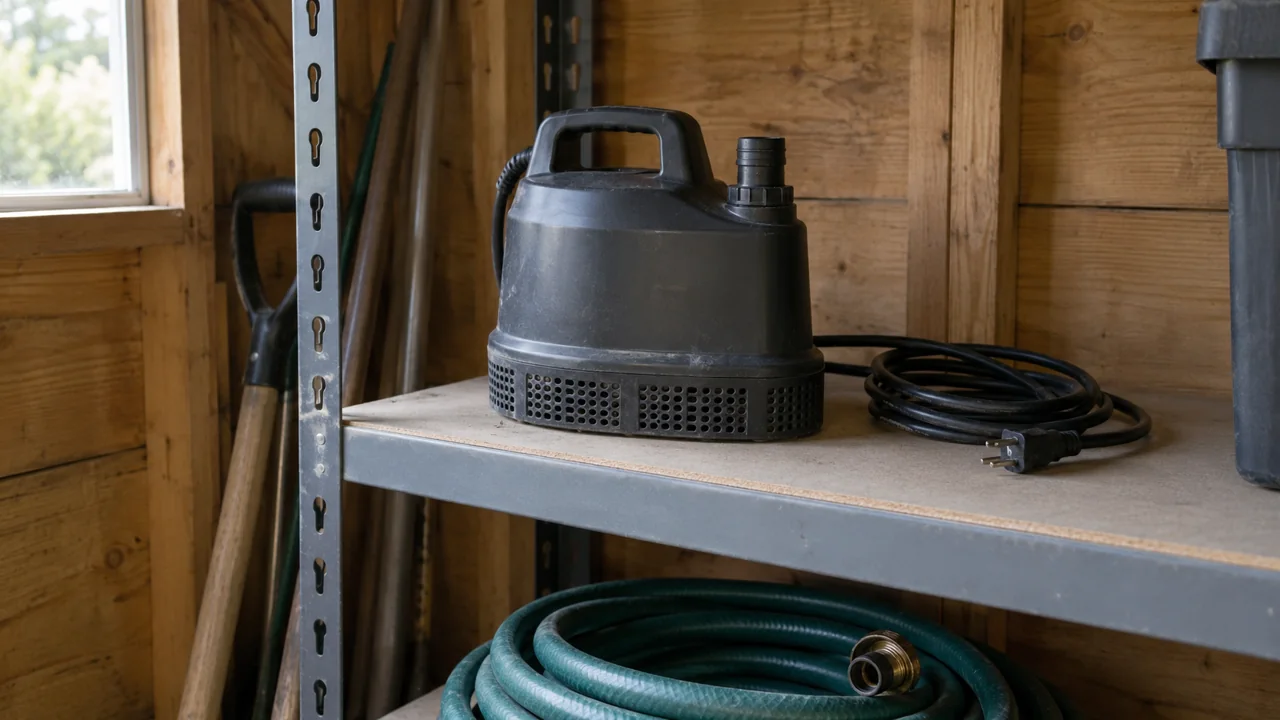
For your own unit, record the storage steps the manufacturer actually specifies, including any draining, drying, orientation or location requirement. Do not invent a storage temperature, leave water in a housing on the assumption that it is freeze-proof, or infer that any shed is frost-free. Keep the manual with the equipment and mark damage for assessment before reuse.
Hose storage deserves its own line in the record. Follow its instructions for emptying and storing it; note damaged fittings and the discharge route that must be restored later. A neatly coiled hose is not evidence that no water remains inside.
Our recommendation is to name the person responsible for inspecting the covered pool after rain and during thaw, and agree how an appropriate pump will be returned to use when conditions and the equipment instructions allow it. If nobody can monitor the property, arrange a suitable maintenance plan before storing the only pump. Broader cover checks belong in the pool cover maintenance guide.
After thaw: confirm water leaves, not just that a motor runs
Look for liquid water on the cover when weather changes, even if snow remains nearby. The Cover-Pools T4 owner manual, printed page 9, treats accumulated surface water as a hazard and calls for checks when an owner is away. Its winter advice assumes the equipment addressed in that manual; it does not establish the freeze tolerance of a different replacement pump.
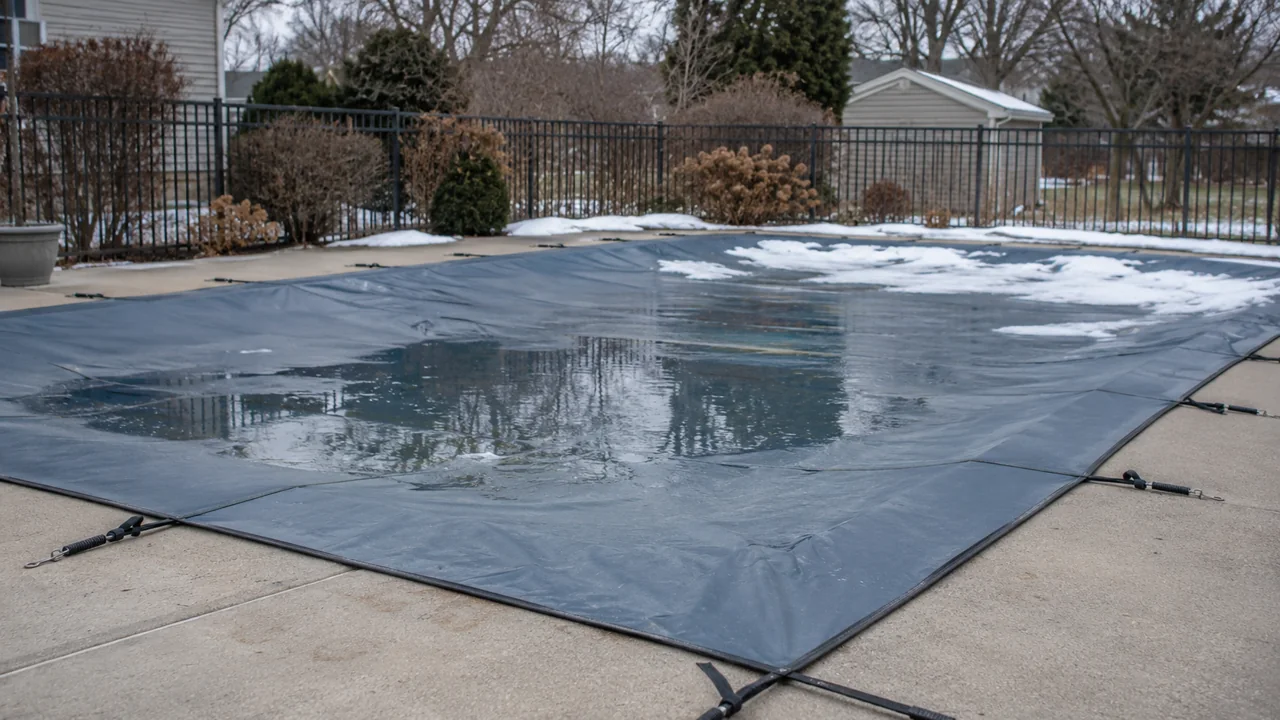
Use this return-to-service sequence as a record of checks, with the equipment manuals supplying the operating procedure:
- Check condition before power. Record visible damage to the housing, cord, hose and connections. Keep damaged equipment out of use pending the manufacturer's remedy; do not splice or bypass protective components.
- Confirm the hose is usable. Snowmelt on the cover does not prove the discharge line has thawed. The APCP-1700 troubleshooting table on printed page 6 lists frozen water in the discharge hose and directs the owner to thaw or replace the hose. It supplies no universal thaw time.
- Check automatic operation as instructed. If a float needs attention, isolate power first and follow the model's maintenance procedure. Never hold a switch on or run the pump dry as a test.
- Observe the discharge during permitted operation. Check that water actually reaches the intended outlet and does not return to the cover. Log flow failure separately from a motor that does not start. Stop for troubleshooting rather than guessing from sound alone.
- Recheck the cover. Record remaining water and new accumulation after the next weather change. An inspection today does not complete the rest of winter.
Little Giant's official APCP-1700 troubleshooting FAQ lists several possibilities for a pump that will not remove water, including obstruction, airlock, power and internal faults. A puddle alone cannot identify which applies. If drainage is unavailable or the cover is visibly distressed, keep access restricted and seek qualified help; see water on an automatic pool cover for that separate cover problem.
Copy this four-stage winter check record
Use the table as an owner handover, not as a substitute for the manual. Fill in the date and responsible person at each stage. Leave uncertain technical fields marked Unknown / verify on the unit until the matching instructions are confirmed.
| Stage | Check to record | Decision or follow-up | Date / responsible person |
|---|---|---|---|
| Before freezing | Pump model, manual revision, hose route and outlet condition | Confirm permitted installed/storage state and any power condition | |
| Freezing weather | Pump/hose condition visible from the deck; new accumulation | Record inaccessible or ice-bound equipment; obtain model-specific advice | |
| Storage | Manual's preparation completed; pump and hose condition; storage location | Assign cover monitoring and a permitted drainage plan for thaw | |
| Thaw | Damage check, usable hose, instructed switch check and observed discharge | Note remaining water; schedule the next weather-related check |
Pump model: __________ Manual/revision: __________
Freezing and storage instructions confirmed with: __________
Person monitoring the cover: __________ Next check: __________
Keep this record with the manual. For the wider seasonal cover plan, continue with automatic pool covers in winter. This page sets no snow-load limit or general air-temperature threshold and supplies no circulation-pump shutdown instructions.
Sources and method
Updated October 2026. This is an independent, document-based owner checklist, not a field test, a brand ranking or a diagnosis of a particular installation. Images show generic hose, storage and thaw scenes; they do not identify either manufacturer's equipment.
- Little Giant APCP-1700 owner's manual, document 998295, fetched October 16, 2026. Printed pages 3–6: freeze warning, discharge route, operation, storage, float maintenance and frozen-hose troubleshooting. Model-specific conditions stay model-specific.
- Little Giant APCP-1700 support FAQ, fetched October 16, 2026. Used for the range of possible no-flow causes, not to diagnose the reader's pump.
- Cover-Pools T4 owner's manual, 800210 REL-0003, fetched October 16, 2026. Printed page 9: accumulated water, discharge and monitoring during absence. Read alongside the instructions for the actual installed pump.