Updated October 2026
Pool Cover Glider Replacement: Identify the Part First
A broken slider can leave an automatic pool cover unable to travel normally. Stop abnormal operation, then identify the brand, track, handed part and hardware generation before ordering a pool cover glider replacement.
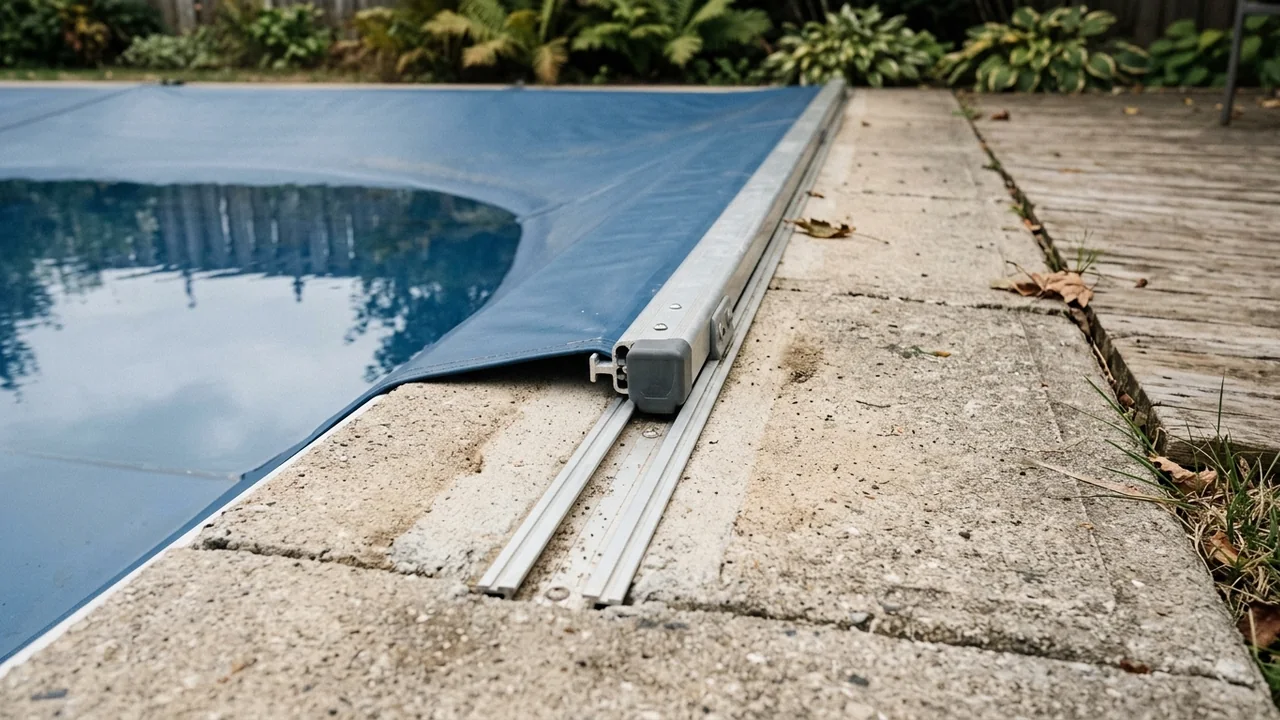
A replacement should be confirmed against the installed assembly, not selected because a shop calls it a “slider” or “glider.” Photograph the damage and both ends of the leading edge, record the track and any readable part or model identification, and leave uncertain fields marked “Unknown / verify on the unit.” The service record below separates what you can observe from what a technician still needs to confirm. It does not require removing a glider, releasing a rope or running the cover again.
Start with the automatic pool cover parts guide if you are unsure which component you are looking at. This page concerns automatic-cover guide hardware, not a solar-cover reel or an anchored winter cover.
What signs justify stopping and recording the damage?
A visible break, a missing piece, or an end that no longer stays in its normal guide position is a reason to stop and obtain a service assessment. Treat these as observations, not a diagnosis that a replacement glider alone will fix the cover.
Our recommendation is to photograph visible cracks, chipped edges, missing pieces and unusual contact marks from a safe stationary position. Note where the problem appeared and whether travel was uneven before you stopped. Do not cycle the cover just to make a better video or reach a hidden surface.
Cover-Pools' T4 owner manual, document 800210 REL-0003, page 14, directs owners to a local service company when retraction or opening is uneven. Its service warning says to switch off power at the mains breaker before maintenance and never maintain or adjust a running cover. Follow the isolation instructions for your own system; this guide supplies no electrical-work procedure. Keep people away from the pool and arrange supervision and access protection while the cover is unusable.
Noise or uneven movement does not identify a particular broken component. The same manual's page 15 calls for service inspection when track condition has changed markedly. A distorted rail or an end pulled out of its guide belongs with automatic pool cover track repair. Record the rail as well as the small part; do not file, bend or trim either to make an unconfirmed replacement fit.
Why do track, left/right and hardware generation matter?
The manufacturer catalogue separates them. The Cover-Pools Parts Guide downloaded on October 15, 2026 is headed Fluidra 2026 Product Catalog and lists distinct undertrack, Dual-Race and SnapTop glider sections. Its undertrack body and arm/base sections on pages 13–14 include a heading for hardware before October 2015. That heading is a catalogue distinction, not proof of your installation date.
| Catalogue example | What it establishes | What still needs confirmation on your unit |
|---|---|---|
| Page 14: 180543 and 180544 | Left and right versions of an undertrack, adjustable-dowel, non-slotted ABC assembly | Correct track, side designation, leading-edge configuration and generation |
| Page 14: 060307 | A set is listed separately from those individual handed assemblies | Whether the repair needs a set, one assembly or a component |
| Pages 13–14: older undertrack headings | Some bodies, arms and bases are grouped as before October 2015 | Actual hardware history, including later alterations |
| Pages 15, 17–20: cable, Dual-Race and SnapTop sections | Track and rope/cable configuration remain part of the identity | Which exact section and part description apply |
These are examples for reading a parts list, not a shortlist to buy. The catalogue does not establish that these parts fit a Coverstar or another manufacturer's system. A motor label also should not be used as the sole identification of a track or leading-edge assembly that may have been altered.
Do not guess handedness from your position beside the pool. Record which end you photographed, describe your viewpoint, and let the technician match that observation to the manufacturer's left/right designation. Likewise, copy “slotted,” “non-slotted,” “adjustable” or a series name only when a document or identification on the unit supports it. Similar color and outline are insufficient confirmation.
What should the photographs show?
Show the context first, then the detail. A tight picture of a broken block can hide the track and attachment information needed to identify it.
- Take an overall view of the leading edge and the guide on each side, without moving the cover for the picture.
- Take a closer view of the damaged area and the adjacent rail or guide entrance, where safely visible. Keep fragments already found loose with the record; do not pull pieces out.
- Photograph the opposite end as a comparison, with your viewpoint recorded. Its appearance is useful context, not proof that the two ends use identical parts.
- Add readable identification from accessible labels, the original installation paperwork and later repair invoices. Record approximate installation age as approximate, not as a verified catalogue cutoff.
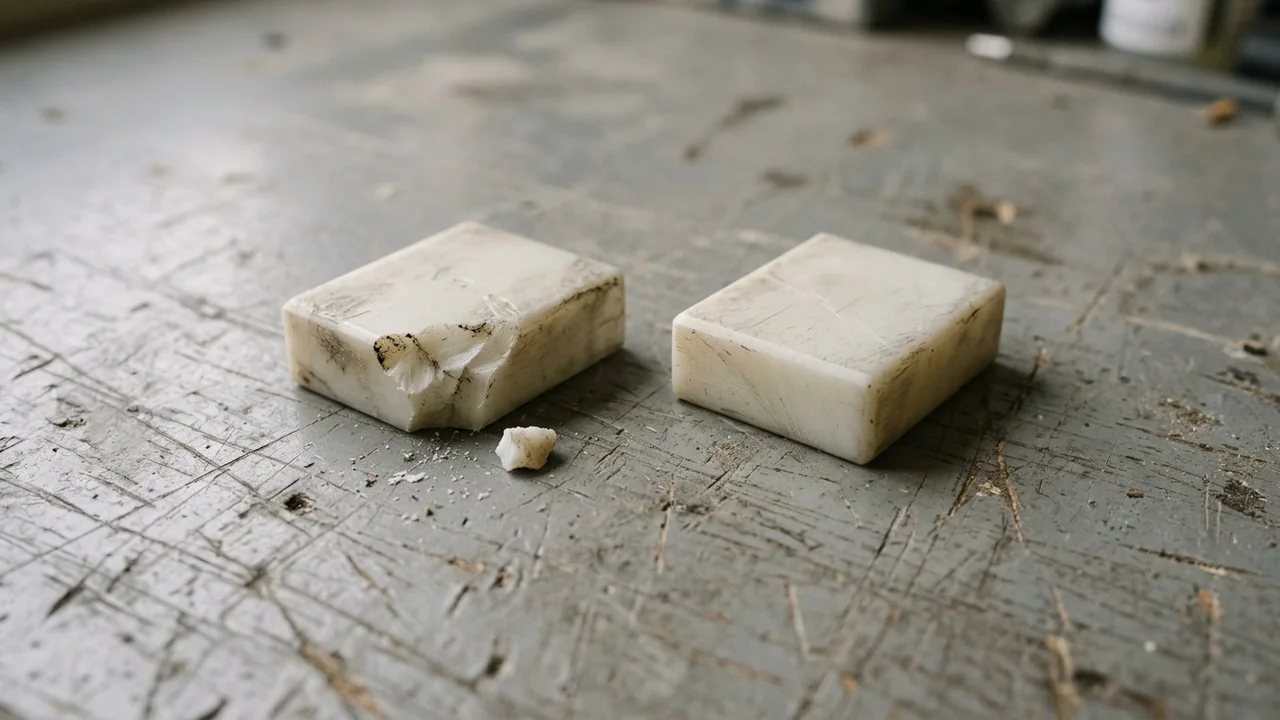
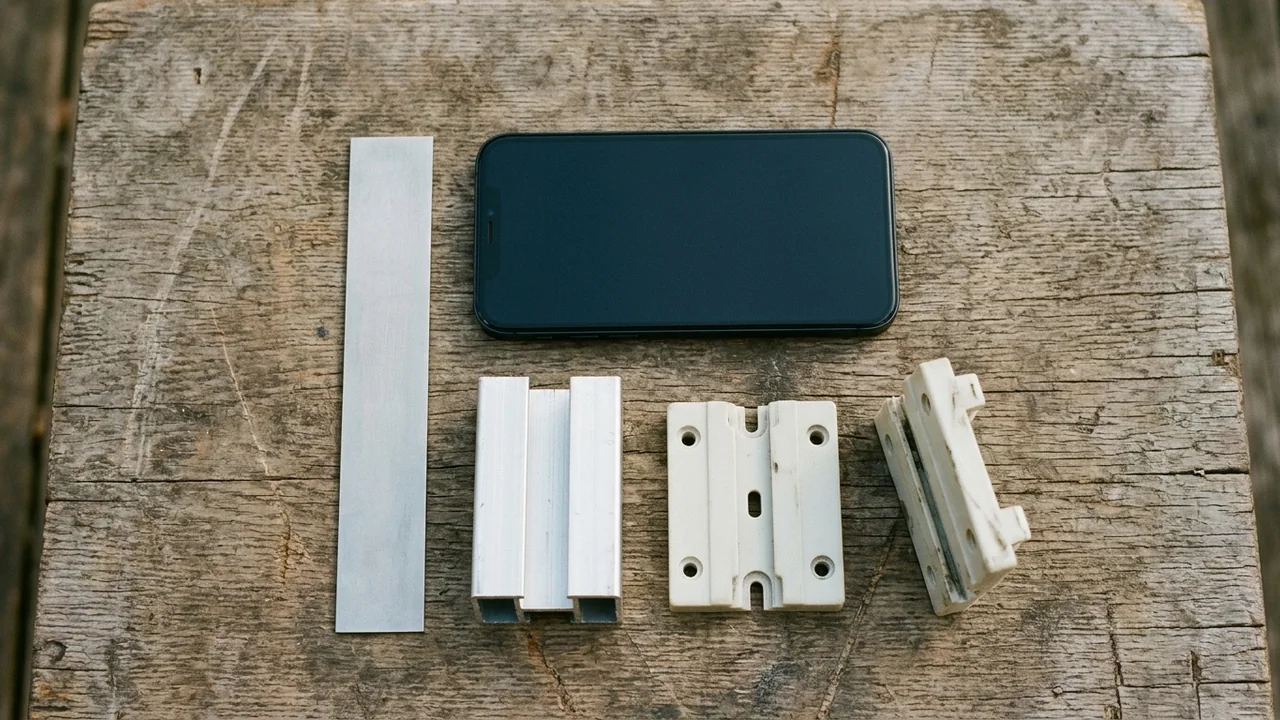
Photographs here show generic pool-edge and bench scenes. They are not reference shapes for any listed part number and do not establish a wear allowance or a compatible fit. For the larger assembly names, use the automatic pool cover parts diagram.
Copy this glider identification and service record
Leave unknowns visible. Completing this record means the condition is documented; compatibility is confirmed only when the technician identifies the appropriate replacement for that configuration.
| Field to record | Your entry | Confirmation needed |
|---|---|---|
| Manufacturer and cover series | Unknown / verify on the unit | Label and applicable parts document |
| Track location and profile | Unknown / verify on the unit | Track series; photograph both sides |
| Observed side and viewing position | Unknown / verify on the unit | Manufacturer's left/right designation |
| Existing part identification | Unknown / verify on the unit | Full number and description, if readable |
| Installation age and later repairs | Unknown / verify on the unit | Hardware generation, not age alone |
| Leading edge and connection | Unknown / verify on the unit | Bar/dowel/arm arrangement, where visible |
| Rope or cable configuration | Unknown / verify on the unit | Technician identifies without owner release |
| Damage and adjacent track condition | Describe only what you can see | Glider fault, track fault or another cause |
| Symptoms before stopping | Direction, location, uneven travel | No additional operating test by the owner |
| Repair scope and replacement reference | Leave blank until assessed | Individual component, assembly or set; document/page |
Keep the photos with this record and the relevant manual. Ask the service technician to identify the replacement number and its application, assess the adjacent track and attachments, and specify who will complete the repair and return-to-service checks. A retail listing's product name is not that assessment.
Is there a universal wear limit or a DIY replacement method?
This guide establishes neither. The sources used here do not establish a numerical glider wear allowance that applies across brands, nor a universal material specification. Do not turn a surface mark into a millimetre replacement threshold or infer material from its color.
Cover Care's parts overview, archived October 11, 2026, describes gliders as wear items that may be replaceable when the remainder of the cover is sound. That is a reason to assess the system before replacing everything; it is not evidence that every broken slider can be swapped in place.
The T4 manual recommends leaving complex repairs to an authorized service technician. This page stops at identification and documentation: no rope release, quick-attach release, tension adjustment, fastener torque or improvised replacement. If the suspected fault is in the rope path, the separate rope and pulley troubleshooting guide explains the documentation boundary for that problem.
Method and sources
Updated October 2026. This is an independent editorial identification guide based on public documents, not an inspection or a tested replacement procedure. Catalogue examples remain specific to Cover-Pools. Unknown material, wear tolerance and unit-specific compatibility remain unconfirmed.
- Cover-Pools Parts Guide, downloaded October 15, 2026; PDF headed Fluidra 2026 Product Catalog. Pages 13–15 and 17–20: generation headings, handed parts, assemblies and track-specific sections. The upload folder date is not an installation date.
- Cover-Pools T4 Owner's Manual, 800210 REL-0003, downloaded October 15, 2026. Page 14: service precautions and uneven retraction; page 15: track deterioration. Follow the manual matching your unit.
- Cover Care, parts of an automatic pool cover, archived October 11, 2026, “track and gliders” section. Used only for its conditional replaceable-wear-item description; it gives no universal glider tolerance.