Updated October 2026
Mesh vs Solid Pool Safety Cover Comparison: Light, Snow and Spring Opening
A cover that blocks leaves can still leave a difficult spring opening if winter water height and water removal are neglected. This mesh vs solid pool safety cover comparison favors mesh for passive rain drainage and solid for light exclusion, then checks the snow-support and opening work each manual safety-cover system requires. Start with the pool safety cover families if the product type is still undecided.
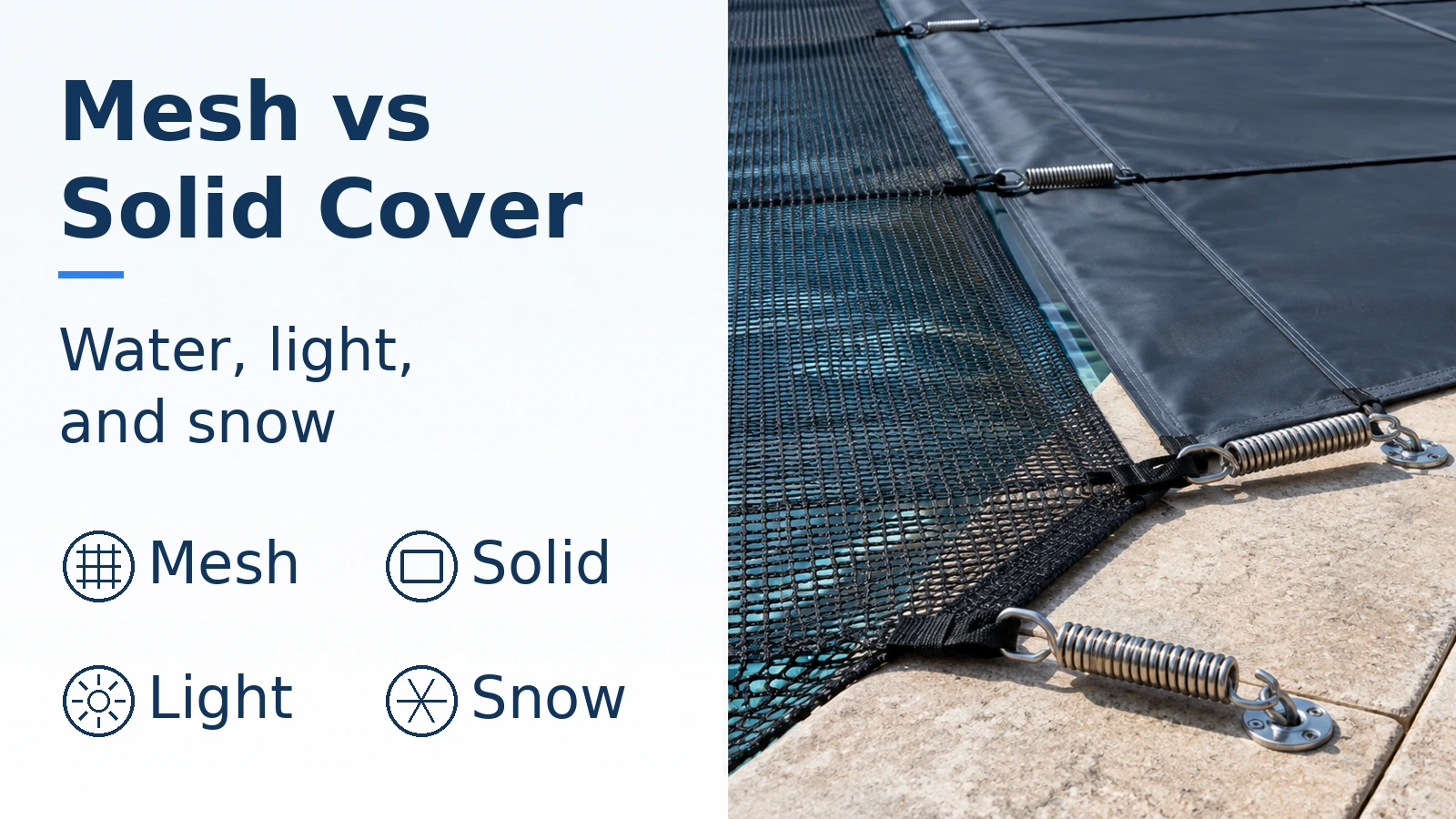
Which cover leaves the right spring workload?
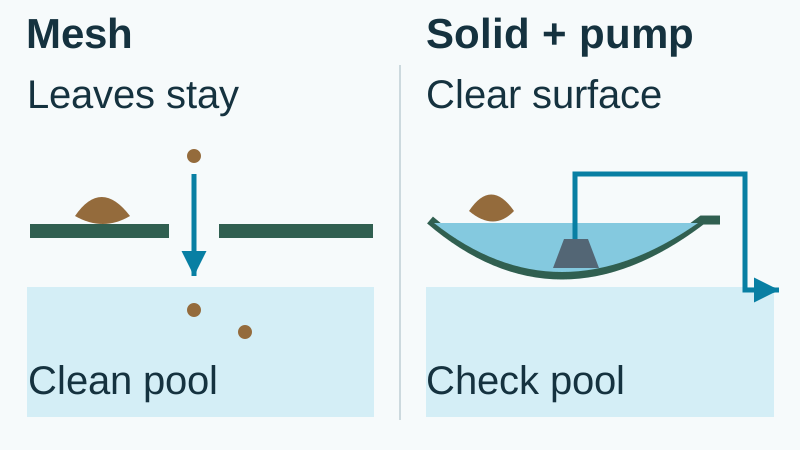
Choose mesh when passive rain drainage is the priority; choose solid when light exclusion is the priority and reliable surface-water removal is available. Dense mesh narrows the light difference, so compare the actual weave rather than the word mesh. Neither material removes winter chemistry checks, snow-support checks, or the need to clear debris before lifting. These are manually installed covers secured by straps, springs, and deck anchors. A pump described as automatic removes water; it does not open the cover.
The existing mesh versus solid drainage comparison covers the basic material choice. Here the decision is what happens during a snowy closure and what must be done before the cover comes off.
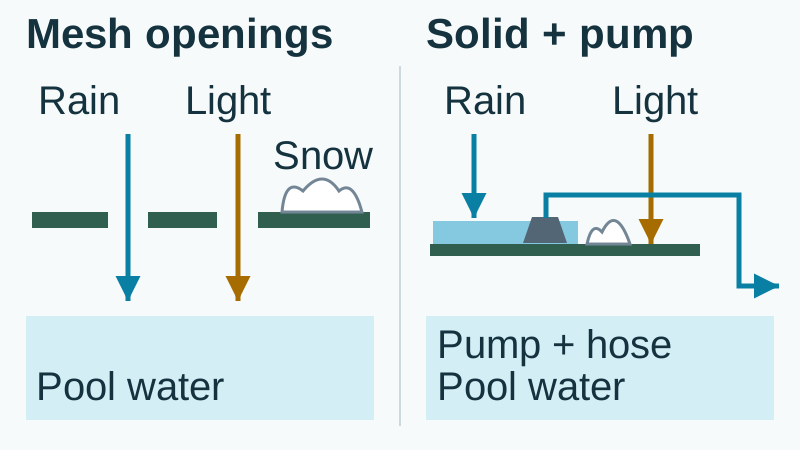
Light blocking changes the opening job, not the chemistry requirement
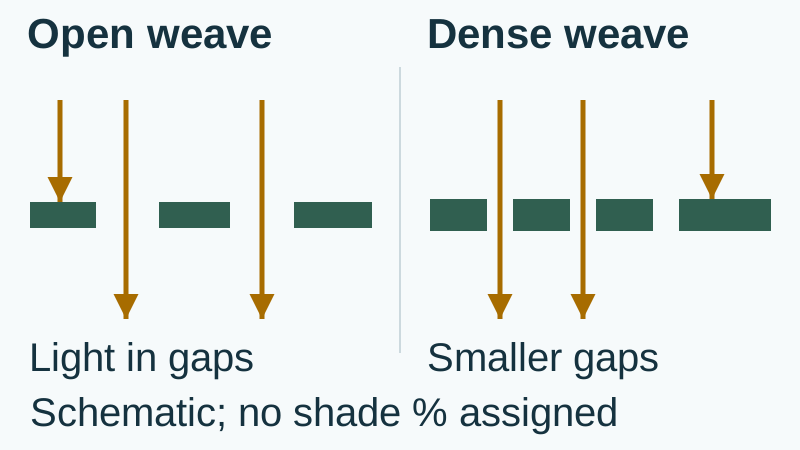
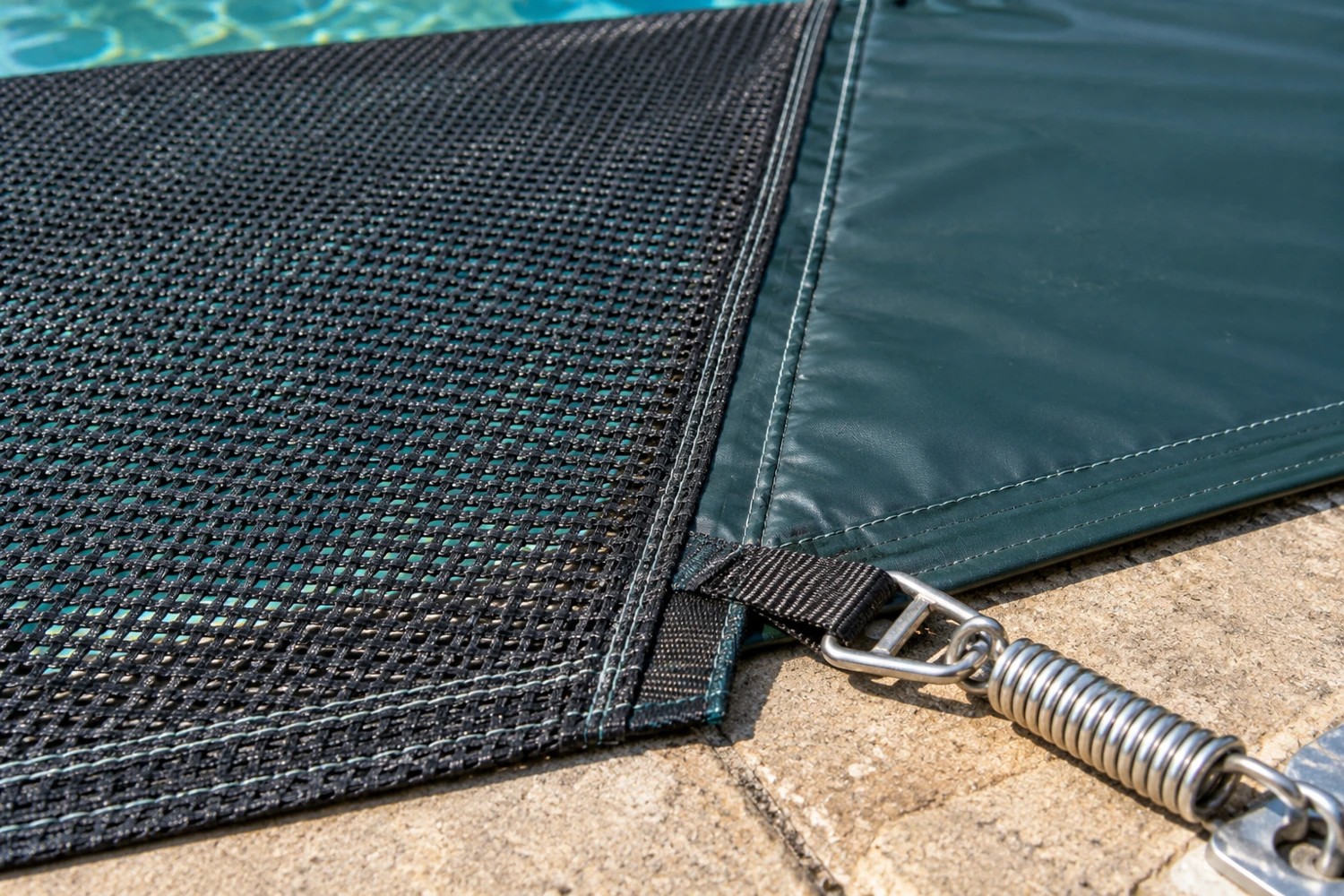
Solid material excludes light; mesh admits light through its openings, with the amount depending on the weave. LOOP-LOC describes its Super Dense Mesh as admitting rain and meltwater while strongly limiting sunlight, and its ULTRA-LOC III solid cover as light blocking with optional mesh drains. Product pages checked October 19, 2026; no measured shade percentage is assigned here to a generic mesh cover or to a complete cover containing drains.
Light exclusion reduces a contributor to algae growth, but does not establish a cleaning-time saving or an algae-free opening. The mesh care document, page 2, requires appropriate winter water treatment regardless of cover use. Mesh can admit fine material with water; a solid sheet instead leaves water and debris above the pool until they are removed. Inspect the water before deciding the opening treatment.
Scroll sideways to compare every column.
| Cover configuration | Light and spring work | Snow-season attention | Dominant Failure Mode & Prevention |
|---|---|---|---|
| Mesh, including dense weave | Some light and fine material may enter; inspect water and plan pool cleaning | Meltwater can pass through; ice and snow still require the specified pool water support | Blocked drainage or unsupported sag → clear accessible debris and maintain the model’s water height and tension |
| Solid with mesh drains | Light-blocking sheet with local drainage areas; clear the panels before removal | Frozen or clogged panels can leave water above the sheet | Surface ponding → inspect panels and tension; remove remaining standing water using the maker’s method |
| All-solid with cover pump | Remove surface water and debris before lifting; chemistry checks remain | Monitor both surface drainage and the pool water beneath | Pump failure or pool-water drawdown through seams → check the pump and pool level together |
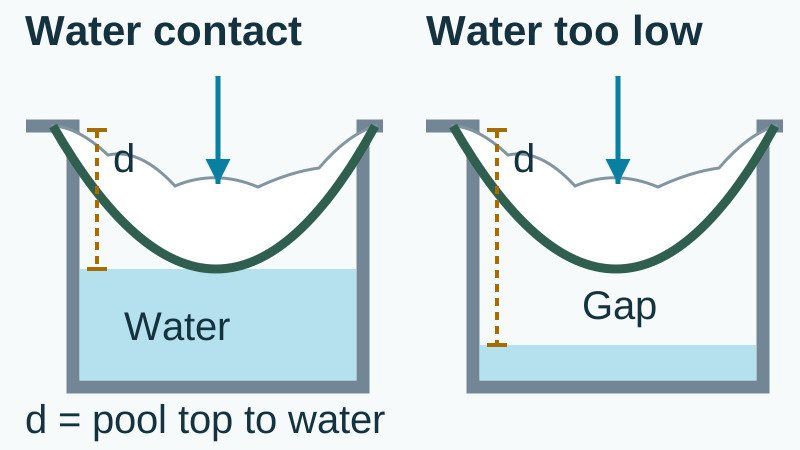
Snow rests on the cover; pool water provides support
Snow does not disappear through mesh openings. Meltwater can drain, but the winter system still depends on water beneath the cover limiting deflection. Neither material name supplies a snow-load rating, and the fetched documents do not establish a universal safe snow depth.
For the in-ground products in the LOOP-LOC installation guide, page 1, the water surface is specified 15–18 inches below the top of the pool for mesh and 12–16 inches for solid. These are manufacturer-specific vertical water-level ranges, checked October 19, 2026, rather than allowable snow thicknesses. A different cover needs its own instructions.
Rules of thumb: for those LOOP-LOC in-ground models, a water surface more than 18 inches below the pool top for mesh or 16 inches for solid is outside the cited support range. Correct the water height with the pool professional; extra strap tension does not replace missing water support. A leak, an unattended pump, or winter drawdown can move a previously acceptable pool outside that range.
Formula: support-range margin m = d_max − d, where d is the measured vertical distance from the pool top to the water surface. Illustrative inputs for the cited mesh limit: d_max = 18 inches and a hypothetical measured d = 19 inches. Then m = 18 − 19 = −1 inch: the water is one inch too low relative to that maximum. A nonnegative margin checks only this lower-water boundary, not the entire safety of the installation.
Check a solid cover’s pump and the water beneath it together
A working surface pump can still leave the pool water too low. LOOP-LOC’s solid-cover pump instructions explain that snow and ice can press the sheet onto pool water, which may seep upward through seams and be pumped away. Check both levels, particularly during freeze and thaw. The October 19, 2026 fetched instructions describe how to handle a pump frozen into ice and when to reconnect it as melting begins; use that procedure and the pump’s own electrical instructions.
A solid cover with drain panels has a different maintenance route. Clear the panels from the deck using the manufacturer’s recommended tools, and investigate persistent pooling. Do not walk onto either cover to clear water or debris. See the solid safety-cover configuration guide to distinguish panel drainage from all-solid pump drainage.
Budget the work that remains after buying the fabric
The recurring cost depends on who does the winter visits and spring cleaning, not just the material price. Keep a seasonal ledger with separate lines for winter inspections, drain or pump service, chemistry checks, pool cleaning, cover cleaning and drying, and anchor maintenance. Count pump electricity and replacement equipment for a pumped solid cover, and cleaning time for material that passes through mesh. No price or labor saving follows from fabric type alone.
Before removal, take surface debris and water away by the maker’s procedure, arrange helpers and storage, and inspect straps, stitching, springs, and anchors. Fold without dragging across rough decking or exposed anchor heads. LOOP-LOC’s mesh care document, pages 1–2, describes accordion folding, draining storage, and closing unused deck anchors flush. The mesh safety-cover guide explains the product family; the ASTM F1346 checklist addresses evidence for the installed safety system.
Method and sources
Updated October 2026. This comparison separates material transport, pool-water support, and removal work. ASTM’s public F1346-23 identity and scope cover performance and labeling and make correct installation and manufacturer-directed use conditions of the intended protection. The public scope is not the full test specification, and ASTM does not establish a generic installation depth here.
Primary documents retrieved October 19, 2026: LOOP-LOC Inground Cover Installation Guide, pages 1–3, manufacturer-authored PDF hosted by a distributor, undated in the retrieved copy; mesh care instructions, pages 1–2, undated; and the linked manufacturer product and care pages, unpaginated. The water-height limits apply only to the named in-ground configurations. Shade percentages, snow capacity, algae rates, universal spring settings, and opening-time savings remain unspecified.
Parent hub: Pool Safety Covers