Updated October 2026
Pool Cover Clutch Slipping: Check Resistance Before Adjustment
Automatic pool cover clutch adjustment should follow identification and a resistance check. A pause is not a torque measurement, and increasing the setting can conceal the condition that made the cover stop. First establish whether the installed drive even has a mechanical clutch.
This guide helps you record what happened and decide when to involve a service technician. It supplies no torque target, spring-preload setting or general calibration procedure. For a motor that will not start, use the separate motor troubleshooting guide.
First branch: mechanical clutch, electrical stop, or unknown?
The Cover-Pools T4 owner's manual, printed page 8, checked October 16, 2026, describes a slip clutch on some units and separately describes auto-shutoff with an amp limiter. The clutch allows slip during overrun; the electrical feature stops the motor when it detects increased load through current. These are different arrangements. Neither a stopped cover nor a sound from the mechanism tells you which protection is fitted.
Check accessible identification, the installation record and the feature list in the matching manual. Write Unknown / technician to identify if they do not establish the installed arrangement. A motor or control could have been changed since installation. Do not open an enclosure, reach under a lid or run exposed parts to settle the question.
| Installed arrangement | Route for this record | Do not infer |
|---|---|---|
| Mechanical slip clutch confirmed in the applicable documentation | Record resistance and symptoms before asking about clutch service | That every pause means the setting is too loose |
| Electrical auto-shutoff / current limiter documented | Give the control model and stopping behavior to service personnel | That changing electrical sensitivity is mechanical clutch calibration |
| Older shear-pin mechanism confirmed | Use the shear-pin identification record | That an electrical or clutch setting will replace a broken pin |
| Arrangement unconfirmed | Stop adjustment plans and obtain identification | That a similar-looking mechanism uses the same procedure |
Second branch: water, obstruction or abnormal pool level?
For its slip-clutch configuration, the T4 manual, printed page 14, checked October 16, 2026, lists surface water, low pool water, faulty track pulleys and track dirt or debris as reasons for slipping. It directs the reader to correct those causes rather than adjust the clutch. A clear-looking deck does not rule out a problem in a concealed pulley or track.
Use observations already available from a safe deck position. Do not run the cover again simply to locate the resistance. Do not stand on it to inspect a puddle or pull a leading edge to see whether it is stuck.
| Observation | Owner handover | Decision |
|---|---|---|
| Standing water on the cover | Record where it is and whether drainage is available | Keep the cover stationary; use the applicable pump instructions and arrange help if drainage is unavailable |
| Visible debris, caught object or abnormal track condition | Describe the location; photograph only where safely accessible | Do not force travel or use a stronger setting to push through it; inaccessible removal or damage needs service |
| Pool level appears abnormal or the permitted level is unknown | Record the observed level against a fixed pool feature and the applicable manual | Confirm the prescribed level with the installer; do not guess a universal distance or drain the pool to test it |
| No visible explanation, but travel paused or failed to finish | Record direction, position and whether travel was uneven | Hidden resistance remains possible; arrange diagnosis before adjustment |
The T4 manual, printed page 9, checked October 16, 2026, warns against operating the cover with water on it because the fabric and mechanism can be damaged. See the cover pump guide for drainage context and track channel care for the separate maintenance topic. This page provides no pulley disassembly or rope adjustment.
The stop-or-service decision tree
Read each numbered branch in order. This is an owner observation tree, not a sequence of operating tests.
- Is a mechanical clutch confirmed? If no or unknown, stop plans to adjust it. Identify the mechanism and send electrical-stop or shear-pin symptoms to the matching service route. If yes, continue to the resistance record.
- Is there surface water, an obstruction, damage, an abnormal pool level or an unresolved resistance concern? If yes or uncertain, leave the cover stopped. Arrange the relevant drainage, obstruction or level assessment under the matching instructions. Do not raise the clutch setting to get past it.
- Have those causes been assessed, but normal travel still cannot be completed? Hand the observations and model-specific manual to the service technician. Clutch assessment may be appropriate; an owner seeing no obstruction has not ruled out hidden drag.
- Is the cover damaged, uneven or repeatedly stopping? Keep it out of use pending assessment and arrange pool access protection and supervision. The technician should determine repair scope and the conditions for returning the system to use.
An apparent protective slip is a reason to release the control, not to hold it on and prove protection works. The T4 manual's page 8 description of overrun protection, checked October 16, 2026, explains the function; it is not a request to deliberately overrun your cover. A pause mid-travel remains a symptom requiring context, even if it resembles an end-of-travel event.
What should the technician receive?
Copy the following with your photos. Leave unknowns visible rather than filling them from another brand's manual.
- Identity: cover and mechanism labels, control type, applicable manual/revision, and later modifications.
- Observed event: opening or closing, approximate location, whole cover or one side, whether the motor seemed to continue or stop, and whether the event repeated. State that these were prior observations if no new test was performed.
- Resistance record: surface water, visible track/debris condition, pool level and any assessment already made. Separate “not visible” from “checked and ruled out by the technician.”
- Service question: identify the installed protection; assess drag and damage; decide whether adjustment or repair is indicated; record the manufacturer's applicable procedure and return-to-service checks.
The T4 manual, printed page 14, checked October 16, 2026, recommends authorized service for complex repairs and requires power off at the mains breaker before maintenance. It prohibits adjustment while running. Follow the instructions for your unit; this guide provides no electrical work or isolation procedure.
Why there is no universal torque calibration here
The 2011 Save-T 3 owner's manual, printed page 15, checked October 16, 2026, separately discusses slip-clutch adjustment and amp-limiter adjustment, and also says to address water, low level, pulley faults or track contamination before changing the clutch. The relevant page is PDF page 15 in this fetched copy, not printed page 14. Match document and page before using an old service note.
That manual and the T4 manual contain instructions scoped to their assemblies. We do not convert those into a cross-brand setting or a promise that a particular fabric cannot tear. A wrench's fastener torque, a clutch's slip behavior and fabric strength are not interchangeable specifications. This guide establishes none of their numerical values and supplies no friction-plate cleaning, spring adjustment or deliberate stall test.
Sources and editorial method
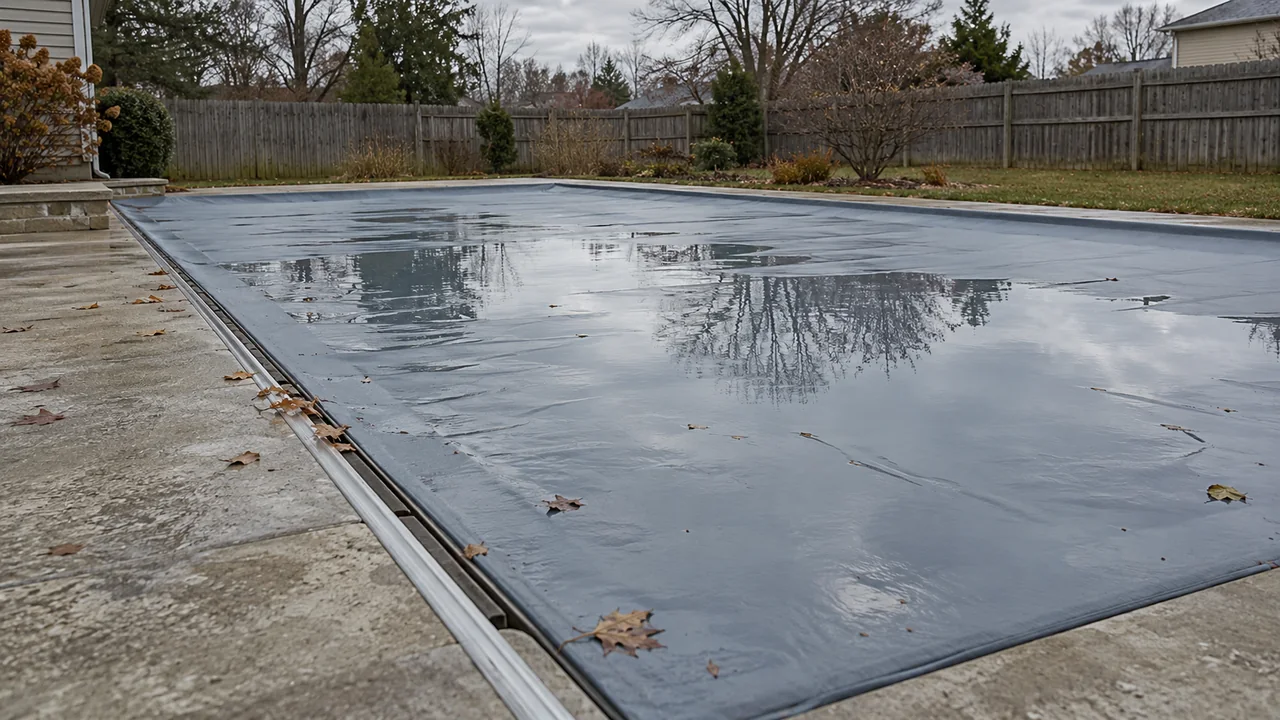
We are an independent technical editorial site, not the manufacturer or an on-site service company. This guide compares public documents to structure a service handover; it does not diagnose or certify your cover. The AI-generated pool scene is generic and does not show a named product, a measured load or a clutch test.
- Cover-Pools T4 Owner's Manual, 800210 REL-0003, checked October 16, 2026. Printed pages 8, 9 and 14: separate protection features, surface-water warning, resistance causes and service precautions.
- Cover-Pools Save-T 3 Owner's Manual, 2011, checked October 16, 2026. Printed page 15: separate clutch and electrical-limit sections and resistance before adjustment. No claim here extends those configurations to other brands.