Updated October 2026
Clearing Sand from Pool Cover Tracks and Checking Lubrication Rules
Spraying lubricant into a track your manual forbids can damage the cover's edging, rope and the track itself, and excess lubricant collects the next load of dirt. Rinse the exposed channel with water first, then lubricate only the parts your own system's manual names, with the product it names.
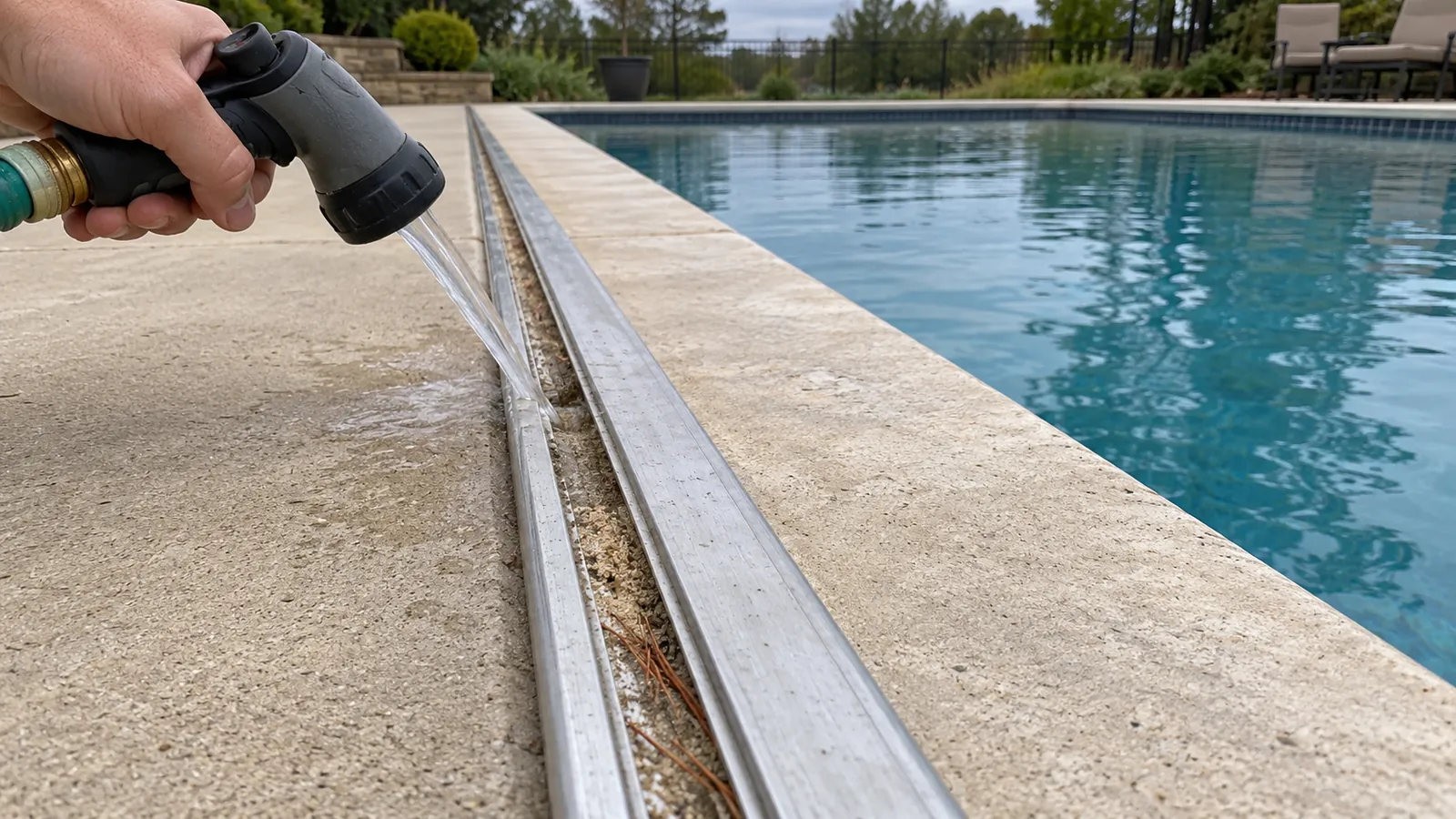
Cleaning a pool cover track and lubricating it are separate jobs. The manufacturer documents checked for this guide agree on the first step: retract the cover and flush the exposed channel with plain water along its full length. They disagree on the second. The Cover-Pools T4 manual says not to put grease or silicone on the tracks, rope or webbing, while a 2007 Aquamatic Hydramatic manual specifies water-based silicone spray along the slider path. None of the four documents approves a general dry PTFE track spray, so your model's manual decides.
Key points:
- Water is the only track cleaner the T4 manual allows, and no checked document gives a spray pressure.
- Lubrication rules are specific to a model and a manual edition; one system forbids what another specifies.
- A product label that calls itself safe for vinyl is not approval from your cover manufacturer.
- Metal shavings, torn webbing, fabric out of the track and travel that still stops after rinsing are service signals, not lubrication problems.
This guide compiles public manufacturer documents; it is not product testing or a service procedure for a specific model. For a broader cleaning overview, see how to clean pool cover tracks. For how tracks, ropes and drives fit together, start with the track mechanisms and drive systems guide.
Is cleaning the track the same job as lubricating it?
No. The Cover-Pools T4 owner's manual (800210 REL-0003) says to clean the tracks with water only and not to put grease or silicone on the cable or rope, the webbing or the tracks, because that causes rapid deterioration of threads, fabric and track. Its lubrication table points to mechanism parts instead.
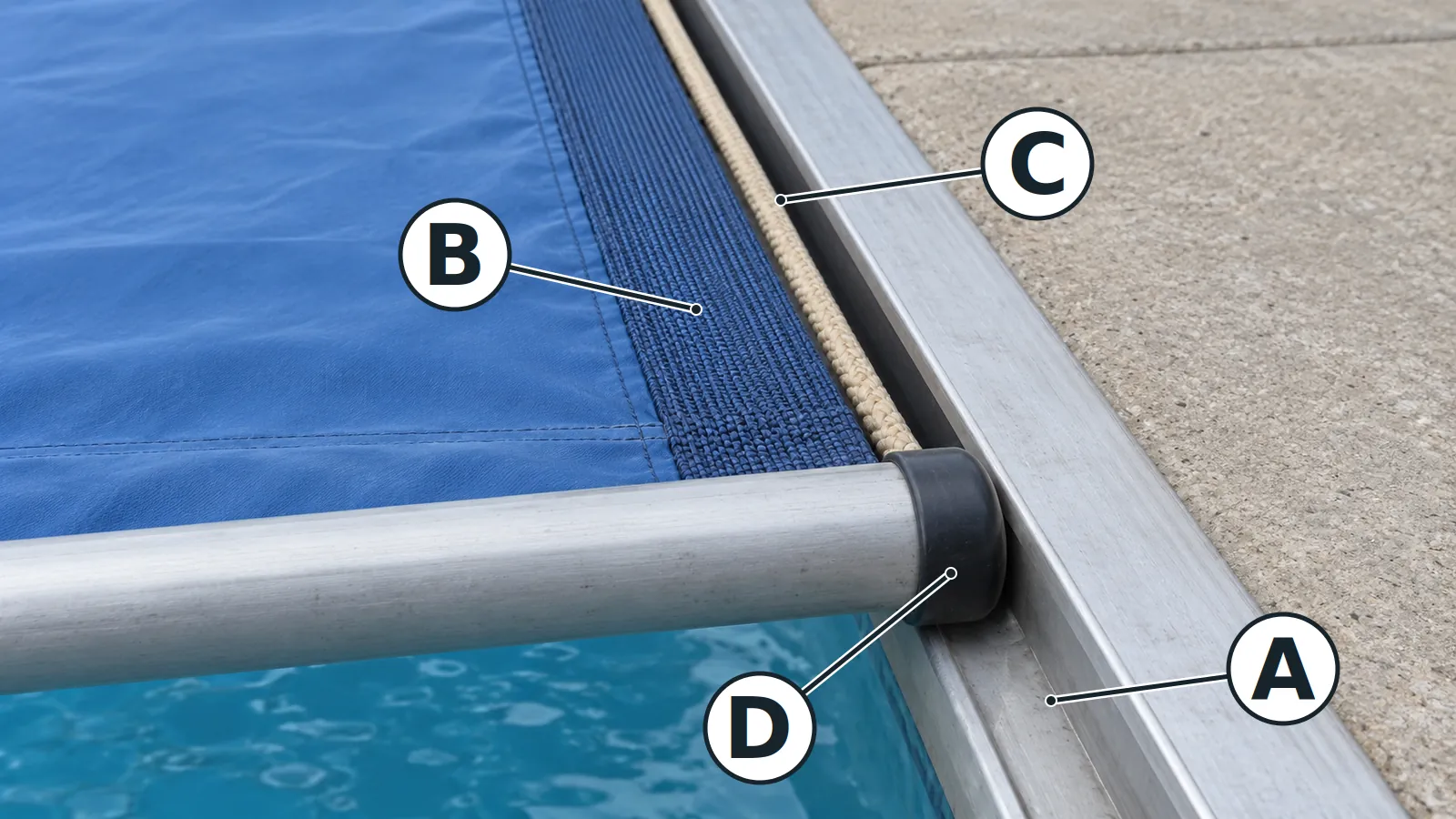
Several parts share the same narrow space. The fabric's webbing edge runs in the channel, the rope runs with it, and the leading-edge bar travels along the track. A spray aimed at "the track" also reaches parts that the T4 and Automatic Pool Covers (APC) documents say take no grease. Use the parts diagram guide to name what you are looking at.
| Part | What the checked documents say | Document |
|---|---|---|
| Track channel | Clean with water only; no grease or silicone | Cover-Pools T4, pp. 10–11 |
| Track where the slider travels | Water-based silicone spray only, not WD-40 or similar oil-based products | Aquamatic Hydramatic, 2007 Revision, printed p. 10 |
| Rope or cable, and webbing | No grease or silicone (T4); no grease or lubrication required (APC) | T4 p. 11; APC DO0010 p. 6 |
| Named mechanism parts | Specific lubricants for listed parts such as an end hub or a grease fitting; the T4 motor needs none | T4 p. 11; Coverstar Central CS3000 note |
Mechanism parts sit at the housing end, out of reach of a deck-track rinse. Review the cover box and housing guide before opening a lid, and use the rope and pulley alignment guide when the problem is rope routing rather than sand.
Takeaway: Name the part first; "lubricate the track" is not an instruction these manuals share.
What has to be true before you rinse the channel?
Rinse only when the cover retracts normally, there is no standing water on it and nobody is in the pool. If the cover stops on the way open, do not keep holding the key to expose more track: the Hydramatic manual tells operators to release the key switch when the cover meets resistance such as an obstruction in the track.
Go / no-go checks:
- Cover fully retracted under normal operation. If it will not open, follow the cover won't open checks instead of forcing travel.
- No water on the cover. The T4 manual says never to run the cover with water on it.
- Key removed after retracting, so nobody operates the cover while your hands are near the track.
- Housing drainage working on recessed systems. Rinse water and sand go somewhere, and the APC manual asks owners to check the recessed box for standing water. See pool cover drainage requirements.
- Power off before any mechanism rinse. The T4 manual requires all electricity to the cover to be off when rinsing the mechanism. Rinsing the exposed deck track is a different job from washing the mechanism.
Takeaway: If any check fails, solve that problem first; rinsing is not a way to free a stuck cover.
How do you flush sand out of an exposed track?
Retract the cover, then spray water into the channel along its full length at close range until the water coming out runs clear. The T4 manual describes this method, and the Hydramatic, APC and Coverstar Central documents describe the same job with a garden hose. None of the checked documents adds detergent, solvent or acid.
- Find your manual and its edition. Note the model label and the document number before you start.
- Start where your manual says. The APC DO0010 manual begins at the motor end and sprays continuously to the far end. The other documents checked here state no direction, so ask your installer if yours is silent.
- Rinse the full length at close range. Aim the stream into the channel opening and along the track, not across the deck.
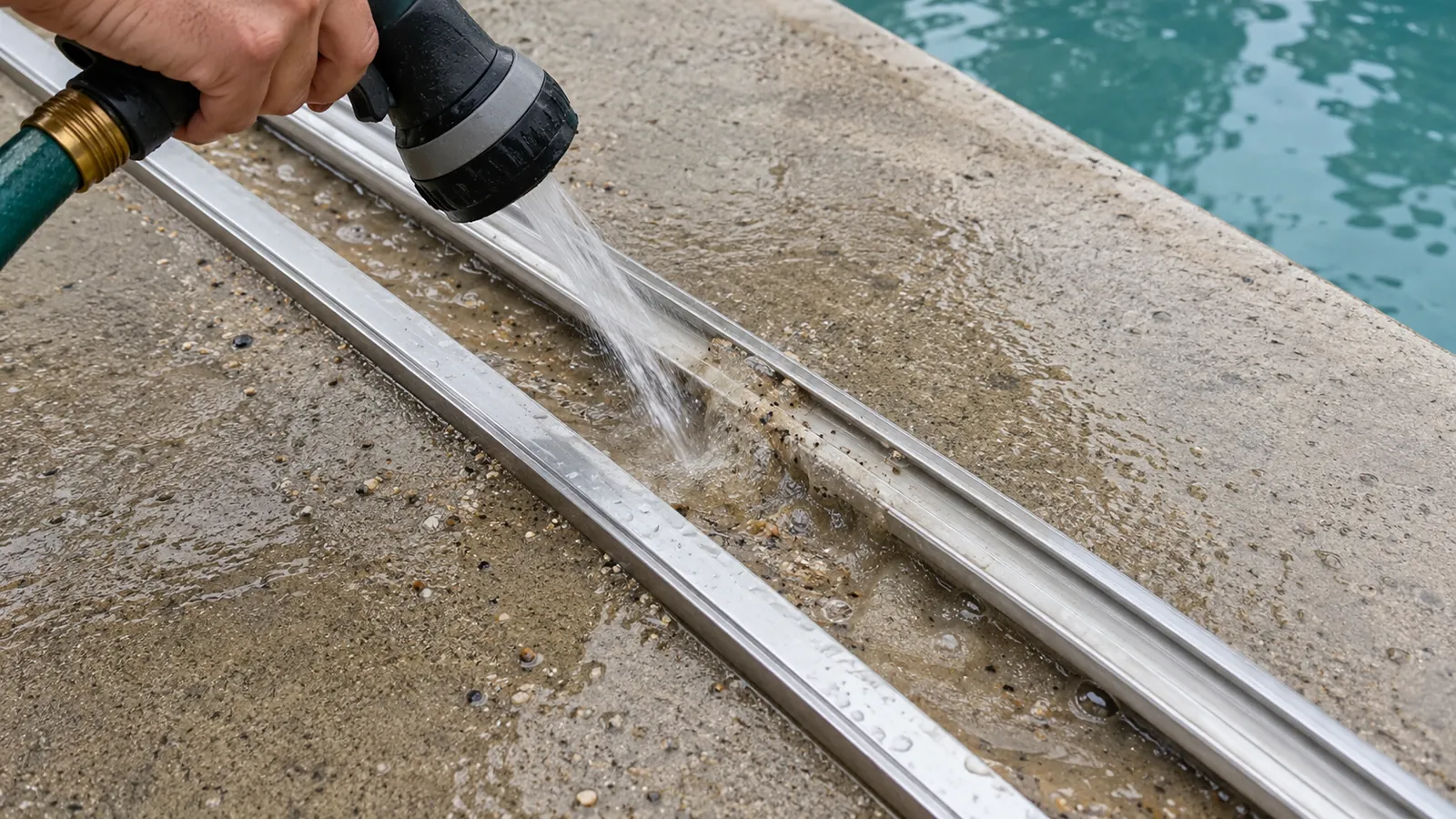
- Keep going until the water runs clear. That is the APC stop point, and it is a practical check on any system.
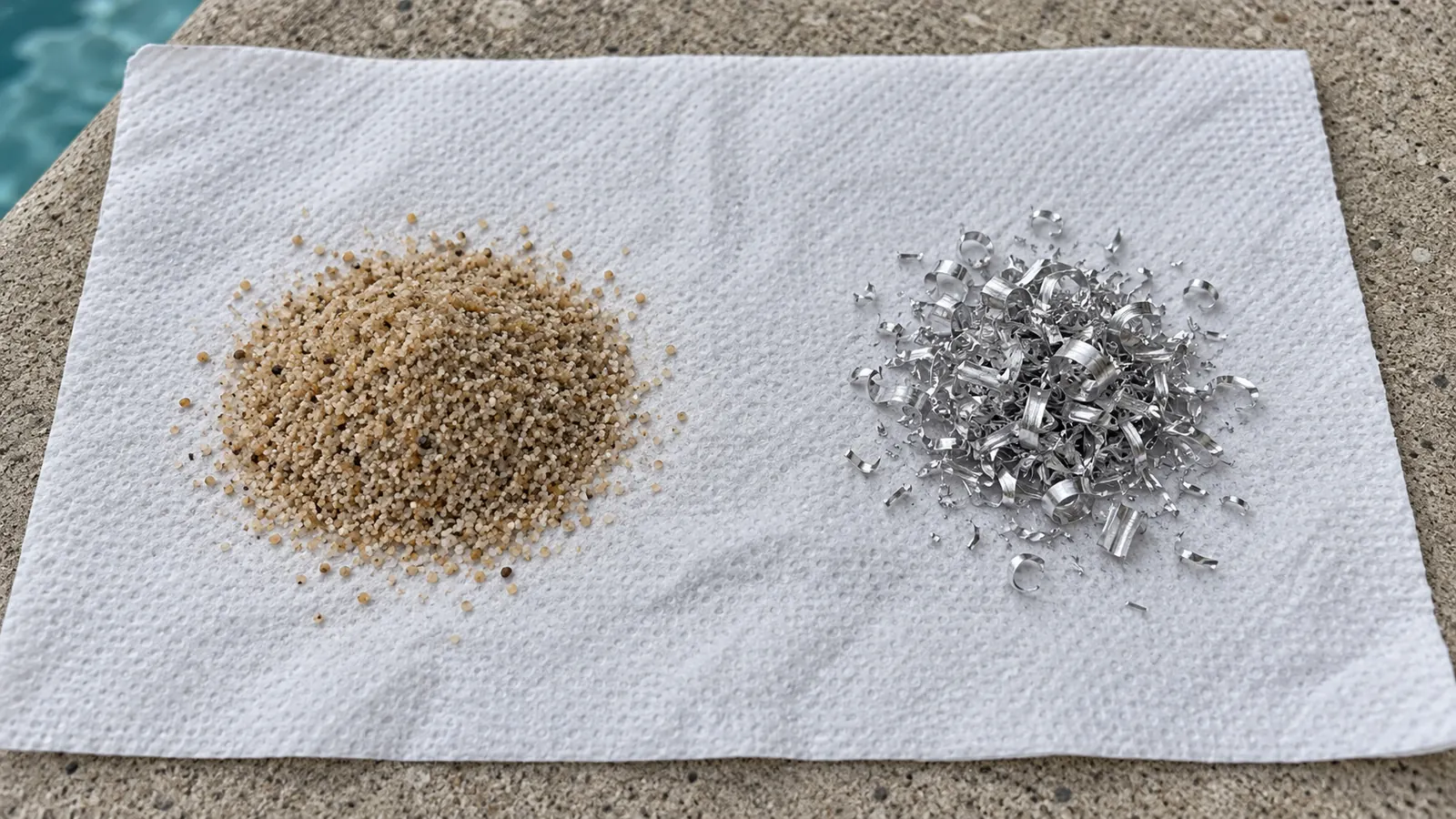
- Look at what came out. Sand, grit and leaves are expected. Bright metal slivers are not; see the stop signals below.
- Run the cover once while watching it. Stay on the dry deck and release the key at once if it stops or runs unevenly.
The T4 manual expects track cleaning twice a season in most situations, and more often for year-round pools or sandy, windy sites. Hydramatic mentions cleaning as often as monthly where sand or dirt blows in. Match the interval to your manual and note it in your maintenance schedule.
Common mistake: Loosening or lifting the track to reach sand. Coverstar Central's care sheet says this is neither necessary nor recommended, and the Hydramatic manual says never to run the system with the pulley caps removed.
Takeaway: Water, full length, until it runs clear; anything beyond that belongs to the manual or a service visit.
Can you use a pressure washer on pool cover tracks?
Not on the strength of any document checked here. None of them gives a pressure, distance or spray angle, and most describe a garden hose with a nozzle. The exception is wording, not a specification: the Hydramatic quick guide says "hose or pressure wash", while the same manual's main section says a garden hose with a pressure nozzle.
| Document | Track wording | What it does not say |
|---|---|---|
| Cover-Pools T4 | Spray water into the track, full length, close range; water only | No pressure figure |
| Aquamatic Hydramatic (2007) | Garden hose with a pressure nozzle; quick guide: "hose or pressure wash" | No machine type or pressure |
| APC DO0010 | Hose and high-pressure nozzle, motor end to far end | A nozzle on a hose, not a pressure-washer unit |
| Coverstar Central care sheet | Garden hose stream into the tracks | No pressure figure |
| Latham maintenance article | High-pressure nozzle on a garden hose for tracks; never a pressure washer on the cover | The pressure-washer warning concerns the cover itself |
The vinyl fabric and its webbing sit next to the channel, so a jet that strays from the track lands on them.
Takeaway: Use a hose nozzle by default; use a pressure washer only with written approval from your system's manufacturer.
Which manual allows which lubricant?
The checked documents set different rules, and only one of them puts a spray in the track. The table keeps each rule with its document and edition. Use it to see why advice from another owner does not transfer, then follow your own manual.
| Document and edition | Track channel | Lubricated parts named | Excluded |
|---|---|---|---|
| Cover-Pools T4, 800210 REL-0003 | Water only; no grease or silicone | End hub, double dog and key-switch tumbler, each with a listed product; the motor needs none | Grease or silicone on rope, webbing and tracks |
| Aquamatic Hydramatic, 2007 Revision | Water-based silicone spray only, along the slider path | Between the black slider and the stainless leading-edge bar plate | WD-40 or similar oil-based products |
| APC DO0010 (10/22) | Clean with water | None stated for the track | Grease or lubrication on ropes and webbing |
| Coverstar Central, CS3000 note | Garden hose | One grease fitting at the motor-side mechanism | Over-greasing that fitting |
| Dry PTFE track spray | Not approved in any of these documents | — | — |
Hydramatic links skipped track lubrication to slider wear and to abnormal track wear that would need non-warranty replacement. That is a reason to follow the Hydramatic rule on a Hydramatic system, not to copy it onto a T4. Keep the manual and the warranty terms side by side when you decide.
Takeaway: The model's own document decides; a rule from another brand proves nothing about yours.
Why doesn't a "safe for vinyl" label settle it?
A product label describes the product, not your cover system. The same product name changes meaning by location: Hydramatic excludes WD-40 from its track, while the T4 lubrication table lists WD-40 or 30-weight motor oil for one mechanism part. Approval belongs to a location, not to a can.
Before using any spray near the track, confirm all four:
- Named approval. Your manual, or the manufacturer in writing, names this product type for this location.
- Formulation match. If the manual says water-based silicone, the current product's safety data sheet supports that; a brand name printed in an old manual does not.
- Location. You know whether the target is the channel, a slider or a mechanism fitting, and the spray stays there.
- Contact materials. The approval covers what overspray touches: vinyl, webbing, rope and plastic sliders.
Common mistake: Treating "dry film" or "PTFE" as another word for approved. The T4 manual explicitly forbids grease or silicone on its tracks and allows only water for cleaning them; it does not name PTFE either way. Because no document checked here approves a PTFE track spray, our conservative advice is not to use one on any system without the manufacturer's confirmation, whatever the label says.
Residue and pool chemicals also act on the fabric; see pool chemistry and cover damage for that side of the problem.
Takeaway: Without a named approval, water is the whole job.
What should make you stop cleaning and call for service?
Stop when rinsing reveals wear or damage, or when the cover still will not move normally after debris is removed. Lubricant fixes none of these, and this guide treats each one as the point to stop and check your manual or arrange service.
| What you see | Why it matters | Next step |
|---|---|---|
| Bright aluminum shavings in the rinse water | Hydramatic: worn sliders expose screws that score the track | Track repair guide |
| Torn or frayed webbing, broken edge threads | T4: cover strength is compromised; repair immediately | Service inspection |
| Fabric out of the track | Further travel loads the rope and fabric, which is why Hydramatic says to release the key at resistance | Stop operating; arrange service |
| Cover stops again after debris removal | T4: call your service technician if it will not move further | Won't close checks |
| Cover runs unevenly | T4: call your local service company | Runs crooked checks |
| Clicking or grinding at a track-end pulley | T4: the pulley is worn; contact your dealer | Rope and pulley checks |
| Standing water in the housing | APC: check the recessed box drainage | Drainage review |
The T4 manual also says not to adjust a slip clutch to compensate when debris, water on the cover, low water or bad pulleys are the cause. Fix the cause.
Takeaway: Shavings, torn edges and repeated stops end the rinsing job; check your manual or bring them to a technician.
What should you record after each cleaning?
A short record turns "the cover sticks" into information a technician can use. The T4 manual separately asks owners to inspect track fasteners, shims and the webbing slot at least two to three times a year; keep that periodic inspection on its own schedule. The table below records this cleaning and how the cover ran afterward.
| Field | Your entry |
|---|---|
| Manufacturer, model and manual edition | |
| Date and which track (left or right) | |
| What came out: sand, leaves, metal, residue | |
| Cover travel afterward: normal, stops, uneven | |
| Lubricant used: product, location, manual page | |
| Installer or service contact |
Bring the record to the annual inspection or to any service call.
Takeaway: Record the model, what came out and how the cover ran afterward.
When this guide does not apply
This guide covers rinsing an exposed deck track and reading lubrication rules. It does not cover hidden undertrack channels, pulley end caps, sliders, rope replacement, electrical work or pressure settings on hydraulic systems. Some manuals do describe owner steps in these areas: the Hydramatic manual explains cleaning a top-track pulley end cap after hydraulic pressure has bled off and says a homeowner can change sliders, and Coverstar Central's care sheet describes a torque-limiter adjustment. Those steps are specific to the model, so this guide leaves them out. If the job needs more than a hose, follow your own manual or contact the installer named on the equipment.
Takeaway: Outside the exposed channel, follow the manual or a qualified technician.
Frequently asked questions
Is dry silicone spray or a dry PTFE lubricant better for pool cover tracks?
Neither is better in general. None of the four manufacturer documents checked here approves a dry PTFE track spray, the T4 manual forbids silicone on its tracks, and Hydramatic specifies water-based silicone. Ask your manufacturer which product, if any, is approved for your track.
How do you remove old silicone or residue from aluminum tracks?
Start with water only, as the T4 manual requires for tracks. If residue, corrosion or scoring remains after rinsing, have a technician inspect it. Acids, solvents and abrasives appear in none of the cleaning instructions checked here.
Why is my pool cover stuck on one side after cleaning the tracks?
Rinsing does not correct rope take-up, pulley wear or a damaged track. The T4 manual sends uneven retraction to a local service company. Stop operating if fabric leaves the track, and note which side lags and where.
What if the cover still won't open or close completely after rinsing?
Remove water and debris, then try reversing. If the cover still will not move in the intended direction, the T4 manual says to call your service technician. Do not hold the key against resistance or adjust the clutch to push through.
Should I spray lubricant if the cover makes a strange sound?
No. In the T4 manual, a clicking or grinding track-end pulley is worn and the dealer should replace it. Spraying the track is no substitute for having a worn pulley inspected and replaced, and on a T4 a grease or silicone spray breaks the manual's rule for tracks.
Which track maintenance can an owner do without a technician?
Rinsing the exposed track with water after retracting the cover, checking that housing drainage is clear, and recording what you find. This guide does not cover end caps, sliders, rope, clutch or electrical work. Some manuals describe owner steps for a few of these, such as Hydramatic slider replacement, so follow your own manual or call a technician.
Method and sources
Updated October 2026. We compiled public manufacturer documents and read the rules on the cited pages; no lubricant was tested and no specific system was cleaned for this guide. Each rule stays with its edition, because a brand's older manual does not describe every current model.
- Cover-Pools T4 Owner's Manual, 800210 REL-0003: pp. 4, 8–11, 14 and 15. Water-only track cleaning; no grease or silicone on tracks, rope or webbing; parts lubrication table; service limits.
- Aquamatic Hydramatic Operational Manual, 2007 Revision: printed pp. 4, 5, 10, 12, 22 and 23. Garden hose with a nozzle; water-based silicone on the slider path; releasing the key at an obstruction; aluminum shavings as a wear sign.
- Automatic Pool Covers, Inc. Owner's Manual DO0010 (10/22): pp. 6–7. Motor end to far end until the water is clear; ropes and webbing need no grease.
- Coverstar Central, Do It Yourself Cover Care, an undated dealer care sheet: garden-hose track cleaning and the CS3000 grease fitting.
- Latham, Automatic Pool Cover Maintenance Checklist: hose nozzle for tracks; no pressure washer on the cover.
The FAQ questions come from public search suggestions and owner discussions. They show what owners ask, not what is correct.
Related guides
- Pool cover track systems: see where each track type sits.
- Pool cover maintenance: the wider maintenance hub.
- How to clean an automatic pool cover: clean the fabric separately from the track.