Updated November 2026
How to Patch a Pool Cover: Double-Sided Repair for Vinyl, Mesh, and Safety Covers
Patch a small, isolated pool cover hole away from seams and tracks by cleaning and thoroughly drying the fabric, then bonding a material-matched patch to both sides. Vinyl automatic covers require vinyl cement with a 1-hour minimum dry and 12-hour cure, while mesh safety covers use self-adhesive patches for holes 3 inches or smaller.
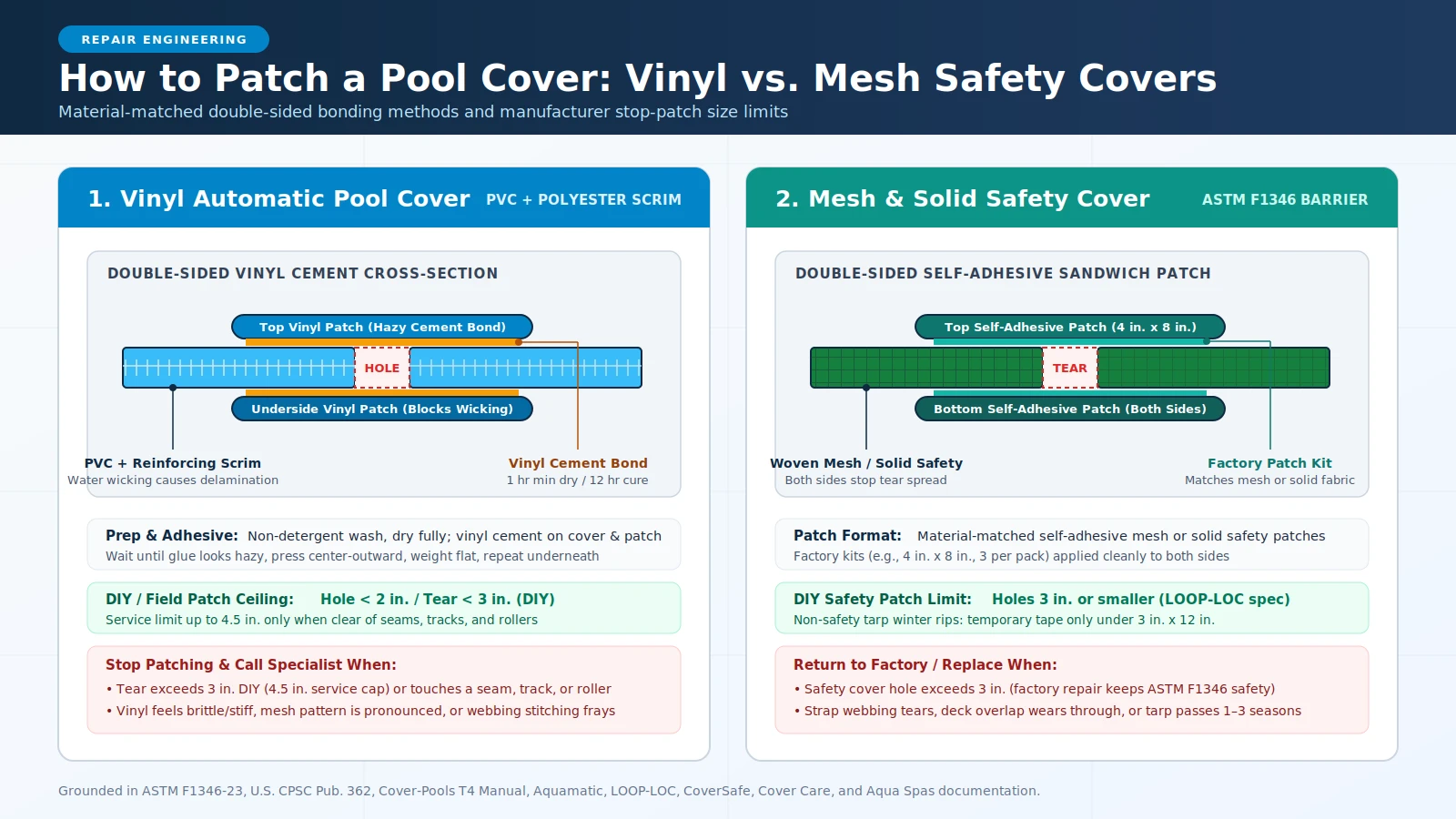
How do you patch a vinyl automatic pool cover?
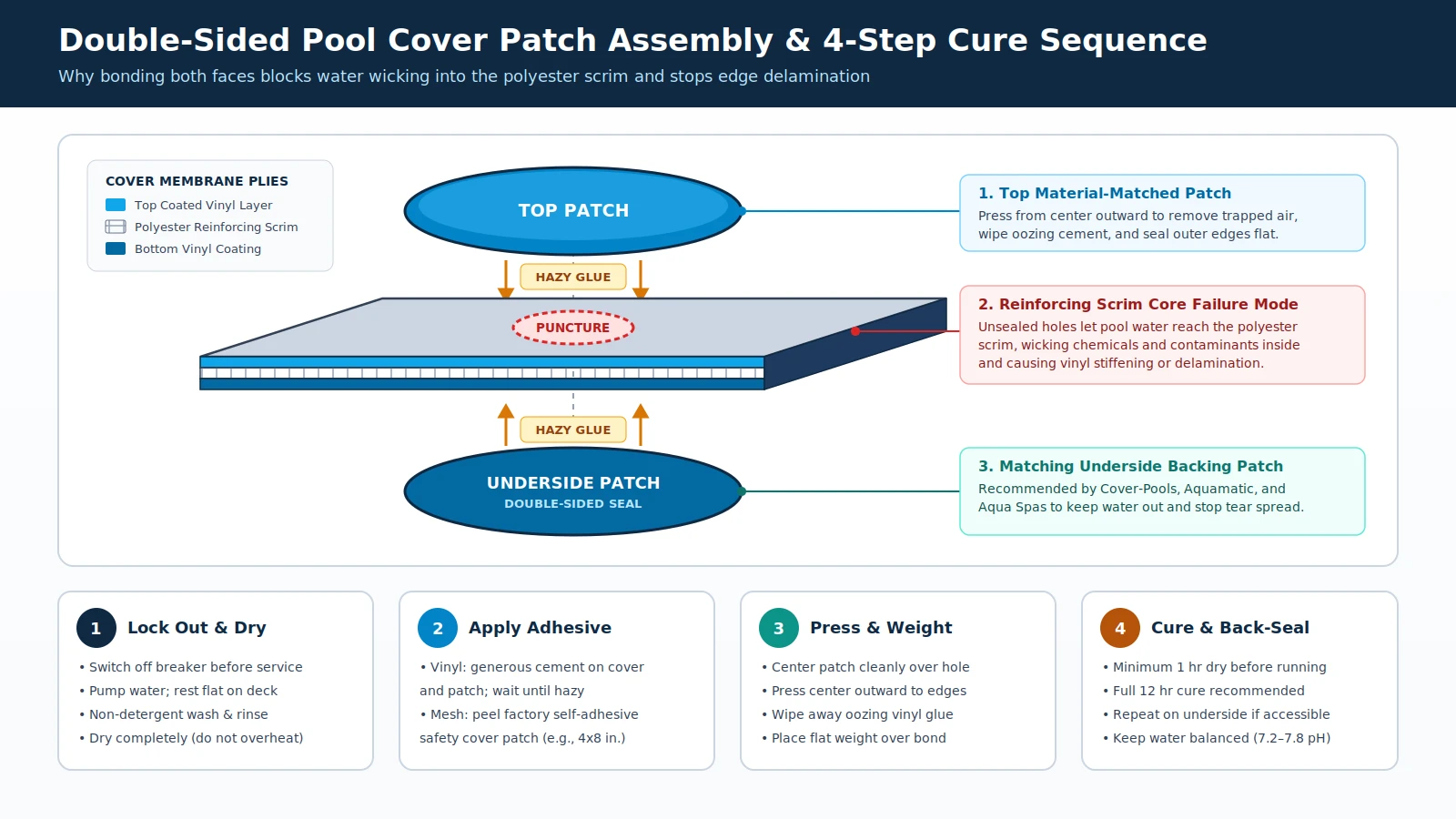
Patch a vinyl automatic pool cover as soon as you spot a leak or recurring puddle by locking out electrical power, drying the vinyl completely, bonding a vinyl patch with vinyl cement until hazy, and sealing both sides when accessible. Fast double-sided sealing stops pool water from wicking into the internal polyester scrim.
Cover Care notes that a puddle reappearing in the same spot on a closed automatic cover signals a puncture allowing pool water to seep upward, and states that holes smaller than 2 inches in diameter or tears shorter than 3 inches long may be DIY-repaired with a color-matched patch kit containing premium-grade vinyl cement adhesive. Cover-Pools directs owners to patch even the smallest holes immediately because water contacting the internal scrim thread wicks chemicals and contaminants inside the fabric, which can lead to stiffening or delamination of the vinyl.
Follow the combined lockout, cleaning, bonding, and cure sequence documented by Cover-Pools and Aquamatic Cover Systems:
- Lock out power and clear water: Pump standing water off the fabric, position the cover so the damaged spot rests flat on the tiled bond beam or deck, and switch off power to the automatic cover at the mains circuit breaker before servicing so the mechanism cannot move.
- Clean without detergents: Cover-Pools warns never to use detergents on vinyl pool cover fabric; wash oily or soiled areas with a non-detergent cleaner such as Ivory bar soap on a wet cloth and rinse thoroughly with fresh water.
- Dry completely before gluing: Aquamatic instructs letting the cleaned area dry thoroughly before applying vinyl adhesive, noting that a hair dryer may be used provided you do not overheat the vinyl.
- Apply vinyl cement to both surfaces: Coat both the cover area and the vinyl patch generously with vinyl glue and wait until the adhesive takes on a hazy appearance before laying the patch over the hole.
- Press outward and weight flat: Press firmly from the center of the patch outward toward the edges to expel trapped air, wipe away any glue that oozes out, and place a flat weight over the repair.
- Seal the underside and cure fully: Both Cover-Pools and Aquamatic recommend repeating the patch on the underside of the fabric whenever possible for added protection; Aquamatic requires drying at least 1 hour before operating the cover and recommends a full 12-hour cure time.
How do you patch a mesh pool cover?
Patch a mesh pool safety cover using self-adhesive patches engineered specifically for mesh fabric, applied cleanly to both sides of the tear when the hole measures 3 inches or smaller. Applying matching top and bottom patches stops weave strands from unraveling and prevents the damage from spreading under tension.
LOOP-LOC supplies self-adhesive patch kits containing three 4-inch by 8-inch patches per pack specifically for safety cover holes measuring 3 inches or smaller. Aqua Spas and Pools likewise notes that patches explicitly designed for mesh or solid pool covers should be applied to both sides of the damaged area so the puncture or tear does not expand.
Do not attempt to bridge large mesh rips with stacked peel-and-stick strips or household tape. LOOP-LOC states that any hole larger than 3 inches must be sent back through a qualified pool professional for factory repair so the cover maintains its tested safety features. For a broader look at woven versus solid barrier construction, review our pool safety covers overview.
Can you patch a pool safety cover?
Yes, you can patch a pool safety cover only when the hole sits in the open field away from seams, webbing, or hardware and stays within the manufacturer's size limit. Oversized tears or edge-webbing damage compromise tested barrier performance and require factory repair or replacement fabric.
Under ASTM International Standard Performance Specification F1346-23 (the active edition following F1346-91R18), safety covers for swimming pools, spas, hot tubs, and wading pools undergo compliance performance tests designed to reduce drowning risk by inhibiting water access by children under five years of age when properly installed and used, alongside marking requirements for all covers. The U.S. Consumer Product Safety Commission Safety Barrier Guidelines for Residential Pools likewise state that power safety covers should conform to ASTM F 1346-91 specifications to protect young children from drowning and advise keeping pool and spa covers well-maintained in good working order with control devices out of children's reach.
Manufacturer repair boundaries exist to preserve that certified barrier. Cover-Pools Save-T covers carry Underwriters Laboratories Listing E52841 under ASTM F 1346-91, and LOOP-LOC safety covers are U.L. certified to ASTM safety cover guidelines—yet both manufacturers restrict field patching. CoverSafe notes that most automatic pool covers can be patched when damage is 4.5 inches or smaller away from seams, rollers, or high-tension zones, whereas larger tears compromise ASTM F1346 safety compliance even if patched and tend to peel under daily rolling loads. Cover-Pools also instructs immediate repair whenever broken threads or frayed side webbing appear along the cover tracks. For complete certification criteria, read our ASTM F1346 pool safety cover guide.
Scroll sideways to compare every column.
| Cover Type | Approved Patch Method | Field Patch Size Limit | Stop-Patch & Escalation Rule |
|---|---|---|---|
| Automatic vinyl safety cover (DIY owner kit) | Color-matched vinyl patch kit with vinyl cement on both sides; 1 hr min dry, 12 hr cure | Hole smaller than 2 in. diameter or tear shorter than 3 in. (Cover Care) | Call automatic cover specialist above 2 in. hole / 3 in. tear or near webbing |
| Automatic vinyl safety cover (service technician) | Heat-sealed patch or heavy-duty pool-cover adhesive with sealed edges (CoverSafe) | Up to 4.5 in. when clear of seams, rollers, and rope tracks (CoverSafe) | Replace fabric above 4.5 in. or on any seam, roller, or high-tension edge |
| Manual mesh or solid safety cover | Factory self-adhesive safety cover patches (4 in. x 8 in., 3-pack) on both sides | Holes 3 in. or smaller (LOOP-LOC) | Return cover to manufacturer for factory repair on holes larger than 3 in. |
| Tarp-style winter cover (non-safety) | Solid cover patch on both sides or short-term repair tape / vinyl adhesive patch | Smaller than 3 in. x 12 in. for short-term fix (Aqua Spas) | Replace cover above 3 in. x 12 in. or after one to three seasons of wear |
My pool cover ripped during winter: how can I fix it?
Stabilize a winter pool cover tear first by relieving surface water load and confirming proper supporting pool water level underneath, then apply repair tape or a vinyl adhesive patch only as a short-term hold if the rip is smaller than 3 inches by 12 inches. Schedule a professional evaluation before relying on the cover again.
Load management matters immediately because Cover-Pools notes that each gallon of water sitting on a pool cover weighs eight pounds and a few inches of rain can quickly accumulate a ton of water. Without supporting pool water underneath, tracks may pull off or the cover may tear further. Cover-Pools instructs keeping standing water pumped off before freezing weather and inspecting pool water level at least once a month through winter, adding water as needed so the pool floats ice and snow upward to relieve cover stress.
Manual safety covers rely on specific winter water clearances too. LOOP-LOC specifies maintaining winter pool water level 15 to 18 inches below the top of the pool for mesh safety covers and 12 to 16 inches below the top for ULTRA-LOC solid safety covers to support snow and ice loads and prevent excess wear. Aqua Spas and Pools notes that pool cover repair tape—such as duct tape or a vinyl adhesive patch—can serve as a short-term winter fix until professional assessment, strictly for rips smaller than 3 inches by 12 inches, while reminding owners to remove standing water and leaves promptly so added weight does not tear the sheet. For seasonal load precautions, see our pool cover rain and snow load guide.
Should you use pool cover patch tape or glue?
Use vinyl cement glue for reinforced vinyl automatic covers, self-adhesive factory safety patches for woven mesh covers, and repair tape only as a short-term winter stopgap. Choosing the wrong bond allows water intrusion into the vinyl scrim or peels loose under cover tension.
On vinyl automatic covers, Cover Care recommends a kit with premium-grade vinyl cement adhesive, Aquamatic specifies coating both cover and patch until hazy and weighting the repair for a 1-hour minimum dry and 12-hour cure, and CoverSafe notes that service repairs use heat-sealing or heavy-duty pool-cover adhesives with sealed edges to prevent peeling or water intrusion. On woven mesh safety covers, factory self-adhesive patches such as LOOP-LOC's 4-inch by 8-inch kits bond cleanly on both sides for holes 3 inches or smaller. By contrast, Aqua Spas and Pools classifies pool cover repair tape or duct tape as a short-term fix for winter rips smaller than 3 inches by 12 inches until a professional assesses the damage.
Scroll sideways to compare every column.
| Repair Method | Best-Fit Cover Material | Bonding & Cure Requirement | Key Operational Limitation |
|---|---|---|---|
| Vinyl cement glue + vinyl patch | Automatic reinforced vinyl covers (holes < 2 in., tears < 3 in.) | Clean without detergent, dry fully, coat both sides until hazy, weight flat; 1 hr min dry, 12 hr cure | Fails on wet or brittle vinyl; does not restore tears near seams or webbing |
| Self-adhesive safety cover patch | Mesh and solid manual safety covers (holes <= 3 in.) | Clean, dry surface; apply matched 4 in. x 8 in. patches to both sides | Holes larger than 3 in. must return to factory to keep ASTM safety rating |
| Technician heat-sealed or heavy-duty adhesive patch | Automatic vinyl covers up to 4.5 in. field damage | Professional edge-sealed bond clear of seams, tracks, and rollers | Cannot certify oversized tears (> 4.5 in.) or high-tension edge failures |
| Pool cover repair tape / duct tape | Winter tarp covers or temporary winter rip stabilization | Dry surface contact for short-term hold only (< 3 in. x 12 in.) | Temporary bridge until professional inspection; never a permanent safety repair |
When is it time to replace rather than patch an inground pool cover?
Replace or professionally retube an inground cover rather than patching whenever damage exceeds manufacturer size caps, touches a seam, roller, or side webbing, or appears alongside brittle, delaminating, or scrim-exposed fabric. Patching degraded material wastes effort because weak surrounding vinyl tears right beside the repair.
Aquamatic emphasizes that whether a patch works depends on the cover's age, condition, and hole size, and larger damage may require removal and factory repair. Cover-Pools advises thoroughly inspecting automatic cover components at least two to three times a year and checking every leak for four structural warning signs: vinyl around the hole feeling brittle or stiffer than the rest of the cover, the normal square fabric pattern turning pronounced so the polyester mesh shows through (indicating weakening vinyl), deck or coping abrasion exposing the reinforcing mesh, and broken sewing threads or frayed side webbing along the tracks.
Service lifespan also varies sharply by cover construction and water care. Aqua Spas and Pools notes that tarp-like winter covers generally last one to three seasons before replacement, whereas LOOP-LOC notes that its mesh and solid safety covers carry a 15-year pro-rated warranty and often last many years longer—though animal damage, coping wear, drag holes, misuse, alteration, and low winter water levels are excluded. On automatic covers, Cover-Pools notes that fabric naturally shrinks 1 to 2 percent (3 to 4 inches across a 20-foot-wide cover) and breaks down prematurely under high chlorine or alkalinity; maintaining swim-safe water chemistry (1 to 5 ppm chlorine, 7.2 to 7.8 pH, and 80 to 120 ppm alkalinity) and waiting 12 to 24 hours after chlorine shock—or 30 minutes after non-chlorine shock—protects vinyl longevity. When fabric has reached replacement territory, review our automatic pool cover replacement fabric and webbing guide, check chemical wear mechanisms in our pool chemistry and cover damage guide, or return to the automatic pool cover repair hub.
Scroll sideways to compare every column.
| Inspection Finding | Patchable in Field? | Required Action | Underlying Failure Risk |
|---|---|---|---|
| Isolated vinyl pinhole or hole < 2 in. / tear < 3 in. in open field | Yes (DIY double-sided vinyl cement) | Clean, dry, cement both sides, cure 1 hr min (12 hr recommended) | Unpatched scrim wicks water and chemicals, causing delamination |
| Mesh or solid safety cover hole <= 3 in. away from straps | Yes (factory self-adhesive patch kit) | Apply matched 4 in. x 8 in. patches to both sides | Single-sided or mismatched patches peel and let weave fray |
| Safety cover hole > 3 in. (manual) or automatic tear > 4.5 in. | No | Send manual cover for factory repair; replace automatic cover fabric | Compromises ASTM F1346 safety barrier and peels under tension |
| Broken sewing, frayed side webbing, or tear near seam or roller | No | Stop cycling cover and call automatic cover specialist immediately | Loss of edge retention and track pull-out under load |
| Brittle/stiff vinyl, pronounced square scrim, or coping abrasion exposing mesh | No | Schedule professional inspection and full fabric replacement | Exposed polyester mesh weakens and surrounding vinyl tears around patches |
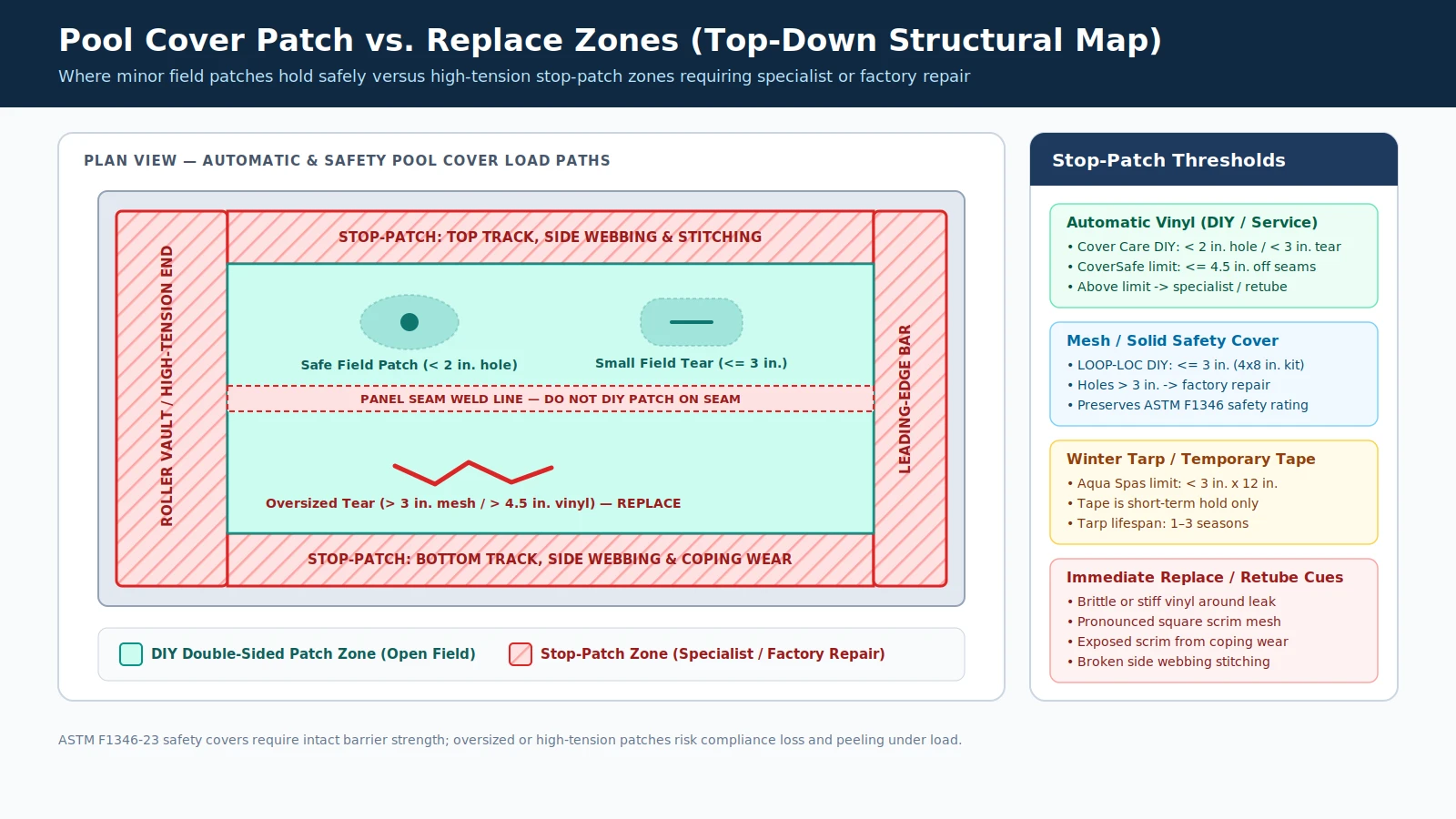
How do you decide whether to patch or replace your pool cover?
Walk through this six-point triage sequence before opening a patch kit so minor leaks stay sealed and safety-critical failures go straight to a specialist:
- Measure the damage first: Keep DIY patching strictly within manufacturer caps (under 2 inches diameter or 3 inches length on automatic vinyl per Cover Care; 3 inches or smaller on mesh safety covers per LOOP-LOC; up to 4.5 inches for specialist-evaluated automatic field tears per CoverSafe).
- Check the structural zone: If the tear touches a longitudinal seam, roller, track, coping wear strip, or stitched side webbing, stop patching and contact a qualified repair technician.
- Test surrounding fabric flexibility: Inspect two to three times per year for brittle or stiff vinyl around leaks, a pronounced square mesh pattern, or exposed reinforcing scrim—any of these cues points to replacement.
- Lock out and prep properly: Turn off the circuit breaker on automatic covers, pump off standing water, wash vinyl only with a non-detergent cleaner, and dry thoroughly without overheating before applying adhesive.
- Seal both sides and respect cure time: Bond both top and underside faces whenever accessible, press from the center outward, weight glued vinyl repairs flat, and observe the 1-hour minimum dry and 12-hour recommended cure.
- Prevent repeat tears: Keep winter water levels at manufacturer specs to support snow and ice, pump rain off solid covers (eight pounds per gallon), and keep pool water within 1 to 5 ppm chlorine, 7.2 to 7.8 pH, and 80 to 120 ppm alkalinity before closing.
Sources
Safety standards, double-sided patching procedures, cure times, winter water-level clearances, and replacement thresholds in this guide draw on the following standards, regulatory, manufacturer, and service-specialist documentation:
- ASTM International: Standard Performance Specification F1346-23 — Active safety cover standard (following F1346-91R18) establishing performance tests to inhibit water access by children under five and marking requirements for all covers
- U.S. Consumer Product Safety Commission: Safety Barrier Guidelines for Residential Pools — ASTM F 1346-91 conformance guidance for power safety covers and maintaining pool covers in good working order
- Cover-Pools Incorporated (T4 Automatic Pool Cover Owner's Manual) — Immediate vinyl patching to prevent scrim water wicking and delamination, double-sided patching, non-detergent cleaning, breaker lockout, two to three times yearly wear inspections, eight pounds per gallon water load, winter water-level support, one to two percent fabric shrinkage, swim-safe chemistry ranges, and UL Listing E52841
- Aquamatic Cover Systems (How to Patch a Cover — Hydramatic Guide) — Resting cover flat on bond beam or deck, drying without overheating, generous vinyl glue on cover and patch until hazy, center-outward pressure, weighting, 1-hour minimum dry and 12-hour recommended cure, and underside repeat
- CoverSafe (Can You Patch an Automatic Pool Cover?) — 4.5-inch maximum repair threshold away from seams, rollers, and rope tracks, heat-sealing or heavy-duty edge-sealed adhesives, and ASTM F1346 compliance limits
- Cover Care (What to Do About an Automatic Pool Cover Hole or Tear) — Recurring puddle leak cue, under 2-inch hole or under 3-inch tear DIY vinyl cement boundary, and specialist escalation above those limits
- LOOP-LOC (Safety Pool Cover FAQs) — 3-inch maximum DIY patch size using 4-inch by 8-inch self-adhesive patch kits (3-pack), factory repair requirement above 3 inches, U.L. certification, 15 to 18 inch mesh and 12 to 16 inch solid winter water levels, and 15-year pro-rated warranty exclusions
- Aqua Spas and Pools (Pool Cover Maintenance and Minor Repair Guide) — Double-sided mesh and solid cover patching, short-term winter repair tape limit under 3 inches by 12 inches, and one to three season lifespan for tarp-style winter covers
Questions
- Can you patch a pool cover without removing it from the pool?
- On an automatic vinyl cover, Aquamatic instructs pumping off standing water and advancing the cover so the damaged spot rests flat on the tiled bond beam or deck rather than over open water, then switching off the circuit breaker before cleaning, drying, and cementing both sides when accessible.
- How long should a vinyl pool cover patch dry before rolling up the cover?
- Aquamatic specifies letting vinyl cement dry under weight for a minimum of 1 hour before operating the cover and recommends a full 12-hour cure time for maximum bond strength.
- Can you use duct tape to fix a torn pool cover?
- Aqua Spas and Pools notes that pool cover repair tape or duct tape is only a short-term fix—such as stabilizing a ripped winter cover smaller than 3 inches by 12 inches until professional assessment—and is not a durable repair for automatic vinyl or ASTM-rated safety covers.
- How big of a hole can you patch on a mesh or automatic safety pool cover?
- Manufacturer and service limits vary by system: LOOP-LOC limits DIY self-adhesive mesh and solid safety cover patches to holes 3 inches or smaller (requiring factory repair above 3 inches), Cover Care sets DIY automatic vinyl patching at holes under 2 inches or tears under 3 inches, and CoverSafe caps serviceable automatic cover patches at 4.5 inches away from seams, rollers, and tracks.
- Why should a pool cover patch be applied to both sides of the hole?
- Cover-Pools explains that water entering an unsealed vinyl hole reaches the polyester reinforcing scrim, wicking water, chemicals, and contaminants inside and causing stiffening or delamination; Cover-Pools, Aquamatic, and Aqua Spas all recommend patching both sides when possible to seal out water and keep tears from spreading.
Parent hub: Automatic pool cover repair