Updated October 2026
Automatic Pool Cover Replacement Fabric & Webbing: 18 oz PVC Architecture, ASTM F1346 Compliance & Full Retube Guide
Automatic pool cover replacement fabric uses 18 oz to 22 oz per square yard (610 to 745 gsm) PVC-coated high-tenacity polyester scrim bonded to sewn 9 oz polymer webbing or heat-welded coated webbing. A complete fabric, webbing, drive rope, glider, and pulley retube costs $2,800 to $5,500 installed, lasts 6 to 10 years, and preserves ASTM F1346-23 safety compliance.
18 oz–22 oz PVC Replacement Fabric & Webbing Specification Matrix
Replacement automatic pool cover fabric is a structural three-ply membrane engineered to float on pool water with at least 85% hydrostatic buoyancy support while transmitting 300 to 500 lb of dynamic draw-cable and roll-up torque through its perimeter webbing and aluminum track channels. Standard retail tarps and non-reinforced pool blankets lack the woven high-tenacity polyester scrim, radio-frequency (RF) panel welds, and perimeter bead geometry required to stay locked inside extruded aluminum tracks under rainwater or foot-traffic loads.
Before approving a fabric replacement quote, compare the proposed membrane and hardware package against the engineering baseline below across finished laminate weight (18 oz vs. 22 oz/yd²), scrim denier, webbing attachment method, ASTM F1346-23 safety compliance, and mandatory track wear hardware.
Scroll sideways to compare every column.
| Component / Parameter | Standard OEM Baseline | Heavy-Duty / Upgraded Spec | Test Method / Field Threshold | Service Interval |
|---|---|---|---|---|
| Finished Laminate Weight | 18 oz/yd² (610 gsm), 0.018"–0.020" (18–20 mil) gauge | 20–22 oz/yd² (680–745 gsm), 0.024"–0.028" gauge | ASTM D751 coated fabric mass & thickness | 6–10 years |
| Base Scrim Construction | 1,000 × 1,000 Denier (18 × 18 threads/sq. in.) | 1,000 × 1,300 Denier (18 × 17 count) 4.71 oz/yd² polyester | ASTM D5035 tensile: 480 × 500 lbs/in² (640 × 595 on 22 oz) | Permanent core (retube if exposed) |
| Tongue Tear & Peel Adhesion | 73 × 63 lbs to 90 × 70 lbs tongue tear | 100 × 100 lbs tear; 15 lb/in² plastisol-to-scrim peel adhesion | ASTM D2261 tongue tear / ASTM D2724 peel; 500 PSI burst | Inspect RF panel welds at year 5 |
| Cold Crack & Linear Shrinkage | -20°F to +150°F continuous operating window | 1%–2% linear shrinkage (3–4 in. width loss on 20 ft pool) | Do not cycle cover below 40°F ambient; replace at <85% water contact | Cut new sheet 6"–8" wider than track space |
| Perimeter Webbing & Bead | 9 oz resin-infused marine polyester sailcloth + Dabond® UV thread | Ultimate™ / hybrid PVC & urethane coated webbing heat-sealed around rope | Double-stitched or thermally welded; hybrid requires 13"–16" box ID | 5–8 years (or mid-life re-web on sewn) |
| Integrated Drive Rope | 0.250" (1/4 in.) braided polyester drive line | 0.250" INVIS-A-ROPE / low-stretch double-core Dacron® (100–200 ft) | Factory-threaded inside webbing bead pocket; zero grease allowed | Replace with every fabric or webbing job |
| Statutory Safety Rating | ASTM F1346-23 Power Safety Cover (PSC) | 485 lb (220 kg) static load; ≤4.5" opening sphere at 40 lb force | ASTM F1346 Sections 6, 7 & 9 + 10 GPM/1,000 sq. ft. drainage test | Permanent warning label required on retube |
| Turn-Key Retube Cost (2026) | $2,800–$4,200 (16×32 to 18×36 ft residential span) | $4,200–$5,500 (20×40+ ft, recessed undertrack, or stone lid tray) | Includes OEM fabric, webbing, ropes, gliders, pulleys & 2-tech labor | Full overhaul every 6–10 years |
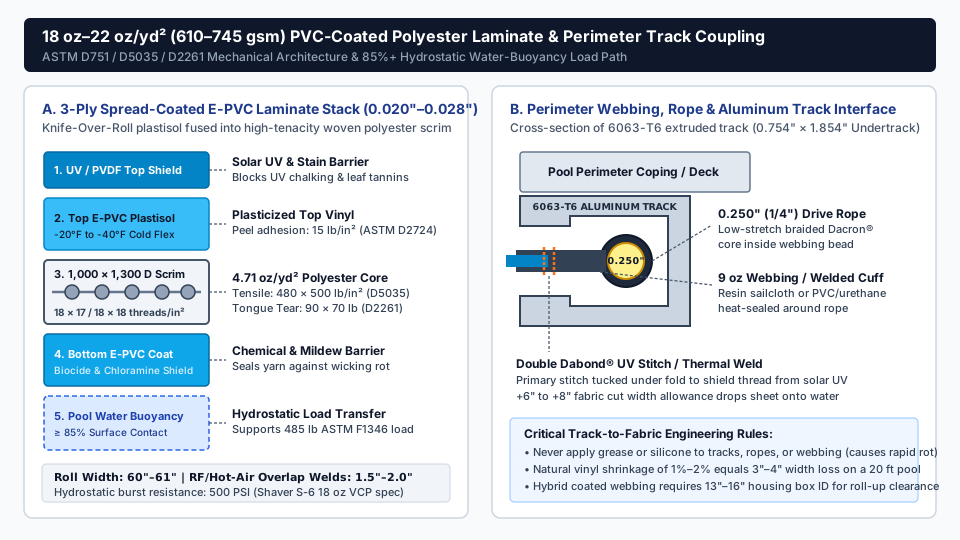
Inside 18 oz–22 oz PVC-Coated Polyester: Scrim Denier, E-PVC Plastisol & Weld Seams
True automatic pool cover fabric is an industrial spread-coated membrane—specifically Knife-Over-Roll E-PVC (emulsion polyvinyl chloride) plastisol fused directly into a woven high-tenacity polyester filament base scrim. According to the PVC-coated polyester engineering data sheet, standard 18 oz/yd² (610 gsm) fabric is built on a 4.71 oz/yd² woven polyester base scrim using 1,000 × 1,300 Denier yarn at an 18 × 17 threads-per-square-inch weave count and finished to a nominal 0.020-inch (20 mil) thickness across a 61-inch roll width. Heavy-duty 22 oz/yd² (745 gsm) membranes upgrade the warp and weft to 1,300 × 1,300 Denier yarn for wide commercial pools or extreme snow-load zones.
Under ASTM D5035 strip tensile testing, 18 oz/yd² E-PVC coated polyester achieves 480 lbs/in² in the warp direction and 500 lbs/in² in the weft direction, rising to 640 lbs/in² warp and 595 lbs/in² weft in 22 oz/yd² grades. Under ASTM D2261 tongue tear testing, the 1,000 × 1,300 Denier scrim resists tearing at 90 lbs warp and 70 lbs weft, while Shaver S-6 18 oz vinyl-coated polyester roll-up specifications document an 18 × 18 threads/sq. in. scrim with 500 PSI hydrostatic burst resistance and 401 × 368 lbs grab tensile strength across a 60-inch roll width. Coating-to-scrim peel adhesion under ASTM D2724 measures 15 lb/in² across a rated material temperature envelope of -20°F to +150°F.
Because industrial coating mills produce PVC-coated polyester in 60-inch to 61-inch roll widths, every residential pool cover spanning 12 ft to 25 ft requires multiple longitudinal seams running parallel to the leading-edge bar. OEM fabricators join these panels using 1.5-inch to 2.0-inch overlapping radio-frequency (RF / dielectric) or hot-air wedge thermal welds. During RF welding, high-frequency electromagnetic energy melts the top and bottom E-PVC plastisol layers together under pneumatic platen pressure, creating a unified molecular bond that exceeds the shear strength of the parent sheet and satisfies Section 6.6 of the ASTM F1346 full technical specification.
Perimeter Webbing & Drive Rope Engineering: 9 oz Sewn Sailcloth vs. Heat-Welded Ultimate™
Perimeter webbing serves as the structural load-transfer and friction-reducing interface between the 18 oz vinyl cover sheet, the 0.250-inch (1/4-inch) drive ropes, and the extruded aluminum track channels. As documented in the Cover-Pools Quad-Core fabric webbing specification, OEM replacement covers use two distinct perimeter webbing architectures: standard sewn marine sailcloth webbing and thermally heat-sealed coated webbing.
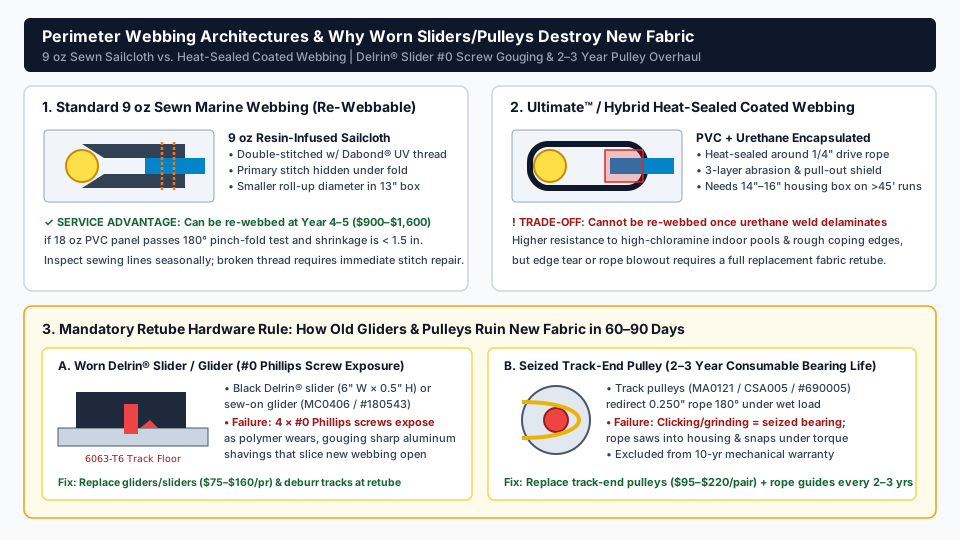
Standard sewn webbing wraps 9 oz resin-infused marine polyester sailcloth around the 1/4-inch drive rope and double-stitches the cuff to the vinyl perimeter using heavy-duty Dabond® bonded polyester thread. The primary structural stitch is tucked beneath the fabric fold to shield the thread from direct solar UV degradation. By contrast, Ultimate™ heat-sealed welded webbing encases high-tenacity polyester fibers inside a UV-stabilized PVC and urethane elastomer jacket that is thermally heat-sealed around the drive rope and double-bonded to the cover edge—creating three layers of abrasion and pull-out protection against rough stone coping and track oxidation.
Both webbing architectures ship from the factory pre-threaded with 0.250-inch (1/4-inch) low-stretch braided polyester drive rope—such as INVIS-A-ROPE in the Automatic Pool Covers Inc. (APC) 2025 Specification Book DO0392—in matched lengths of 100 ft, 120 ft, 140 ft, 160 ft, 180 ft, or 200 ft. Notice on page 49 of the APC specification book that hybrid coated webbing rolls up to a larger coil diameter than standard white Dacron webbing, requiring a minimum recessed housing box interior dimension (ID) of 13 inches for tracks up to 44 ft, 14 inches for 45 to 55 ft, 15 inches for 56 to 65 ft, and 16 inches for tracks 66 ft and longer. Review our rope and webbing replacement guide before ordering standalone lines.
| Engineering Attribute | 9 oz Sewn Polymer Sailcloth Webbing | Heat-Sealed / Hybrid Coated Webbing (Ultimate™) |
|---|---|---|
| Material & Coating | 9 oz resin-infused marine polyester sailcloth | Polyester core encased in UV-resistant PVC & urethane coat |
| Fabric Attachment | Double-stitched with Dabond® UV thread (stitch hidden under fold) | Thermally heat-sealed around rope + double-bonded to cover edge |
| Mid-Life Re-Webbing Capability | Yes — can be un-stitched and factory re-webbed at Year 4–5 ($900–$1,600) | No — urethane weld cannot be re-sewn; edge failure requires full retube |
| Roll-Up Coil Diameter & Box Size | Compact roll bundle; fits standard 12"–13" recessed housing boxes | Thicker edge coil; requires 13" ID (≤44 ft) up to 16" ID (66+ ft) |
| Abrasion & Chloramine Resistance | High; exposed thread stitching requires periodic inspection for fray | Maximum three-layer defense against rough coping & indoor chloramines |
| Best Application | Standard residential outdoor pools seeking mid-life re-web economy | Year-round heated pools, salt-chlorinated pools & rough undertrack coping |
Why Pool Cover Fabric Fails: Plasticizer Leaching, Chloramine Attack & 1%–2% Shrinkage
Authorized service data from Coverstar Central replacement cover guidance establishes an average service life of 6 to 8 years (extending to 7 to 10 years in mild climates) before UV radiation, heat, and sanitizer chemistry deplete the flexible PVC topcoat. Flexible E-PVC relies on monomeric and polymeric plasticizers dispersed between polyvinyl chloride chains. When solar UV and trapped sanitizer gases extract those plasticizers, pigment chalking appears ("color rubbing off onto your hands when touching the cover"), followed by stiff, board-like folding and micro-cracking along roll-up creases.
Once a pinhole, crease crack, or seam split breaches the outer vinyl film, the failure accelerates via scrim wicking. As explained on pages 12 and 15 of the Cover-Pools T4 Owner Manual (800210), chlorinated water penetrates the compromised topcoat and wicks along the internal 1,000 × 1,300 Denier polyester threads—dropping peel adhesion below 15 lb/in², delaminating the PVC layers from the scrim core, and exposing the white fibrous grid ("windowpaning").
Chemical gas trapping is the single fastest destroyer of replacement fabric. Page 13 of the Cover-Pools T4 manual mandates maintaining swim-safe water chemistry prior to closing the cover: Free Chlorine between 1 and 5 ppm, pH between 7.2 and 7.8, and Total Alkalinity between 80 and 120 ppm. After adding chlorine shock, the cover must remain completely open for 12 to 24 hours (whereas non-chlorine monopersulfate shock allows closing after 30 minutes, and page 6 of the APC Pool Owner Guide DO0010 requires up to 60 minutes of venting after routine chemical dosing). Never clean PVC fabric with household detergents or degreasers; use mild Ivory bar soap only, and follow our pool chemistry and cover damage guide.
As plasticizers migrate out of the laminate, the vinyl contracts linearly by 1% to 2%—which page 12 of the Cover-Pools T4 manual notes equals 3 to 4 inches of width loss on a 20-foot wide pool cover (and even more on year-round heated indoor pools). Page 16 of the Aquamatic Hydramatic Manual establishes the critical 85% water-support boundary: because 1 inch of rain on a 20 × 40 ft cover weighs 2 tons (4,000 lb), automatic pool covers are engineered to rest on the pool water. When fabric shrinkage or low water reduces water contact below 85%, the sheet "bridges" taut across the pool, transferring rain and safety loads directly into the tracks and coping. Both APC and Aquamatic manuals also prohibit operating the cover below 40°F to prevent cold-crack fracturing. Compare component lifespans in how long automatic pool covers last.
Diagnostic Field Checklist: When to Patch, Re-Web, or Order a Full Fabric Retube
Field technicians evaluate four physical thresholds—tear geometry, vinyl flexibility, width shrinkage, and scrim exposure—to decide whether an existing cover qualifies for a field vinyl patch ($25 to $65), a mid-life factory re-webbing ($900 to $1,600), or a complete replacement fabric retube ($2,800 to $5,500). Page 17 of the Aquamatic Hydramatic manual specifies that pinholes and small cuts can be patched on both top and bottom surfaces using HH-66 vinyl adhesive and rounded-corner PVC patches extending at least 2 inches beyond the tear (pressed for 15 minutes and cured for 2 hours), whereas any rip wider than 8 inches or hole larger than 6 inches in diameter cannot be patched or factory-repaired on weathered vinyl.
Under the 5-year (60-month) Cover Fabric Limited Warranty in APC Document DO0010 (pages 10–11)—which provides full replacement in Months 1 to 36 and pro-rated coverage at 1/60th per month in Months 37 to 60—mandatory fabric replacement is triggered whenever excessive shrinkage or deterioration prevents the fabric from keeping pool water from penetrating upward through the sheet or renders the cover system inoperable. Use the diagnostic matrix below before scheduling a service crew.
Scroll sideways to compare every column.
| Observed Symptom / Failure Mode | Quantitative Field Threshold | Root Mechanical Cause | Corrective Action & Service Scope |
|---|---|---|---|
| Clean Puncture or Short Cut in Main Panel | Rip ≤8 in. wide or hole ≤6 in. diameter; ≥12 in. from webbing/weld; supple vinyl <5 yrs old | Sharp tree branch, animal claw, or dropped deck tool | Dual-sided 18 oz PVC patch with rounded corners (+2" overlap) & HH-66 adhesive ($25–$65) |
| Frayed Webbing or Broken Stitch w/ Supple Vinyl | Sewn cover ≤5 yrs old; passes 180° pinch-fold test without cracking; width loss <1.5 in. | Track splice burr, worn slider screw, or misaligned return pulley | Factory re-webbing + new 0.250" Dacron ropes + new gliders & pulleys ($900–$1,600) |
| Longitudinal RF / Thermal Seam Splitting | Weld peel >4 in. along 60"–61" panel joint or water seeping upward through seams | Chloramine hydrolysis & loss of 15 lb/in² plastisol peel adhesion | Full replacement fabric retube required — tensioned seams cannot hold field glue |
| Exposed White Scrim Grid or Heavy Chalking | White 1,000×1,300 D polyester threads visible through topcoat; pigment rubs off on hand | 6–8+ years of UV & sanitizer plasticizer extraction; wicking delamination | Full replacement fabric retube — cover no longer qualifies as ASTM F1346 safety barrier |
| Width Shrinkage & Track Pullout ("Bridging") | Fabric narrowed ≥3–4 in. (1%–2% shrinkage); <85% water contact; high drive amp draw | Cumulative plasticizer loss or year-round high water temperature | Full replacement fabric cut 6"–8" wider than track space + new gliders & pulleys |
| Delaminated Heat-Welded Webbing / Rope Blowout | Drive rope breaking through webbing tunnel or urethane weld peeling off cover edge | Seized return pulley or leading-edge slam at track end casting | Full replacement fabric & webbing assembly + mandatory pulley & glider overhaul |
ASTM F1346-23 Statutory Compliance: Load, Perimeter Deflection & Surface Drainage Tests
In the United States, municipal building codes and the International Swimming Pool and Spa Code (ISPSC) recognize an automatic pool cover as a statutory barrier only when the complete installed assembly complies with ASTM F1346-23: Standard Performance Specification for Safety Covers and Labeling Requirements for All Covers for Swimming Pools, Spas and Hot Tubs (the active 2023 standard under Subcommittee F15.28, superseding historical F1346-91R18 and F1346-91R10). Scope Section 1.1 states that the specification reduces drowning risk for children under five years of age only when the cover is installed, operated, and maintained according to the manufacturer instructions. Substituting generic truck tarp vinyl or operating a cover with exposed scrim threads, split welds, or missing webbing stitches voids its classification as a Power Safety Cover (PSC).
As detailed in Sections 6, 7, and 9 and Annex A1 of the ASTM F1346 standard test specification, a replacement automatic pool cover fabric and webbing assembly must satisfy four quantitative physical performance tests alongside permanent consumer warning labeling (Section 8):
- Static Load Support Test (Sections 7.1 & 9.1): On any pool wider than 8 ft (2.4 m), the installed cover must support a 485 lb (220.0 kg) static load—composed of one 225-lb weight (95th percentile adult male), one 210-lb weight (95th percentile adult female), and one 50-lb weight (child under age 5), each distributed over 1 sq. ft. within a 3-ft radius—for 5 minutes at both the center of the pool and 4 to 6 ft from the pool wall without any weight passing through or causing performance-impairing damage to seams or tracks.
- Perimeter Deflection Test (Sections 7.2 & 9.2): With a 50-lb weight placed 4 to 6 ft from the pool wall, perimeter deflection between the cover edge and the track/wall must not allow passage of a 3.7 in. × 5.7 in. × 12 in. (36.6 lb, 16.6 sq. in.) ellipsoidal test object.
- Opening Test (Sections 7.4 & 9.4): No opening at the leading edge, step transition, or perimeter track may permit a 4.5-inch diameter test sphere (representing the 5th percentile 7-month-old head breadth) to pass through when subjected to 40 lb (±1 lb) of steady applied force.
- Surface Drainage Test (Sections 7.3 & 9.3): Because 18 oz PVC-coated polyester is solid and waterproof, the cover and its auxiliary submersible cover pump must drain water sprayed at 10 gal/min per 1,000 sq. ft. for 30 minutes so that within 30 minutes of rainfall cessation, a supine 3-year-old torso test mannequin ("Timmy", measuring 32 in. × 9 in. × 5 in. and weighing 36.6 lb) placed 2 to 3 ft from the pool edge is not covered by standing water.
Why New Fabric Fails in 90 Days Without Replacing Gliders, Return Pulleys & Rope Reels
Both APC (DO0010, page 10) and Aquamatic (Hydramatic Manual, pages 4 and 10) explicitly exclude pulleys, guides, leading-edge gliders, black Delrin® sliders, drive ropes, and webbing from their 10-year mechanical component warranties—classifying them as consumable wear hardware. Installing $1,800 to $3,200 of new replacement fabric onto worn gliders and seized track-end pulleys is the leading cause of premature webbing destruction within 60 to 90 days of a retube.
Pages 12 and 13 of the Aquamatic Hydramatic manual explain the exact mechanical failure mechanism: leading-edge sliders are machined from low-friction black Delrin® (acetal homopolymer) fastened to the leading-edge carrier by four countersunk #0 Phillips stainless steel screws. As the Delrin® shoe wears down over 5 to 8 years of sliding against fine sand and calcium scale, those four #0 Phillips screw heads become flush with the polymer surface and gouge directly into the lower channel of the 6063-T6 aluminum track. The exposed screws carve razor-sharp aluminum shavings and burrs inside the track channel that slice through brand-new perimeter webbing on the very first travel cycle. Review our glider and slider wear tolerance guide to identify your exact replacement hardware.
Furthermore, the Cover-Pools Parts Guide (Fluidra 2026 Catalog) and APC Spec Book DO0392 (pages 6 and 9) show that glider and pulley part numbers are strictly tied to track profile, handedness (Left-Hand vs. Right-Hand, such as Cover-Pools #180543 / #180544 or complete glider set #060307), dowel style, and pre- vs. post-October 2015 hardware generation. In APC systems, Large 2-Channel Undertrack (XC0054 / XC1109, measuring 0.754 in. × 1.854 in.) pairs with MA0121/MA0142 pulleys, MA0147 rope guides, and Sew-On Large 2-Channel Gliders (MC0406, 3.5 in. W × 2.66 in. H × 0.5 in. D) or Screw-On Gliders (MC0618, 3.5 in. W × 3.3 in. H × 0.375 in. D), whereas Small 3-Channel Undertrack (XC0092 / XC1130, 0.754 in. × 1.902 in.) pairs with CSA005 pulleys, RA0006 guides, and Universal Small Gliders (MC0601) or Detachable Black Sliders (CSA-018, 6 in. W × 0.5 in. H × 2.22 in. D).
Track-end return pulleys have a documented service life of 2 to 3 years (Cover-Pools T4 Manual, page 11; Aquamatic Manual, page 10). Any clicking or grinding noise at the far end of the track indicates a worn or seized pulley bearing that will flat-spot the sheave, fray the new 0.250-inch rope, and snap the drive line. During every fabric retube, technicians must replace both leading-edge gliders and both track-end pulleys, flush all sand from the tracks without applying grease or silicone (track channel cleaning and lubrication rules), recalibrate the slip-clutch torque limiter, and verify leading-edge stop limits per page 7 of the Cover-Pools T4 Versa Manual (800235)—stopping Universal top-track covers 2 to 3 inches short of the pulley castings and using the soft-stop coast method on Undertrack systems.
Measuring for Replacement Fabric: Cross-Brand Track Fit, 6"–8" Slack Allowance & Tube Sizing
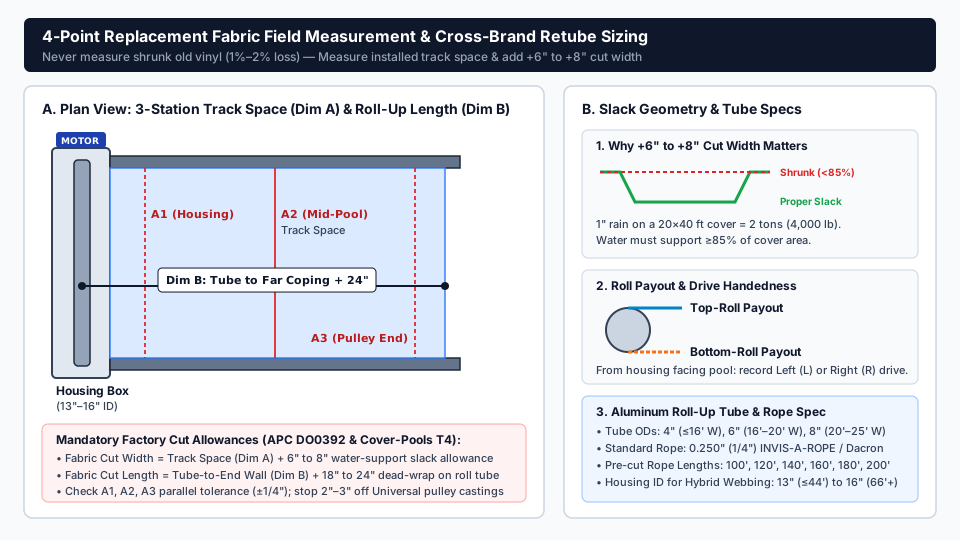
Never measure an old, removed vinyl sheet to order replacement fabric. Because aged PVC fabric has shrunk 1% to 2% in width (3 to 4 inches on a 20-foot pool) and stretched unevenly near the roll-up tube, duplicating old fabric dimensions guarantees an undersized cover that bridges across the water and pulls out of the tracks. Instead, take four field measurements directly from the pool structure using our pool cover measurement protocol and automatic pool cover parts hub:
- Dimension A — Track-to-Track Space + 6" to 8" Cut Width Allowance: Measure the perpendicular distance between the inside edges of the aluminum tracks at three stations (housing end A1, mid-pool A2, and far pulley end A3) to verify parallel geometry within ±1/4 inch. Per page 13 of the APC 2025 Specification Book (DO0392), factory replacement fabric is cut 6 to 8 inches wider than the measured track space so the sheet drops down the coping wall and rests on the water across ≥85% of its surface.
- Dimension B — Roll-Up Tube Centerline to Far Wall Coping + 18" to 24" Wrap Allowance: Measure from the centerline of the aluminum roll-up tube inside the housing to the far coping stop point, then add 18 to 24 inches of length so at least one full dead-wrap of fabric remains coiled on the tube when the cover is fully closed. This dead-wrap prevents radial shear from tearing the fabric spline or fastener line out of the aluminum tube.
- Drive Side Handedness (Left vs. Right): Stand behind the cover housing box looking out toward the pool and record whether the drive motor and rope reels sit on the Left (L) or Right (R) end of the roll-up tube.
- Roll Payout Direction & Tube Diameter: Record whether the fabric unspools from the top of the roll-up tube (Top-Roll) or underneath the tube (Bottom-Roll) so the UV/acrylic topcoat faces the sky and the primary webbing stitch remains hidden under the fold. Verify roll-up tube outside diameter—4-inch, 6-inch, or 8-inch aluminum tubing (APC DO0392, page 12)—and confirm that wide spans (18 to 25 ft) are not upgrading from 18 oz to heavier 22 oz fabric on an undersized tube that will sag at mid-span.
2026 Automatic Pool Cover Replacement Fabric & Webbing Cost Breakdown ($2,800–$5,500)
In 2026, a complete automatic pool cover replacement fabric and hardware retube costs $2,800 to $5,500 installed for most residential pools. The total price is governed by four physical variables: water surface area and pre-threaded rope length (100 ft to 200 ft), laminate specification (standard 18 oz sewn sailcloth vs. 20–22 oz heavy-duty vinyl or heat-welded Ultimate™ webbing), track accessibility (surface top-track vs. concealed undertrack beneath bullnose coping or heavy walk-on stone lid trays), and the condition of the leading-edge gliders, return pulleys, and rope reel brakes.
Compare itemized material and two-technician field labor costs in the table below alongside our automatic pool cover cost guide, automatic pool cover repair hub, and warranty coverage guide.
Scroll sideways to compare every column.
| Replacement Line Item / Service Scope | OEM Material & Part Cost | 2-Tech Field Labor (2.5–6.5 hrs) | Total Installed Price Range | When Required / Applicable |
|---|---|---|---|---|
| Standard 18 oz PVC Fabric + Sewn Webbing + 1/4" Ropes (16×32 to 18×36 ft) | $1,550–$2,350 | $650–$950 | $2,200–$3,300 (base) | Standard residential rectangular pools (100–140 ft ropes) |
| Large-Span or 20–22 oz / Heat-Welded Webbing Retube (20×40 to 22×44 ft) | $2,350–$3,200 | $800–$1,200 | $3,150–$4,400 (base) | Oversized spans, indoor heated pools, or 160–200 ft ropes |
| Mandatory Track Hardware Kit (Gliders/Sliders + Return Pulleys + Rope Guides) | $190–$380 | Included in retube (or $180–$280 standalone) | $190–$450 | Mandatory at every 6–10 yr fabric replacement to prevent webbing cuts |
| Recessed Undertrack & Walk-On Stone Lid-Tray Access Surcharge | $0–$95 (stainless fasteners/shims) | +$300–$650 | +$300–$745 | Pools with concealed under-coping tracks or heavy stone lid brackets |
| Old Wet Vinyl Cut-Out, Tube De-Spooling & Hauling Disposal (80–130 lb) | $45–$90 landfill fee | $125–$225 | $170–$315 | Standard turn-key removal of waterlogged old fabric |
| Complete Turn-Key Fabric, Webbing & Hardware Retube (Total Installed) | $1,800–$3,650 | $950–$1,850 | $2,800–$5,500 | Full 6–10 year ASTM F1346-23 safety barrier restoration |
| Mid-Life Factory Re-Webbing Only (Existing 18 oz vinyl ≤5 yrs + new ropes) | $450–$850 | $450–$750 (unspool & reinstall) | $900–$1,600 | Sewn covers with supple vinyl (<1.5" shrinkage) & intact RF seams |
Questions
- What weight and denier fabric is used for automatic pool cover replacement?
- OEM automatic pool cover replacement fabric uses 18 oz/yd² (610 gsm, 18 to 20 mil thick) to 22 oz/yd² (745 gsm) E-PVC plastisol spread-coated onto a 4.71 oz/yd² high-tenacity woven polyester base scrim. Standard 18 oz fabric uses 1,000 × 1,300 Denier or 1,000 × 1,000 Denier yarn at an 18 × 17 or 18 × 18 threads/sq. in. weave count, delivering 480 × 500 lbs/in² tensile strength (ASTM D5035), 90 × 70 lbs tongue tear strength (ASTM D2261), 15 lb/in² coating peel adhesion (ASTM D2724), and 500 PSI hydrostatic burst resistance.
- How much does automatic pool cover fabric and webbing replacement cost in 2026?
- A complete turn-key automatic pool cover fabric, webbing, rope, glider, and pulley retube costs $2,800 to $5,500 installed in 2026. That total includes $1,550 to $3,200 for custom-cut 18 oz to 22 oz PVC fabric with pre-threaded perimeter webbing and 0.250-inch Dacron drive ropes, $190 to $380 for new leading-edge gliders and track-end return pulleys, and $950 to $1,850 for two-technician removal, track flushing, installation, and clutch/limit calibration. If a sewn cover is under 5 years old with supple vinyl, mid-life re-webbing costs $900 to $1,600.
- Can you replace just the webbing on an automatic pool cover without buying new fabric?
- Yes, if the cover uses sewn 9 oz marine polyester webbing (such as Cover-Pools standard sewn or APC Dacron webbing) and the 18 oz PVC center sheet is under 5 years old, passes a 180° pinch-fold test without white stress-cracking, and has shrunk less than 1.5 inches in width. Covers built with thermally heat-sealed coated webbing (such as Coverstar Ultimate™ webbing) or covers showing exposed polyester scrim, stiff vinyl, or split RF panel welds require a complete replacement fabric retube.
- Why must leading-edge gliders and return pulleys be replaced with new pool cover fabric?
- Leading-edge gliders and Delrin® sliders wear down against track grit over 5 to 8 years until their four countersunk #0 Phillips stainless steel mounting screws become exposed and gouge sharp aluminum shavings inside the 6063-T6 track channel. Those metal burrs slice through brand-new replacement webbing within 60 to 90 days. Likewise, track-end return pulleys have a 2 to 3 year bearing life; a clicking or seized pulley flat-spots and burns through the new 1/4-inch braided drive rope.
- Does replacement automatic pool cover fabric meet ASTM F1346-23 safety standards?
- Yes, when ordered as an OEM-matched 18 oz to 22 oz PVC fabric, perimeter webbing, and drive rope assembly fitted to the installed track profile and paired with an automatic cover pump rated for at least 10 gal/min per 1,000 sq. ft. Under ASTM F1346-23, the installed cover must support a 485 lb (220 kg) static load (two adults and one child), block a 50 lb (3.7 × 5.7 × 12 in.) perimeter deflection test object, and resist a 4.5-inch head-probe sphere under 40 lb of force.
- How long must an automatic pool cover stay open after shocking the pool to protect new fabric?
- After adding chlorine shock (calcium hypochlorite, sodium hypochlorite, or dichlor), keep the automatic pool cover completely open for 12 to 24 hours with the circulation pump running until Free Chlorine returns to the 1 to 5 ppm swim-safe band (alongside pH 7.2–7.8 and Total Alkalinity 80–120 ppm). After dosing non-chlorine potassium peroxymonosulfate (MPS) shock, leave the cover open for at least 30 minutes (or up to 60 minutes after routine chemical additions). Closing the cover early traps corrosive chloramine gas that leaches PVC plasticizers and causes 1% to 2% shrinkage.
Parent hub: Automatic Pool Covers