Updated November 2026
Pool Cover vs. Pool Fence: Safety Mechanisms, Building Codes, and Layered Barriers
A four-sided isolation pool fence is the safer baseline barrier because it protects a pool 24/7 without relying on switches, motors, or remembering to close a cover. An ASTM F1346 safety pool cover—especially an automatic cover—adds evaporation control and a tested water-surface barrier when closed, yet local codes determine whether it can replace fencing.
What are the pros and cons of a pool cover vs a pool fence?
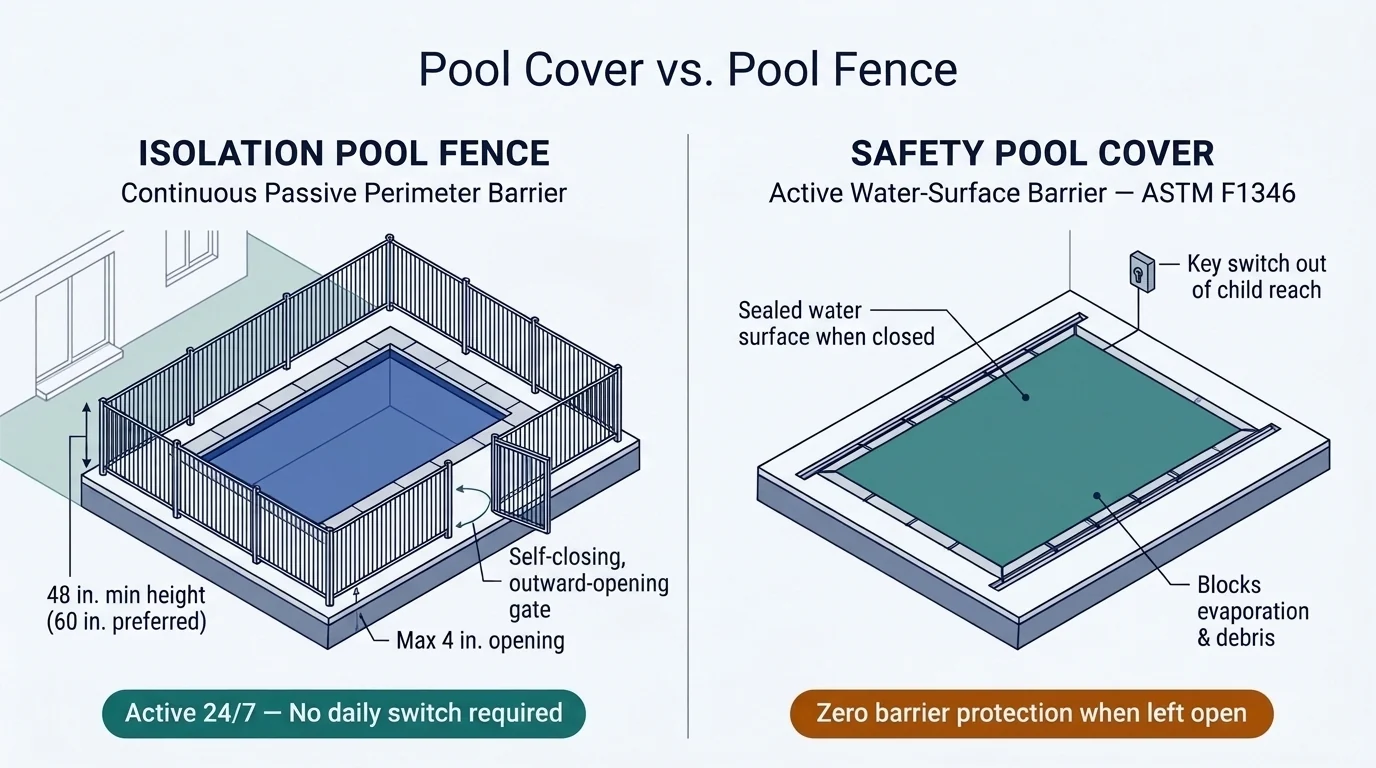
The core tradeoff between a pool cover and a pool fence is continuous passive perimeter control versus an active water-surface seal that also saves heat and blocks debris. A four-sided isolation fence stays upright continuously, whereas an automatic or manual safety cover only blocks water access when someone closes and secures it.
Colonial Fence contrasts the two mechanisms directly: automatic pool covers add convenience, conserve energy by limiting heat loss and evaporation, and keep out debris, yet they only protect when closed and leave the pool unprotected if left open while entertaining or during a mechanical issue. By contrast, a pool fence establishes a constant 24/7 physical barrier independent of switches, motors, or human memory.
The U.S. Consumer Product Safety Commission Safety Barrier Guidelines for Residential Pools emphasize that barriers are not child proof and cannot replace adult supervision; instead, fences, house door alarms, and power safety covers work together as layers of protection during a lapse in supervision. To explore certified cover families before comparing layouts, start with our pool safety covers hub.
| Comparison Factor | Four-Sided Isolation Pool Fence | Certified Safety Pool Cover (Automatic or Manual) |
|---|---|---|
| Protection mode | Passive 24/7 perimeter barrier independent of daily operation | Active water-surface barrier that protects only while fully closed and anchored |
| Primary consensus standard | ASTM F2286-16(2023) for removable mesh fencing; local fence codes for permanent barriers | ASTM F1346-23 for manual and powered safety covers plus cover labeling |
| Core operational weak link | Gate propped open, broken self-closer, or climbable object placed beside fence | Cover left open during gatherings, skipped closure, or mechanical fault |
| Non-safety utility | Keeps yard and patio separated without covering the water surface | Limits heat loss, reduces evaporation, and blocks falling leaves and debris |
| Typical code role | Baseline residential enclosure mandated across most state and local barrier codes | Accepted as a barrier exemption under ISPSC powered-cover rules or as one layer in multi-feature statutes |
Which is safer: an automatic pool cover or a pool fence?
A four-sided isolation pool fence with a self-closing, self-latching gate is safer as a standalone barrier because its protection does not fail when a busy household leaves a switch unpressed. Epidemiological evidence consistently backs four-sided isolation fencing as the strongest single physical intervention against unsupervised child entry.
In the Cochrane Database systematic review on pool fencing covering three case-control studies, fenced pools reduced drowning or near-drowning risk with an odds ratio of 0.27 (95% CI 0.16 to 0.47) compared with unfenced pools. Isolation fencing enclosing the pool alone was markedly superior to three-sided perimeter fencing that allows house access, achieving an odds ratio of 0.17 (95% CI 0.07 to 0.44); the review notes that adequate fencing preventing unsupervised access can prevent about three-quarters of child pool drownings.
National surveillance reinforces why passive protection at home matters. CPSC submersion data show nearly 300 children younger than 5 drown in pools and spas each year (75 percent of the 390 fatalities under 15), with children aged 1 to 3 years (12 months through 47 months) representing 67 percent of fatalities and 66 percent of injuries, and residential locations accounting for 85% of under-5 fatalities and 54 percent of injuries. Similarly, an Injury Prevention analysis of US drowning mortality recorded 4,509 US drowning deaths (including 840 in swimming pools), estimated that adequate four-sided isolation fencing could prevent 51 child drowning deaths per year using a conservative 19% US effectiveness estimate (compared with 40%–70% in earlier Australia and New Zealand studies), and highlighted the US National Water Safety Action Plan recommendation for four-sided isolation fencing.
An automatic safety cover still strengthens household protection substantially when paired with a fence, because it seals the water surface between swim sessions and CPSC advises keeping covers well-maintained with control devices out of children's reach. When evaluating drive mechanisms and daily closing habits, review our automatic pool covers guide and our comparison of automatic versus manual safety covers.
When can an automatic pool cover replace a pool fence under building codes?
An automatic pool cover can legally replace a pool fence only when the local building authority enforces a code—such as an unamended International Swimming Pool and Spa Code (ISPSC) powered-cover exemption—that explicitly allows an ASTM F1346 power safety cover in lieu of a barrier. Never assume a cover qualifies without written pre-permit confirmation from your building department.
There is no single nationwide residential pool barrier statute in the United States. CPSC explicitly states that its barrier guidelines are not mandatory federal requirements and directs pool owners to check local building codes, while the Injury Prevention drowning study likewise notes that pool fencing laws for newly installed pools vary by jurisdiction. Likewise, ASTM International Standard Performance Specification F1346-23 (the active edition last updated Jul 13, 2023) establishes performance tests in Sections 1.1 and 1.2 intended to inhibit water access by children under five when properly installed and used, plus marking requirements for all covers—yet Section 1.4 explicitly places responsibility on the user to determine applicable regulatory limitations before use.
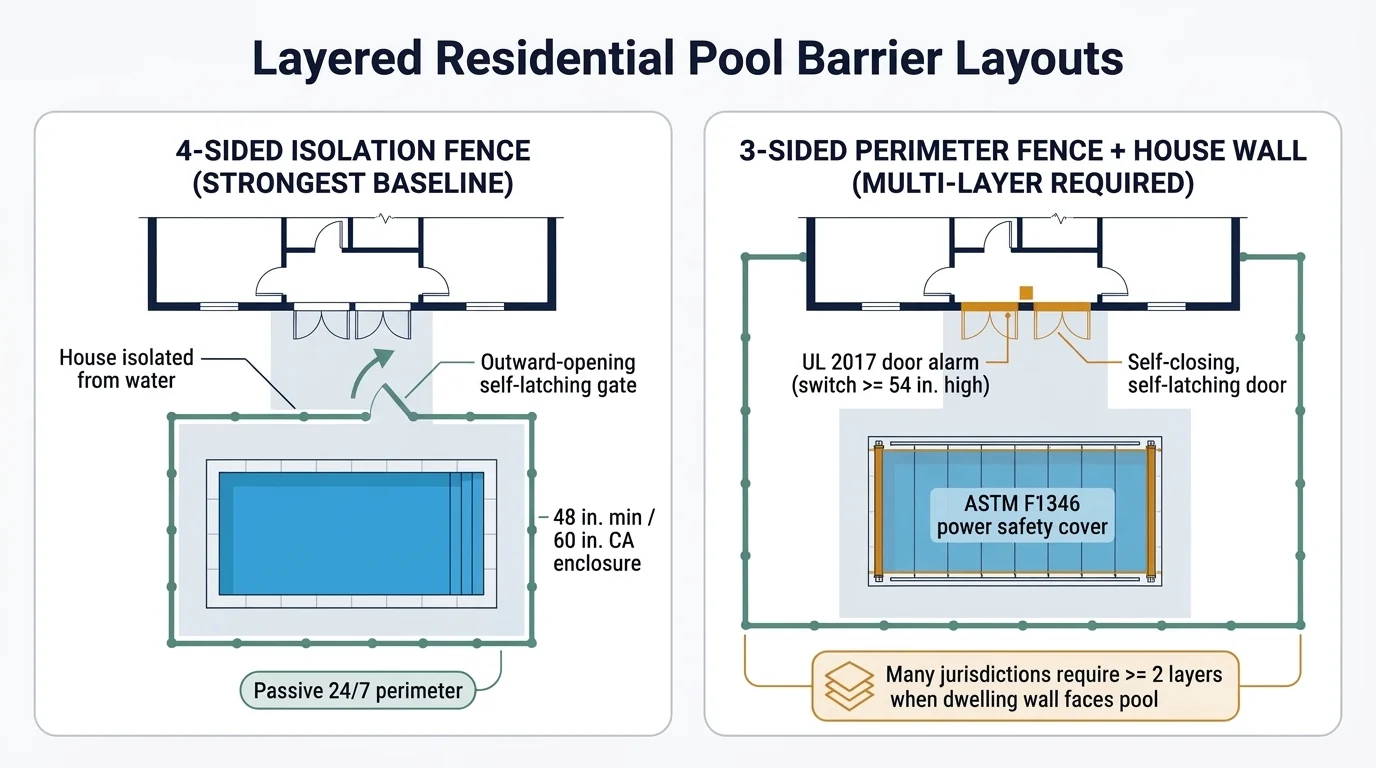
CPSC guidelines distinguish two common code scenarios. First, where a house wall forms the fourth side of a perimeter fence, CPSC lists three dwelling-wall safeguards: UL 2017 Section 77 door alarms (sounding at least 85 dBA at 10 feet for 30 seconds or more within 7 seconds of opening, with auto-reset and a temporary deactivation switch of up to 15 seconds mounted at least 54 inches above the threshold), a power safety cover conforming to ASTM F 1346-91, or equivalent self-closing and self-latching doors. CPSC also warns never to have a pet or doggy door leading directly to a pool unless an isolation fence surrounds the pool. Second, All-Safe reports that jurisdictions adopting ISPSC basics require a 48-inch barrier with 4-inch sphere opening limits, outward-opening self-closing and self-latching gates (latch at least 54 inches high or on the pool side), and removable mesh fences within 1 inch of the deck and at least 20 inches from water, while typically exempting pools with a powered ASTM F1346 safety cover and spas with a lockable ASTM F1346 cover. Before signing a contract, inspect our ASTM F1346 pool safety cover verification guide.
Scroll sideways to compare every column.
| Code Framework or Jurisdiction | Can a Powered ASTM F1346 Cover Replace a Fence? | Mandatory Enclosure & Gate Baseline | Required Dwelling-Wall or Secondary Layer |
|---|---|---|---|
| CPSC Safety Barrier Guidelines (Advisory) | Not a federal mandate; lists power cover as a dwelling-wall safeguard or added layer | 48 in. minimum height (60 in. preferable); max 4 in. openings; outward self-closing/self-latching gate | UL 2017 Section 77 door alarms (85 dBA at 10 ft), ASTM F 1346-91 power cover, or self-closing doors; no pet doors |
| ISPSC-based local codes (All-Safe summary) | Usually yes for powered ASTM F1346 covers (and lockable spa covers), subject to local adoption | 48 in. barrier, 4 in. sphere limit, outward self-closing gate; mesh max 1 in. gap and at least 20 in. from water | Confirm whether local amendments delete the powered-cover exception before permitting |
| California SB 442 / HSC Section 115922 | No on its own; counts as one of two required safety features | 60 in. isolation enclosure (Section 115923) or ASTM F2286 removable mesh fence with key-lockable gate | Choose at least 2 of 7 features (fence, mesh fence, ASTM F1346 cover, exit alarms, 54 in. self-closing doors, ASTM F2208 alarm, or lab equivalent) |
| New York 2020 Residential Code R326.4.2 | No; exempts the ASTM F2208 water-entry pool alarm, not the permanent barrier | 48 in. permanent barrier for pools deeper than 24 in.; max 2 in. bottom clearance; lockable outward self-latching gate | UL 2017 door alarms (54 in. bypass switch; 48 in. Accessible) and 48 in. window latches when house forms barrier |
How do California barrier rules treat pool covers vs pool fences?
California does not allow a safety pool cover alone to satisfy barrier law: under Health & Safety Code Section 115922 (SB 442), new or remodeled residential pools deeper than 18 inches are required to include at least two of seven approved safety features. Because an ASTM F1346 cover counts as one feature, it requires a second qualifying safeguard.
All-Safe summarizes the California Swimming Pool Safety Act update under SB 442 (effective January 1, 2018, with SB 552 amendments effective January 1, 2025) and lists the seven approved options in Health & Safety Code Section 115922:
- An enclosure isolating the pool from the home complying with Section 115923 (at least 60 inches tall).
- Removable mesh pool fencing meeting ASTM F2286 with a self-closing, self-latching, key-lockable gate.
- A manual or automatic approved safety pool cover complying with ASTM F1346.
- Exit alarms on private single-family home doors or windows providing direct access to the pool.
- Self-closing, self-latching devices on doors giving direct pool access with release mechanisms at least 54 inches above the floor.
- An ASTM F2208 pool alarm that sounds upon accidental or unauthorized entrance into the water.
- Other means of protection verified by a certified testing laboratory to provide equal or greater protection.
Why do California researchers still prioritize an isolation enclosure under SB 442?
Even with California's two-feature mandate, emergency medicine researchers found no decline in fatal toddler drownings and caution that only one of the seven statutory options—a four-sided enclosure isolating the pool from the home—represents a true best practice. Relying on two active or alarm-only options leaves households vulnerable to missed closures or muted alarms.
In a Western Journal of Emergency Medicine study of California drownings from 2017–2021, Agran et al. documented 4,166 drowning incidents among young children (234 fatalities, 846 hospitalizations, and 3,086 emergency department visits), with 65% of fatalities occurring in pools and no statistically significant reduction in annual fatality rates (P = 0.88). While the original California Pool Safety Act took effect January 1, 1997, and SB-442 expanded requirements in 2017 to two features plus home-sale and remodel inspections, Agran et al. point out that there is no documentation of ongoing compliance after a one-time inspection and that only an isolation enclosure meeting California Building Standards Code specifications isolates the water passively from the house.
What are the legal pool fence requirements in New York State?
New York requires residential swimming pools deeper than 24 inches to have a permit and a permanent 48-inch barrier with max 2-inch bottom clearance, plus outward-opening, self-closing, self-latching, lockable gates. An automatic ASTM F1346 power safety cover exempts a pool from New York's separate water-entry alarm mandate, not from the permanent enclosure.
As published by the Town of Kent Building Department from New York's 2020 Residential Code Section R326.4.2, residential pool enclosures follow strict geometric and hardware rules:
- Barrier height and bottom gap: Minimum 48 inches above grade measured on the outside of the barrier, with vertical clearance between grade and the bottom of the barrier not greater than 2 inches.
- Gate hardware and locks: All gates must be self-closing and self-latching, pedestrian gates must open outward away from the pool, the latch handle must sit on the pool side at least 40 inches above grade (and if under 54 inches, at least 3 inches below the top with no opening over 0.5 inch within 18 inches), and gates must be locked with a key, combination, or child-proof lock when unsupervised.
- Dwelling-wall protections: Where a house wall forms part of the barrier, direct-access doors shall be equipped with UL 2017 audible alarms activating within 7 seconds for at least 30 seconds (with a temporary manual bypass up to 15 seconds located 54 inches or more above the threshold, or 48 inches in Accessible units) and operable windows shall have latches at least 48 inches above the floor preventing passage of a 4-inch-diameter sphere, unless equivalent approved self-closing and self-latching protection is installed.
- Pool alarm mandate and ASTM F1346 exception: Pools installed, constructed, or substantially modified after December 14, 2006 require an ASTM F2208 water-entry pool alarm, with explicit alarm exceptions for a hot tub or spa with an ASTM F1346 safety cover or a swimming pool equipped with an automatic power safety cover complying with ASTM F1346.
How does a pool safety net compare with a pool fence and safety cover?
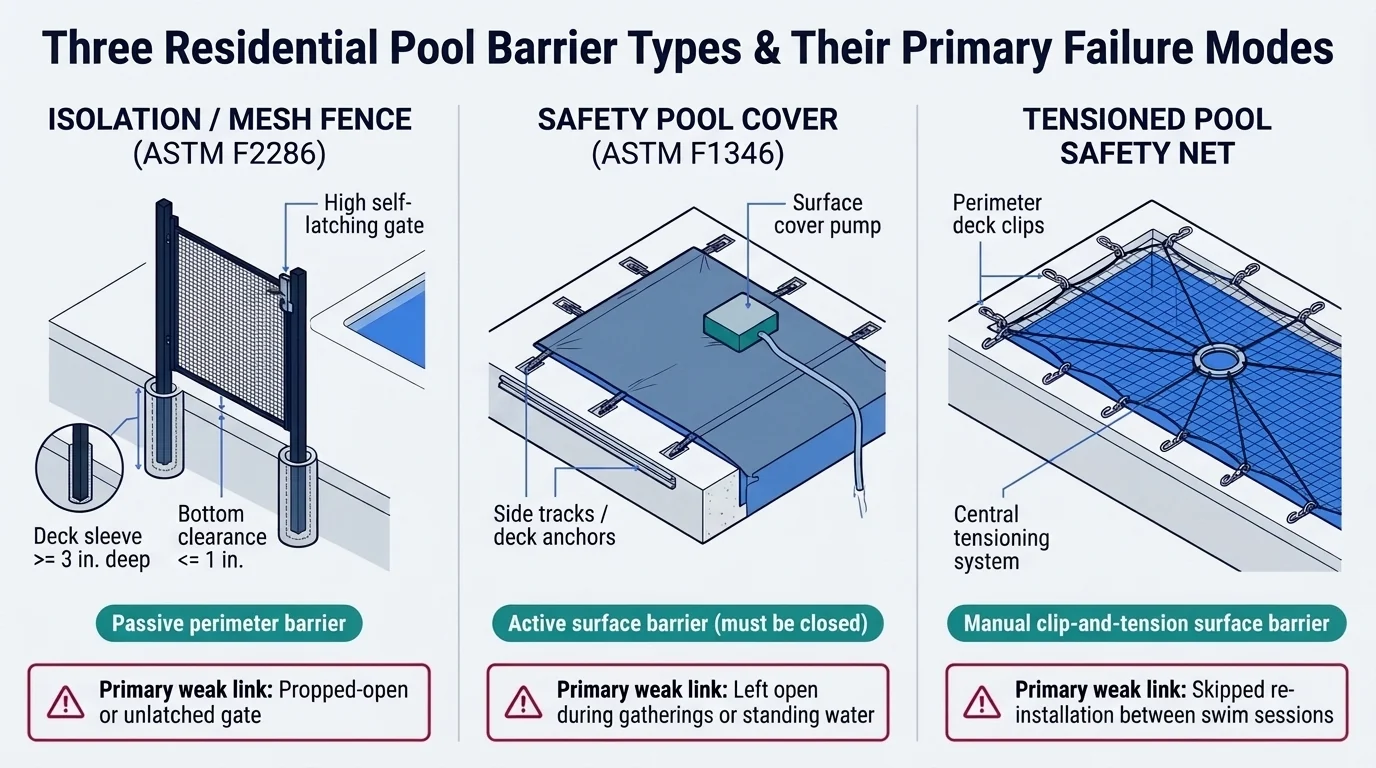
A tensioned pool safety net sits between a fence and a cover in workflow: like a cover, it spans the water surface and must be manually removed and re-tensioned every time you swim, so it never delivers the 24/7 passive convenience of a fenced gate. Unlike an automatic cover, a net offers no evaporation savings or fine-debris exclusion.
Two distinct ASTM specifications govern mesh fences versus covers and nets. ASTM F2286-16(2023) (catalog designation F2286-16R23, Active, last updated Mar 21, 2023) defines design and performance requirements in Scope 1.1 for removable mesh safety barriers for swimming pools, hot tubs, and spas to reduce injuries or death for infants and children up to and including five years of age. CPSC barrier guidelines advise locking removable mesh fences into the deck so removal requires extensive use of tools, standing at least 48 inches tall with posts at least 3 inches below grade spaced no more than 40 inches apart and bottom clearance no greater than 1 inch above the deck (versus up to 4 inches on solid surfaces and 2 inches on grass or pebbles for rigid fences, with barrier openings blocking a 4-inch diameter sphere and vertical spacing capped at 1¾ inches when horizontal rails sit less than 45 inches apart).
By contrast, All-Safe notes that many inspection agencies evaluate pool safety nets under ASTM F1346 (originally written for safety covers), requiring the installed net or cover to hold weight, keep a child out of the water, and block a 4-inch object, whereas leaf covers keep debris out and are never ASTM F1346 safety covers. For manual anchor layouts on concrete and pavers, read our pool safety cover installation and deck anchoring guide.
Scroll sideways to compare every column.
| Barrier System | Governing Standard | Clearance & Geometry Benchmark | Daily Effort & Non-Safety Tradeoff |
|---|---|---|---|
| Permanent four-sided isolation fence | State & local codes; CPSC barrier guidelines | 48 in. min height (60 in. CA/preferred); max 4 in. sphere opening; max 4 in. solid or 2 in. grass bottom gap | Walk through self-closing outward gate; zero daily setup; no evaporation or debris blocking |
| Removable mesh pool fence | ASTM F2286-16(2023) (F2286-16R23) | 48 in. min height; deck posts at least 3 in. deep and max 40 in. apart; max 1 in. bottom gap; tool-locked sleeves | Passive perimeter while installed; removable only with tools; no heat or debris protection |
| Manual or automatic safety pool cover | ASTM F1346-23 | Sealed perimeter track or deck-anchored tension; manufacturer-specified installation and labeling | Push-button closure (automatic) or seasonal anchoring (manual); blocks debris and evaporation |
| Tensioned pool safety net | Evaluated by many agencies under ASTM F1346 | Must support weight, inhibit child water entry, and prevent passage of a 4-inch object | Manual perimeter unclipping and re-tensioning every swim; leaves water open to leaves and evaporation |
| Leaf or solar debris cover | None (not a safety barrier; labeling only under ASTM F1346-23 Section 1.2) | Untested against child entry or structural load performance requirements | Cannot satisfy barrier codes and must never substitute for a fence or ASTM F1346 cover |
How do pool cover vs pool fence costs and ownership tradeoffs compare?
Comparing ownership commitments without guessing local contractor quotes comes down to scope complexity, expected service life, insurance underwriting, and compliance re-work risk. A perimeter fence is a single structural installation with minimal ongoing mechanics, whereas a powered safety cover adds mechanical drives, tracks, drainage, electrical circuits, and periodic fabric maintenance alongside ongoing heat and evaporation savings.
Peer-reviewed public health research highlights three practical ownership factors that buyers often overlook. First, service lifespan varies by construction: a Texas cost-benefit analysis of universal pool fencing modeled a conservative 10-year fence lifespan while noting that many pool safety experts estimate removable mesh fencing lasts 15–20 years. Second, the same study points out that despite AAP and CPSC recommendations, nearly two-thirds of pool-owning parents still lack four-sided isolation fencing and routine post-permit inspections seldom occur—yet homeowners insurance underwriting frequently enforces its own floor. Most Texas home insurance policies require pools to be enclosed by a secure fence at least four feet in height, and noncompliance can lead to denied coverage or policy cancellation, even though insurers rarely distinguish three-sided from four-sided fencing.
Third, buying the wrong specification creates avoidable replacement waste. All-Safe warns that if a homeowner installs a 4-foot fence where a local agency or inspector requires a 5-foot fence, the shorter fence cannot simply be extended—a new, taller fence must be installed. Similarly, purchasing an untested leaf cover instead of an ASTM F1346 cover leaves the safety requirement unresolved. For line-item scope planning on automatic systems without relying on generic price guesses, review our automatic pool cover cost scope breakdown.
What should you verify with your building department before choosing a barrier?
Before ordering a fence, safety cover, or layered combination, get written answers on six compliance points from your local building department, homeowner association, and homeowners insurance carrier so your barrier layout passes final inspection without expensive redesigns, delayed permits, or coverage gaps:
- Adopted code edition and cover rule: Ask which code edition applies (such as ISPSC, California SB 442 / HSC Section 115922, or New York Residential Code R326.4.2) and whether a powered ASTM F1346-23 cover is accepted in place of a fence, counts as one of two required features, or exempts only an ASTM F2208 pool alarm.
- Required fence height and layout: Confirm whether your jurisdiction or foster-care/daycare/HOA rule requires a 48-inch or 60-inch barrier and whether a four-sided isolation enclosure separating house doors from the water is required.
- Clearances and climbability dimensions: Verify bottom clearance limits (4 inches solid surface, 2 inches grass or New York code, 1 inch removable mesh fence), 4-inch sphere opening rules, and vertical spacing limits when horizontal rails sit under 45 inches apart.
- Gate swing, latch height, and locking hardware: Confirm outward-opening self-closing and self-latching gate rules, minimum latch height (54 inches or pool-side 3 inches below top with no opening over ½ inch within 18 inches), and key or child-proof lock mandates.
- Dwelling-wall doors, windows, and pet doors: If a house wall forms one side of the barrier, confirm UL 2017 door alarm specifications (85 dBA at 10 feet, 30-second sound within 7 seconds, bypass switch at 54 inches), operable window latch heights, and local restrictions on pet doors.
- Written compliance packet and insurance check: Confirm that the installed safety cover complies with ASTM F1346-23 performance and labeling requirements. Verify that any removable mesh pool fence complies with ASTM F2286-16(2023) design and performance specifications, and confirm your homeowners insurer's minimum four-foot fence requirement in writing.
Sources
Barrier geometry benchmarks, ASTM designations, epidemiological odds ratios, state code rules, and operational tradeoffs in this comparison draw on the following regulatory, standards, peer-reviewed, municipal, and industry references:
- U.S. Consumer Product Safety Commission: Safety Barrier Guidelines for Residential Pools — Child submersion statistics, layers of protection, 48-inch and 60-inch barrier heights, bottom clearances, 4-inch sphere limits, gate latch geometry, UL 2017 Section 77 door alarms, and pet door warnings
- ASTM International: Standard Performance Specification F1346-23 — Active standard (last updated Jul 13, 2023) establishing safety cover performance tests to inhibit access by children under five, marking requirements for all covers, and Section 1.4 regulatory limitation caveat
- ASTM International: Standard Design and Performance Specification F2286-16(2023) — Active standard (F2286-16R23, last updated Mar 21, 2023) defining removable mesh pool fencing design and performance requirements for infants and children up to five years of age
- Thompson DC, Rivara FP — Cochrane Database of Systematic Reviews: Pool fencing for preventing drowning of children — Case-control meta-analysis showing OR 0.27 for fenced vs. unfenced pools and OR 0.17 for four-sided isolation fencing vs. three-sided perimeter fencing
- Agran PF et al. — Western Journal of Emergency Medicine: Drowning Among Young Children in California, 2017–2021 — Analysis of 4,166 California pediatric drowning incidents (65% of fatalities in pools), California Pool Safety Act (1997 / SB-442 2017), and isolation-enclosure best-practice review
- Peterson C et al. — Injury Prevention: Unrealised potential of pool fencing and life jackets to prevent US drownings — National US drowning mortality counts (4,509 total; 840 pool deaths; 51 preventable child pool deaths per year), jurisdictional variation in fencing laws, and US National Water Safety Action Plan recommendations
- Rhodes J, Nguyen L, Shenoi RP — Injury Epidemiology: Cost-benefit analysis of universal pool fencing for Texas households with young children — Isolation fencing adoption gaps, 10-year model vs. 15–20 year mesh fence lifespan estimates, post-permit inspection limits, and four-foot homeowners insurance underwriting baselines
- Town of Kent, NY Building Department (Pools — 2020 Residential Code of New York State Section R326.4.2) — New York 24-inch pool permit threshold, 48-inch permanent barrier and 2-inch clearance rules, pool-side gate latch and lock mandates, UL 2017 dwelling-wall door alarms, and ASTM F2208 pool alarm exception for ASTM F1346 automatic power safety covers
- All-Safe Pool Fence & Covers (Pool Fence Laws & Code Requirements: California, Other States & ASTM) — California SB 442 / SB 552 seven-feature menu under HSC Section 115922, ISPSC barrier basics and powered ASTM F1346 cover exemptions, ASTM F1346 evaluation of pool safety nets vs. leaf covers, and replacing a 4-foot fence with a 5-foot fence
- Colonial Fence (What is Safer: Automatic Pool Safety Cover or Fence?) — Operational comparison of closed-only automatic cover protection, energy/debris advantages, and 24/7 passive fence reliability
Questions
- Can a solar blanket or leaf cover satisfy a pool safety cover code requirement?
- No. ASTM F1346-23 places performance testing specifically on safety covers and marking requirements on all covers, and All-Safe explicitly notes that leaf covers keep debris out rather than qualifying as ASTM F1346 safety covers. Untested solar blankets and leaf covers must never substitute for a fence or certified safety cover.
- Why does a four-sided isolation fence outperform a three-sided yard fence?
- A four-sided isolation fence separates the water directly from house doors as well as the yard, eliminating unsupervised indoor-to-pool exits. In the Cochrane systematic review of case-control studies, four-sided isolation fencing achieved an odds ratio of 0.17 (95% CI 0.07 to 0.44) compared with three-sided perimeter fencing.
- Does an automatic pool cover eliminate the need for a fence in California or New York?
- Not by itself in either state. California Health & Safety Code Section 115922 (SB 442) requires at least two of seven approved safety features for new or remodeled pools over 18 inches deep, so an ASTM F1346 cover counts as only one layer; New York Residential Code Section R326.4.2 requires a 48-inch permanent enclosure for pools deeper than 24 inches and lets an automatic ASTM F1346 cover exempt only the separate ASTM F2208 pool alarm.
- What gate latch and clearance dimensions do CPSC guidelines specify for pool fences?
- CPSC barrier guidelines specify outward-opening, self-closing, self-latching lockable pedestrian gates where any latch release lower than 54 inches from the bottom sits on the pool side at least 3 inches below the gate top with no opening wider than ½ inch within 18 inches, paired with a maximum 4-inch bottom gap on solid surfaces, 2 inches on grass or pebbles, and 1 inch on removable mesh fences.
- Can a home with a pet door rely on a perimeter fence instead of an isolation fence?
- No. CPSC guidelines warn never to have a pet or doggy door leading directly to a pool because locking pet doors is insufficient and young children can crawl through them; an isolation fence separating the pool from the home is the recommended defense whenever pet doors exist.
Parent hub: Pool safety covers