Updated November 2026
Do Solar Pool Covers Work? Evaporation, Heat Retention, and Limits
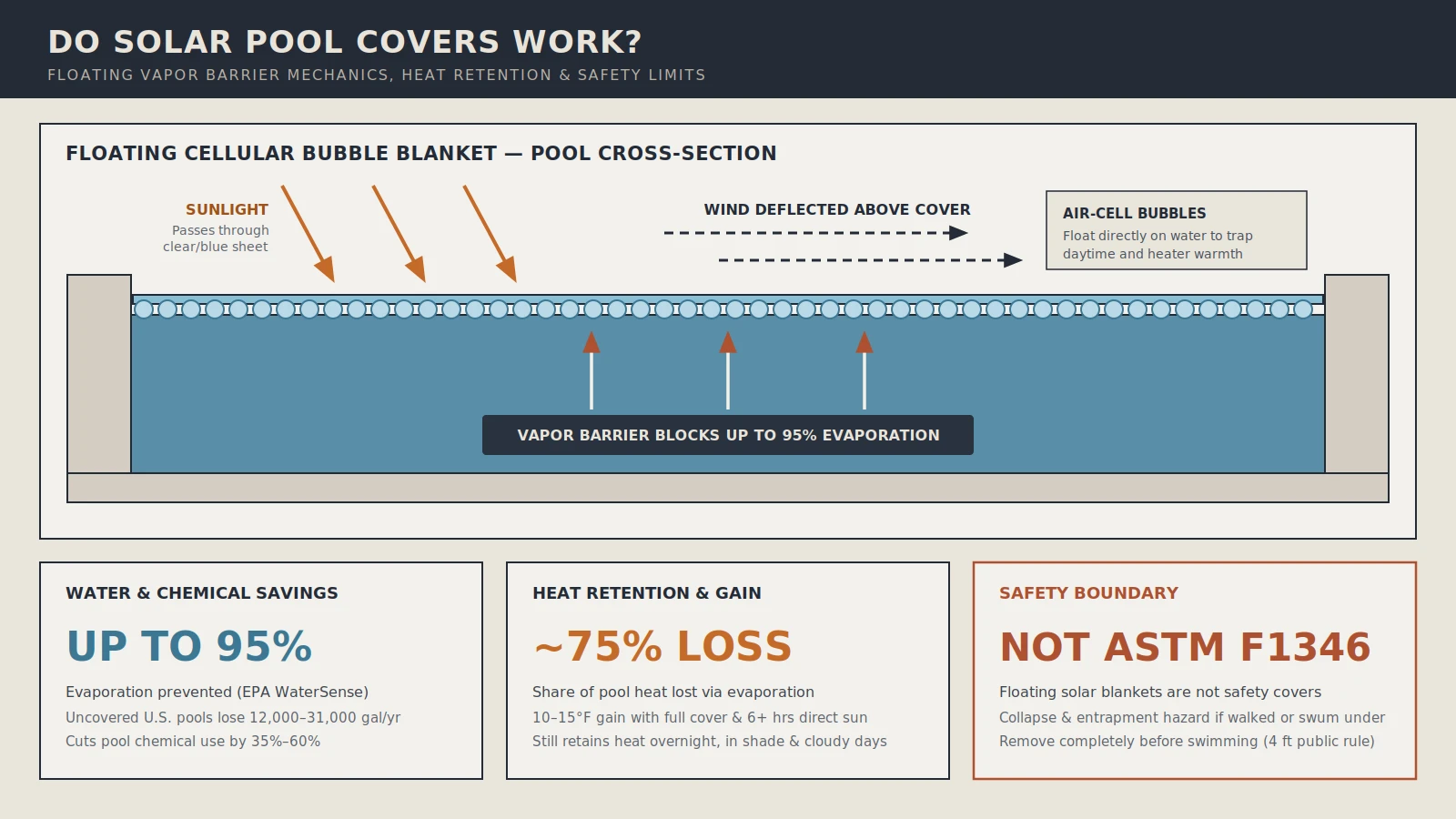
Yes, solar pool covers work primarily by floating on the water to block up to 95 percent of evaporation, which causes about 75 percent of pool heat loss. With full coverage and at least 6 hours of direct sun, bubble covers commonly add 10 to 15 degrees F, though they are not heaters in shade or safety covers.
How does a solar pool cover actually work?
A solar pool cover works mainly as a floating physical vapor barrier rather than an active heating appliance. Thousands of tiny air pockets—shaped like heavy bubble wrap—sit on the water surface to trap warmth while translucent or clear sheeting lets sunlight enter the pool.
According to U.S. EPA WaterSense pool cover guidance, consistent and appropriate use of a pool cover prevents up to 95 percent of pool water evaporation and helps the water retain heat, delivering water, energy, and cost savings. WaterSense estimates that a typical uncovered U.S. pool loses between 12,000 and 31,000 gallons of water to evaporation every year depending on location.
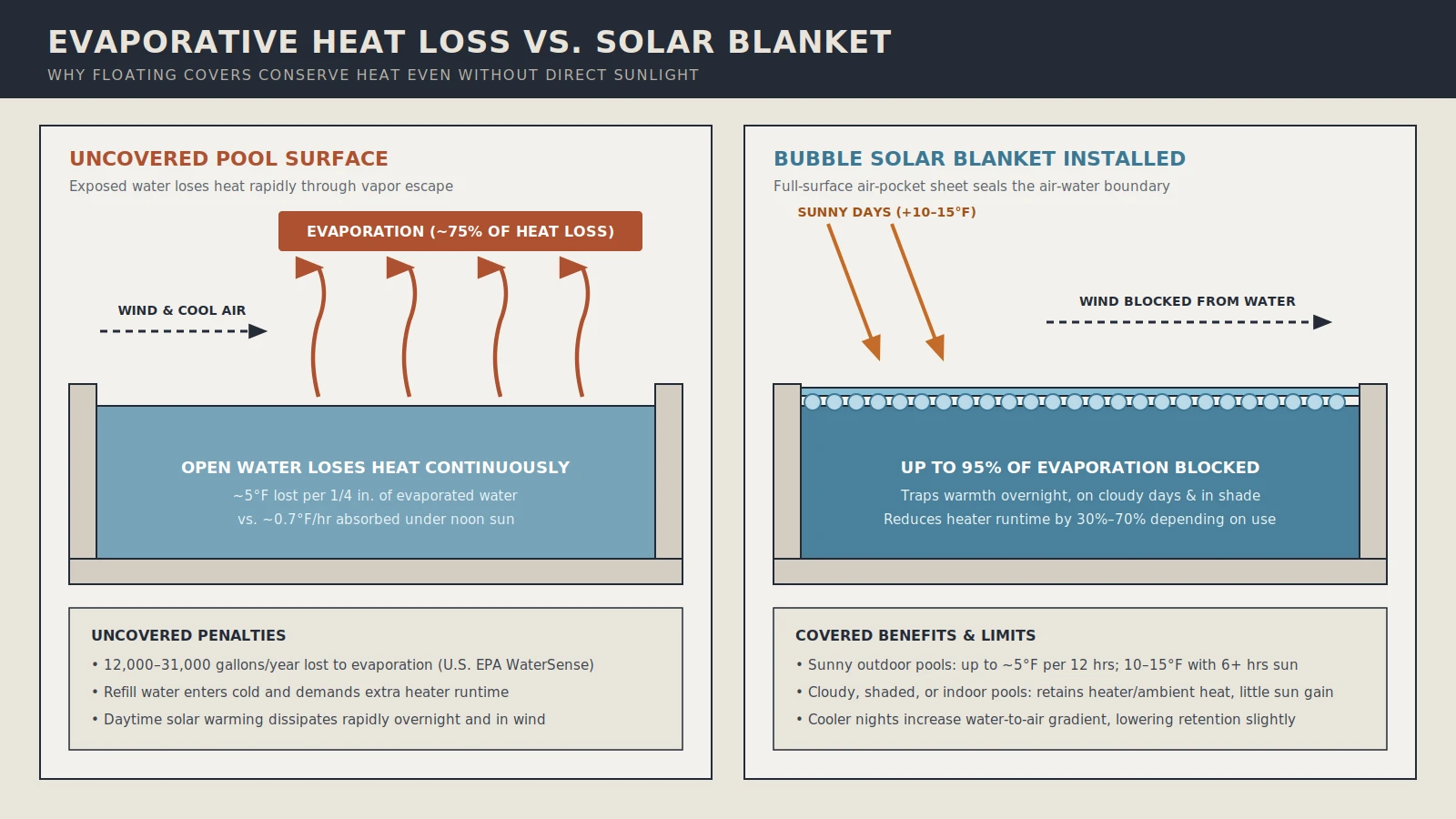
Stopping evaporation is why the cover changes water temperature so noticeably. Magen Eco-Energy reports that about 75 percent of a pool's heat loss comes from evaporation as warm surface water escapes into cooler or windy air. Swim University notes that an uncovered white plaster pool averaging 4.5 feet deep absorbs about 60 percent of solar energy—warming roughly 0.7 degrees F per hour under noontime sun—yet loses about 5 degrees F for every quarter-inch of water that evaporates.
Blocking the water surface also cuts routine chemical and cleaning demand. Sunplay notes that a solar blanket can reduce pool chemical consumption by 35 to 60 percent, and EPA WaterSense confirms that covers lower cleaning requirements and chemical use across indoor, outdoor, in-ground, and above-ground pools of almost any size or shape.
How fast do solar pool covers warm up pool water?
A full-surface bubble solar cover warms sunny outdoor water gradually over multi-hour and multi-day cycles rather than heating on demand. In The Swim reports that a completely covered pool receiving at least 6 hours of direct daily sunlight commonly gains 10 to 15 degrees F, depending on surface coverage and daily sunshine.
Sunplay cites up to 5 degrees F of warming per 12 hours of coverage and up to 12 degrees F total gain with clear solar covers, along with swimming pool heating cost reductions of up to 70 percent. Institutional measurements show substantial savings even with partial daily schedules: In The Swim cites a 2014 Colgate University study on the campus Lineberry pool covered 7 hours each night that recorded over 30 percent energy cost savings, and a 2012 Michigan Energy Office indoor pool case study at Chesaning Union Middle School that recorded a 50 percent reduction in energy use along with lower indoor humidity.
When paired with an active heater or rooftop collector, a floating blanket preserves overnight warmth so the morning starting water temperature stays higher. The U.S. Department of Energy guide Heat Your Water with the Sun notes that a pool cover or blanket reduces heat loss and maintains warm temperatures longer, and the DOE FEMP Solar Water Heating Federal Technology Alert identifies conserving generated heat with a pool cover as generally the most cost-effective investment alongside solar water heating. Magen Eco-Energy likewise notes that starting the morning warmer means solar collectors need less energy to reach target temperature.
Do solar pool covers work on cloudy days and in the shade?
Yes, solar pool covers still work on cloudy days, in full shade, and on indoor pools, because heat retention from blocking evaporation does not require direct sunlight. Without direct sun, passive temperature gain drops off, but the floating blanket continues to prevent warm water from evaporating into wind and cooler air.
Sunplay observes that a solar cover does most of its work overnight when air temperatures fall below the water temperature, and remains very effective on indoor pools that lose heat into cooler room air. Magen Eco-Energy similarly compares the cover to an overnight blanket that holds onto daytime warmth after air cools down.
Performance does decline as the temperature gap widens. In The Swim notes that evaporation and heat-loss reduction up to 95 percent depends on surface coverage and average nightly temperature; as nights turn colder and the differential between water temperature and air temperature increases, retention efficiency drops compared to mild nights, though covering still remains the best way to curb heat loss.
Scroll sideways to compare every column.
| Operating Condition | Passive Solar Warming | Evaporation and Heat Retention | Primary Limiting Factor |
|---|---|---|---|
| Full sun (at least 6 hours direct sun) | 10 to 15 degrees F typical cumulative gain; up to 5 degrees F per 12 hours | Up to 95 percent evaporation blocked with full surface coverage | Uncovered gaps around edges or steps reduce retention |
| Cloudy or overcast days | Minimal direct solar gain without direct sunshine | High retention by sealing water from wind and dry air | Little new solar energy added; holds existing warmth |
| Shaded yard or indoor pool | Little to no direct solar heating | High retention and lower indoor humidity (50 percent energy cut in Michigan school case) | Requires heater or ambient warmth to raise base temperature |
| Cool, windy nights | None after sunset | Most heat-retention work happens overnight against cool air | Larger water-to-air temperature differential lowers retention efficiency |
How do bubble solar covers compare to floating rings and liquid covers?
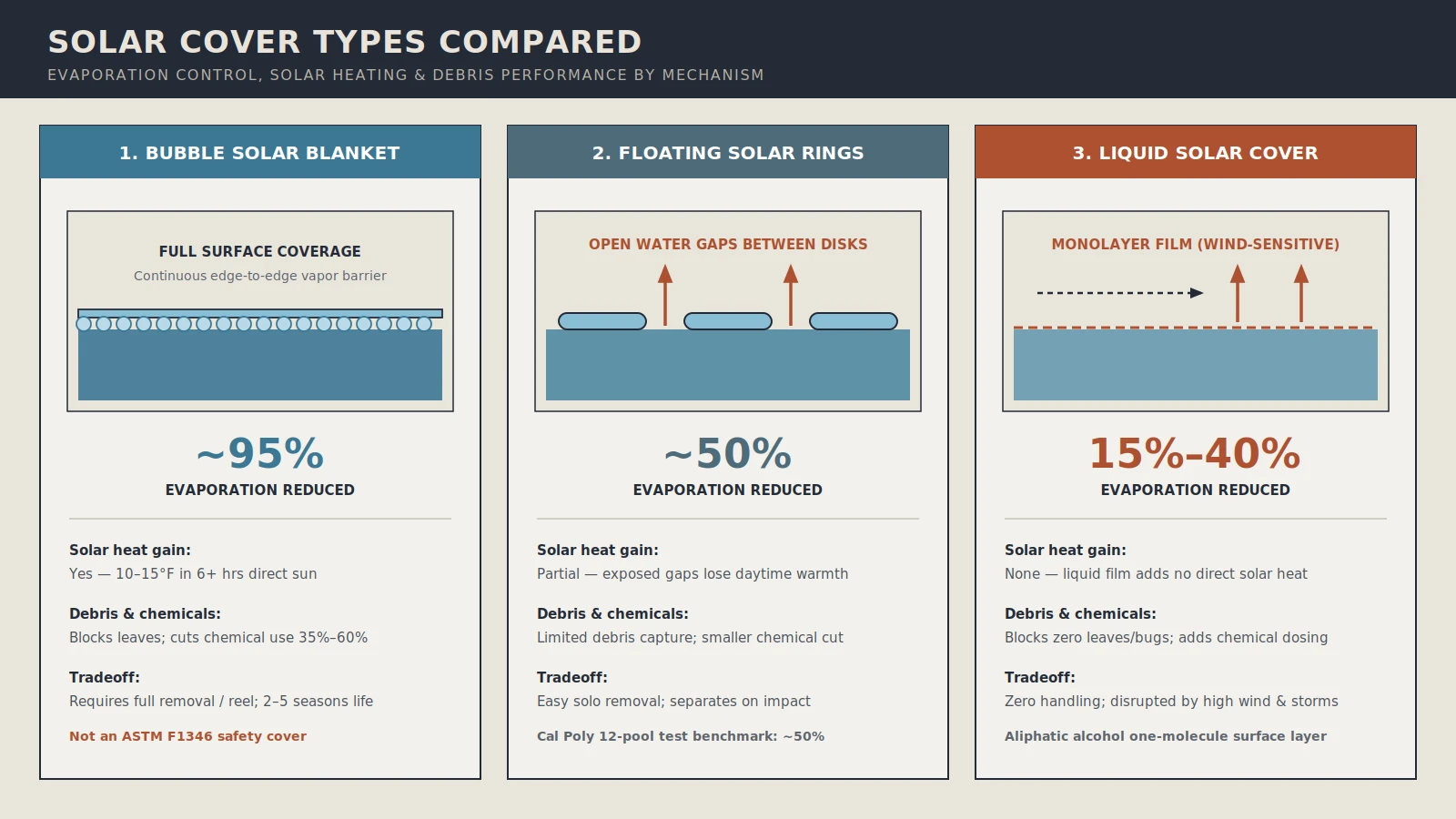
Full-surface bubble solar covers outperform both floating solar rings and liquid solar covers because evaporation control scales directly with uninterrupted surface coverage. In a 2016 Cal Poly study across 12 test pools summarized by In The Swim, automatic covers, solar bubble covers, and foam covers all achieved about 95 percent evaporation reduction, whereas floating solar rings reduced evaporation by about 50 percent because open water remains exposed between the circular disks.
Liquid solar covers trade performance for zero physical handling. Swim University explains that liquid solar covers use aliphatic alcohols to form a one-molecule-thick monolayer film across the water surface, requiring escaping water molecules to push through the molecular layer. Swim University reports about 15 percent evaporation reduction with liquid covers and notes they do not block leaves, bugs, or other debris.
Wind and storms further limit chemical films. In The Swim reports that liquid evaporation suppressants performed poorly during the windy 2016 Cal Poly test period, that other chemical-film studies have measured 20 to 40 percent evaporation reduction, and that liquid solar products do not add heat to the water. If rolling up a bulky full sheet is the main friction point, pairing a bubble cover with a hand-turned roller is covered in our manual and commercial pool cover reel systems guide.
Scroll sideways to compare every column.
| Cover Type | Evaporation Reduction | Passive Solar Heat Gain | Debris Barrier and Key Tradeoff |
|---|---|---|---|
| Bubble solar blanket | About 95 percent (Cal Poly 12-pool test) | Yes (10 to 15 degrees F in full sun) | Blocks leaves and bugs; requires full removal before swimming |
| Foam floating blanket | About 95 percent (Cal Poly 12-pool test) | Primarily heat retention | Full-surface barrier; bulky storage without a reel |
| Floating solar rings | About 50 percent (Cal Poly 12-pool test) | Partial; gaps lose daytime warmth | Easy solo removal; exposed water between disks limits savings |
| Liquid solar cover | About 15 percent (Swim University) to 20 to 40 percent in chemical-film studies | None (does not add solar heat) | No debris barrier; high winds and storms disrupt the monolayer film |
| Automatic track safety cover | About 95 percent (Cal Poly 12-pool test) | Primarily evaporation and heat retention | Key-operated and can meet ASTM F1346 safety standards when labeled |
Can you run a pool pump with a solar cover on, and how long can it stay on?
Yes, running your pool filtration pump while a floating solar blanket is on the water is completely safe, as noted by Swim University. Keep the cover on whenever the pool is not in use to maximize overnight and daytime heat retention, but pull it off completely before swimming, before shocking the pool, or whenever water overheats.
Three operating limits govern how long a solar cover can stay on continuously and how long the material lasts. In The Swim recommends removing the cover before super-chlorinating to prevent chemical damage and removing it whenever water temperatures climb above 90 degrees F to prevent overheating and shortened cover life. Swim University also notes a chemistry tradeoff with clear blankets: sunlight UV passing through clear film burns off unstabilized chlorine unless cyanuric acid stabilizer is maintained. Broader sanitizer degradation mechanics are detailed in our pool chemistry and cover damage guide.
With regular care, In The Swim estimates most solar covers last 2 to 5 seasons, while Magen Eco-Energy and Sunplay cite roughly three years before disinfecting chemicals and constant sun exposure require replacement. Flaking plastic and bubbles losing their shape indicate end of service life. When storing a cover off the water for more than a day, keep it in the shade or under a protective sheet to prevent UV degradation; routine seasonal habits live on our pool cover maintenance hub.
What are the safety limits of a floating solar pool cover?
A floating solar pool cover is strictly an evaporation and heat-retention blanket and is not a safety cover. San Bernardino County public pool cover guidelines state explicitly that floating pool covers are not safety covers, and Sacramento County pool cover guidelines warn that floating blankets can appear as a solid surface to children or animals who may walk onto them and become trapped in the collapsed sheet.
Sacramento County further warns that drowning incidents have occurred when bathers swim under a partially removed floating cover, become disoriented, and cannot come up for air. For public pools, both Sacramento County and San Bernardino County require floating covers to be completely removed, rolled up, and stored at least four feet away from the pool whenever the pool is open.
By contrast, ASTM F1346 (historical edition F1346-91R18 alongside active F1346-23) establishes performance tests for safety covers intended to inhibit water access for children under five years of age when properly installed and used, along with marking requirements for all pool covers. If child-access protection is part of the job, review our ASTM F1346 safety cover guide, compare track-driven systems in how automatic pool covers work, or start at the pool cover buying guide.
What should you verify for reliable daily solar cover results?
Consistent coverage drives almost all of the water, heat, and chemical savings from a solar blanket. Use the checklist below to keep daily operation effective and within safe boundaries:
- Cover the pool overnight and during windy periods, when about 75 percent evaporative heat loss peaks against cooler air.
- Trim the blanket for full wall-to-wall surface coverage, since open gaps drop evaporation control from roughly 95 percent down toward the 50 percent range seen with floating rings.
- Keep the filtration pump on its normal schedule with the cover installed, and maintain cyanuric acid stabilizer when using a clear cover that transmits UV rays.
- Remove the solar blanket before super-chlorinating or shocking the pool, and uncover the water if temperatures rise above 90 degrees F.
- Remove the cover completely—never leave it partially folded on the water—before anyone enters the pool, and store it in the shade or under a protective sheet whenever it stays off the pool for more than a day.
- Replace the blanket once the plastic begins flaking or the air bubbles lose shape; with regular care, most solar covers last 2 to 5 seasons.
Sources
Evaporation figures, energy-conservation guidance, safety standards, and operational limits in this guide reference the following public-agency, standards, and industry documentation:
- U.S. Environmental Protection Agency WaterSense: Pool Covers — Up to 95 percent evaporation reduction, 12,000 to 31,000 gallons annual uncovered loss, and heat-retention benefits
- U.S. Department of Energy EERE: Heat Your Water with the Sun — Pool cover and blanket heat-loss reduction alongside solar pool heating
- U.S. Department of Energy FEMP: Solar Water Heating Federal Technology Alert — Heat conservation with swimming pool covers as a cost-effective investment
- Sacramento County Environmental Management Department: Pool Cover Guidelines for Public Pools — Collapse and underwater entrapment hazards and complete removal with four-foot storage
- San Bernardino County Environmental Health Services: Guidelines for Use of Pool Covers on Public Pools — Floating blanket definition and non-safety-cover classification
- ASTM International: Standard Performance Specification F1346 (F1346-91R18 and Active F1346-23) — Safety-cover performance tests for children under five and marking requirements for all covers
- Magen Eco-Energy (Solar Pool Cover Heating Guide) — 75 percent evaporative heat-loss share, overnight blanket retention, and three-year service life
- Sunplay (Pool Solar Cover FAQs) — Air-pocket insulation, up to 70 percent heating-cost reduction, 5 degrees F per 12 hours, 35 to 60 percent chemical reduction, and wear indicators
- In The Swim (Solar Cover Effectiveness and Care Guides) — 2016 Cal Poly 12-pool evaporation test, 2014 Colgate University and 2012 Michigan Energy Office studies, 10 to 15 degrees F sunny gain, 90 degrees F removal threshold, and 2 to 5 season lifespan
- Swim University (Solar Pool Covers Guide) — Noon solar absorption vs. quarter-inch evaporation loss, pump operation safety, cyanuric acid UV tradeoff, and liquid monolayer evaporation testing
Questions
- Do solar pool covers work on cloudy days?
- Yes. While overcast skies limit passive solar warming, a solar cover still acts as a floating vapor barrier that blocks up to 95 percent of evaporation and prevents wind and cool air from stripping existing heat out of the water.
- Does a solar pool cover work in the shade or on an indoor pool?
- In shaded yards and indoor pools, a solar cover adds little or no direct solar heat, but it remains highly effective at conserving warmth from a pool heater, curbing water loss, and lowering indoor humidity.
- Can you run a pool pump with a solar cover on?
- Yes. Running the pool pump and filtration cycle with a floating solar blanket on the water is safe and keeps water circulating while the cover blocks leaves and debris.
- When do you have to take a solar pool cover off?
- Remove the cover completely before anyone swims, before super-chlorinating or shocking the pool to prevent chemical damage, and whenever water temperature climbs above 90 degrees F.
- How long do solar pool covers last?
- With regular care and shaded off-pool storage, most bubble solar covers last 2 to 5 seasons (about three years on average). Flaking plastic and flattened bubbles signal that replacement is due.
Parent hub: Pool cover buying guide