Updated October 2026
How Automatic Pool Covers Work
Holding the key on a stalled automatic pool cover can damage the fabric, the ropes, and the drive. An automatic pool cover works by turning reels so a leading-edge bar travels the length of the pool inside side guides, while the water under the fabric carries the sheet between those guides.
An automatic pool cover travels when a reel pays the fabric out or takes it up, and ropes or webbing pull the leading-edge bar along two guides. The Cover-Pools T4 Versa component diagram names the main tube, reels, cover fabric, gliders, leading edge, and track pulleys. The key switch, toggle, or CoverLink pad chooses a direction. Stops end the run. Coverstar's Standard Topguide checklist runs ropes through the guides onto the rope reels and pins the fabric to the leading edge, flush with the tube ends. The water surface is part of that travel. The T4 Versa owner's manual says the cover supports weight and runs properly only when the pool stays at normal operating level. Every number below is tied to the document beside it and applies to that system.
| Input or item | Typical value or source | Why it matters |
|---|---|---|
| Electric drive, Cover-Pools 800024 | 3/4 hp motor with slip clutch, 120 VAC, 15 A dedicated GFCI | The motor turns the reel. The key selects direction. |
| Hydraulic option, same overview | Pump unit, two 1/2 in. hoses, hydraulic motors above ground | Fluid reaches a motor at the housing. The pack still needs its own circuit. |
| Rope left on the reel, Coverstar top guide | 8 ft left on the rope reel in the install checklist | Leftover rope is part of a finished rope path on that checklist. |
| Water sitting on the fabric | 8 lb per gallon, Cover-Pools 800235 page 12 | Standing water is a load. The same manual says not to run the cover with water on it. |
| Guide rectangle, Cover-Pools recessed layout | AB = CD and AD = CB, tracks at 90° to the mechanism | The leading edge stays square only if the guides are the rectangle that layout requires. |
The reel pulls a bar along the guides
The visible sheet is the fabric. The motion is at the housing and at the edges. Cover-Pools draws a main tube and reels at the housing, fabric across the water, gliders in the tracks, a leading edge at the front, and pulleys at the track ends (T4 Versa owner's manual, 800235 REL-0001, cover components, printed page 6). Coverstar's Standard Topguide checklist splits the same jobs: ropes run through the guides, ropes attach to the reels, the leading-edge inserts move freely for the whole pool length, and the fabric is pinned to the leading edge flush with the ends of the tube (Installation Guide, checklist).
Stops are part of the run, not a guess at the key. On Cover-Pools undertrack systems the operator releases the control a few inches before the end, lets the cover coast, then closes until the front taps the end wall. On universal track systems the cover stops within 2 to 3 inches of the track end and does not close against the pulley castings. For most undertrack models the leading edge rests halfway across the pool end wall. On universal track models it stops before the mechanism housing (800235, operating instructions, printed page 7).
When an auto-shutoff is installed, it stops the motor at the fully covered and fully uncovered positions. An adjustable amp limit also stops the motor when the draw rises. The manual names that resistance: water on the cover, dirt or contamination in the tracks, or something damaged on the system (800235, printed pages 8 and 14). After a power interruption the shutoff sequence is not restored until the cover has been run a few feet in the correct direction. Until then, the manual says, it is possible to overrun the cover.
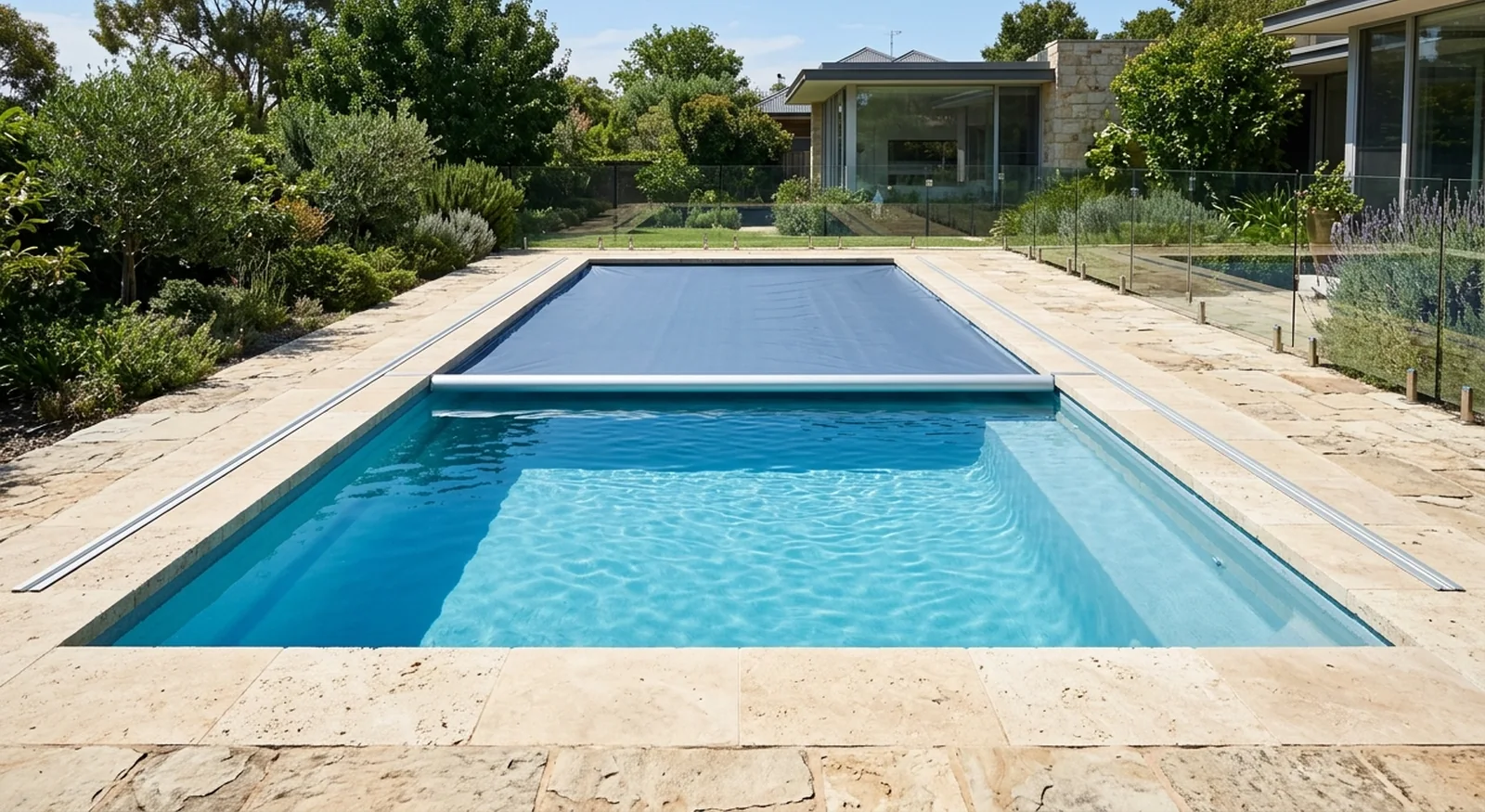
Takeaway: name the reel, the two guides, and the leading edge before anyone treats a mid-pool stop as a motor replacement.
Electric and hydraulic drives turn that same path
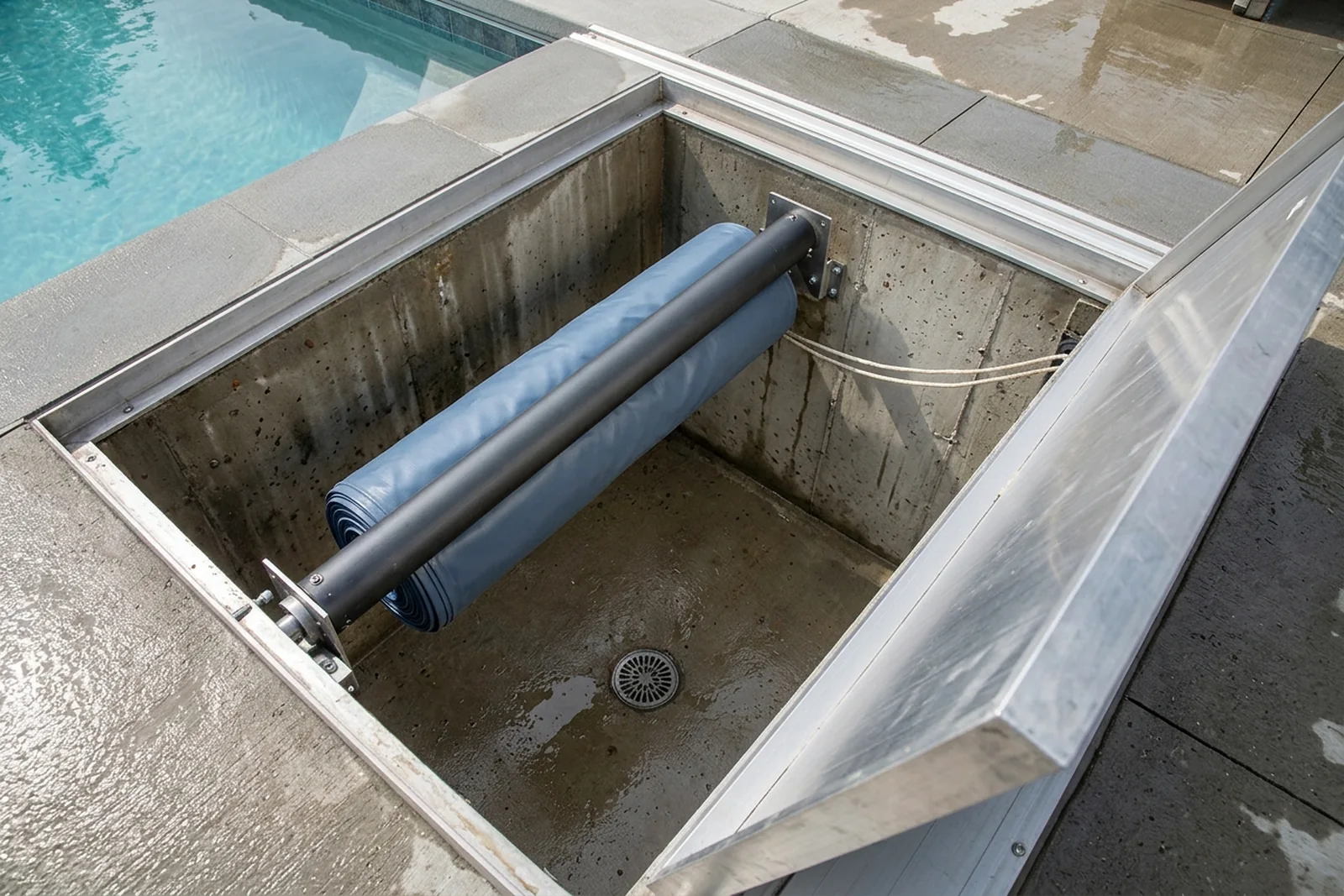
Cover-Pools 800024, the Save-T 3 / Autosave general installation overview, shows two ways to turn the mechanism. Standard equipment is a 3/4 hp electric motor with a slip clutch, supplied from a 120 VAC 15 A dedicated GFCI breaker. The switch is mounted in full view of the cover. The optional hydraulic system uses a pump unit, two 1/2 in. hoses, and hydraulic motors mounted above ground level. The sheet calls these minimum recommendations and says the diagrams are general information, so the matched installation instructions still govern the unit (800024, electrical section). Coverstar's top-guide checklist states the same split in one line: adjust the torque limiter for the pool, and if the mechanism is hydraulic, set both bypass valves slightly higher than necessary to run the cover.
| Drive layout | What moves at the pool | Dominant failure mode and prevention |
|---|---|---|
| Electric motor at the housing | The motor turns the reel. A slip clutch is part of the Cover-Pools standard layout. | A stall from water on the fabric or debris in the guides. The amp limiter is there to open the motor circuit. Clear the water and the track before another run. |
| Hydraulic pack away from the water | Hoses feed a hydraulic motor at the housing. | A crushed hose or a bypass set off the value for that pool stops travel. Cover-Pools calls for sweeping bends and no sharp bends in the hose conduit. Coverstar's checklist sets both bypass valves for that mechanism. |
| Either drive, past the end stop | The bar keeps traveling after the water ends. | Overrun after a power cut, or a hard hit on the pulley casting. Use the stops and the soft-stop method in the matched manual. |
The choice of pack room versus a dry motor space is the comparison on hydraulic vs electric pool covers. Feeder, switch sightline, and vault drainage are on automatic pool cover electrical requirements. Guide hardware is on the track mechanisms and drives guide.
Water under the sheet carries the fabric
The T4 Versa manual states the condition in one place: the cover's ability to support weight and to operate properly depends on keeping the pool water at normal operating level. Run over a low or empty pool, the cover will not support itself in many cases, and low water increases friction (800235, printed page 10). The winter section gives the failure that follows. Without water underneath, tracks can pull off, the cover can tear, or other damage can occur. Keep the same water level all year. In winter, inspect it at least monthly, because ice or snow on top can make the water look normal while the pool is low (printed page 12).
Rule of thumb: if collected water exceeds 0 gallons on top of the fabric, stop and leave the key out. Page 9 says never to run the cover with water on it, because damage can occur to the fabric and the mechanism. Each gallon of that water weighs eight pounds (page 12). The level under the sheet is the normal operating level for that pool. This manual does not publish one universal inch mark below the tile. Record the commissioned level on the pool water level guide.
The two guides have to be the rectangle the manual requires
Cover-Pools requires a true rectangle for a recessed mechanism, whether the guide is underside track or a deck-mounted track. AB = CD, AD = CB, and the tracks are perpendicular to the mechanism at 90°. Corners on the finished tile line or coping are square, with no radius (800024, excavation and plumbing). Coverstar's top-guide checklist uses a different tolerance. An inch or two out of square is not uncommon and is not a concern for operation of that cover, because the fabric roll and changes in operating conditions can shift alignment slightly (0903 checklist). Use the sentence that belongs to the mechanism on the deck. Do not average the two documents into one allowance.
Gliders or wheels stay in the guide. SnapTop track in the Cover-Pools overview uses gliders or wheels (800024, track options). Dirt in the channel wears the cover edging and the anodized coating. The T4 manual says to retract the cover and flush the track with water only, twice a season, and more often for a year-round pool or a sandy or windy site. Do not grease the cable, the webbing, or the tracks (800235, pages 10 and 11). A worn pulley at the track end makes a clicking or grinding sound and can break the rope. Cover-Pools writes that those pulleys usually last about three years (page 10). That life note is theirs, for that pulley, not a universal part life.
The guide families themselves are compared on pool cover track systems. Flushing procedure is on how to clean pool cover tracks.
Worked example: one inch of water on a 20 by 40 foot sheet
Cover-Pools states the unit weight used here. Each gallon of water on the cover weighs eight pounds (800235, page 12). The 20 ft by 40 ft area and the 1 in. depth are assumptions for the arithmetic. They are not a measured load on a built pool. One cubic foot of water is taken as 7.4805 US gallons.
Weight = 498.7 * 8
Worked example. Area = 20 ft × 40 ft = 800 ft². Depth = 1/12 ft. Volume = 800 × 1/12 = 66.667 ft³. Gallons = 66.667 × 7.4805 = 498.7 gal. Weight = 498.7 × 8 = 3,989.6 lb.
Cover-Pools builds extra slack into the sheet for rain and snow, so a real cover is not a flat tank and the puddle volume is smaller than this full-sheet film. The eight pounds still apply to every gallon that remains. The same page says the fabric shrinks 1 to 2 percent, which can equal 3 to 4 inches on a 20-foot-wide cover. A replacement sheet is cut to the measured guides, not to the memory of last year's width. Fabric identity belongs with automatic pool cover parts.
A forced run spends the parts the key does not show
Later cost shows up as service hours and replacement parts. This page does not price them.
Water left on the sheet is eight pounds per gallon, and a run with that load is the case the manual says can damage fabric and mechanism. Pump the water off first. Use water on an automatic pool cover and the cover pump guide.
Low water under the sheet raises friction, and the cover will not support itself over a low or empty pool in the cases the manual describes. Holding the key on that stall heats the motor. The T4 motor has an internal thermal overload that resets when the motor cools. Cooling does not repair a bent guide. Check the operating water level before a second attempt.
A dirty track wears edging and anodizing, and the cover runs unevenly. Flush it with water, using how to clean pool cover tracks. A clicking pulley is a rope-path problem before it is a motor problem. Start from automatic pool cover parts.
A bar that arrives crooked means one guide is dragging or the rectangle no longer matches the commissioned layout. Stop the key. The owner checks are on crooked travel and the repair hub.
Housing water is separate from water on the fabric. The T4 motor is described as waterproof for short submersion, not for hours in a pit with a blocked drain. Keep the housing drain clear, and keep the lid on. The next page for that pit is pool cover box and housing.
The map for the whole system is automatic pool covers.
Common questions
Why does the Cover-Pools auto-shutoff key take two turns?
The auto-shutoff keyswitch in the T4 Versa manual requires two motions before the cover will run. Turn the key to cover or uncover for 1 second, return briefly to off, then operate within 4 seconds. If the switch sits for more than 20 seconds it times out and needs the two turns again (800235, printed page 7). A CoverLink pad uses a four-digit PIN instead of that key sequence. Match the control that is on the wall.
Does the ASTM F1346-91 line make every automatic cover safe to walk on?
The T4 Versa manual says Save-T covers comply with the applicable requirements of ASTM F1346-91. The same warnings say not to walk on the cover except in an emergency, and to remove standing water because a child can drown on top of the cover (800235, opening warnings and printed page 7). That compliance sentence is about Save-T covers in that manual. It is not a walk rating for every automatic system. Read the matched manual and the ASTM F1346 pool safety cover page before treating a cover as a deck.
What should happen when the cover stops in the middle of the pool?
The T4 manual names water on the cover, dirt in the tracks, or damage on the system. Remove the water and debris, then try the reverse direction. If the cover moves, continue. If it will not move in the intended direction, stop and call the service technician (800235, printed page 8). Holding the key in the stalled direction is the overrun the amp limiter is built to interrupt.
Sources and method
Updated October 2026. This page explains the travel path of an automatic pool cover from public manufacturer manuals. It is an independent technical reading. It is not a field test, a product ranking, or a substitute for the manual that matches the mechanism on a given pool.
- Cover-Pools Incorporated, T4 Versa Owner's Manual, 800235 REL-0001, fetched 17 October 2026 from https://www.coverpools.com/wp-content/uploads/2020/08/800235-T4-Versa-OWNERS-MANUAL.pdf. Printed pages 6 through 12 and 14: component names, soft stop, auto-shutoff and amp limiter, the ban on running with water on the cover, normal operating water level, 8 lb per gallon, track flushing, pulley service note, and fabric shrink of 1 to 2 percent (3 to 4 inches on a 20-foot-wide cover).
- Cover-Pools Incorporated, General Installation Overview, 800024, fetched 17 October 2026 from https://www.coverpools.com/wp-content/uploads/2016/11/800024-PUBL-GENERAL-INSTALLATION-OVERVIEW.pdf. Track options and the electrical section: rectangle AB = CD and AD = CB, 3/4 hp slip-clutch motor, 120 VAC 15 A dedicated GFCI, and the hydraulic pump, 1/2 in. hoses, and above-ground hydraulic motors.
- Coverstar, Standard Topguide Installation Guide, file 0903.pdf, fetched 17 October 2026 from https://ellispoolcovers.com/wp-content/uploads/2020/05/0903.pdf. Installation checklist: rope path, 8 ft of rope left on the reel, torque limiter or hydraulic bypass valves, leading-edge inserts, and the inch-or-two alignment note for that guide.
- Cover-Pools, Leading Edge component page, fetched 17 October 2026 from https://www.coverpools.com/pool-professional/components-and-technology/leading-edge/. Used for the published job of the bar: it guides the cover across the water. Width limits and marketing deflection claims on that page are catalog limits for named extrusions and are not used as a general travel rule here.
The local industry library had no pool-cover mechanism document for this topic. The manuals above are the primary text.