Updated November 2026
Manual Pool Cover Rollers and Commercial Reels: Tube Sag, Safety Limits, and Deck Storage
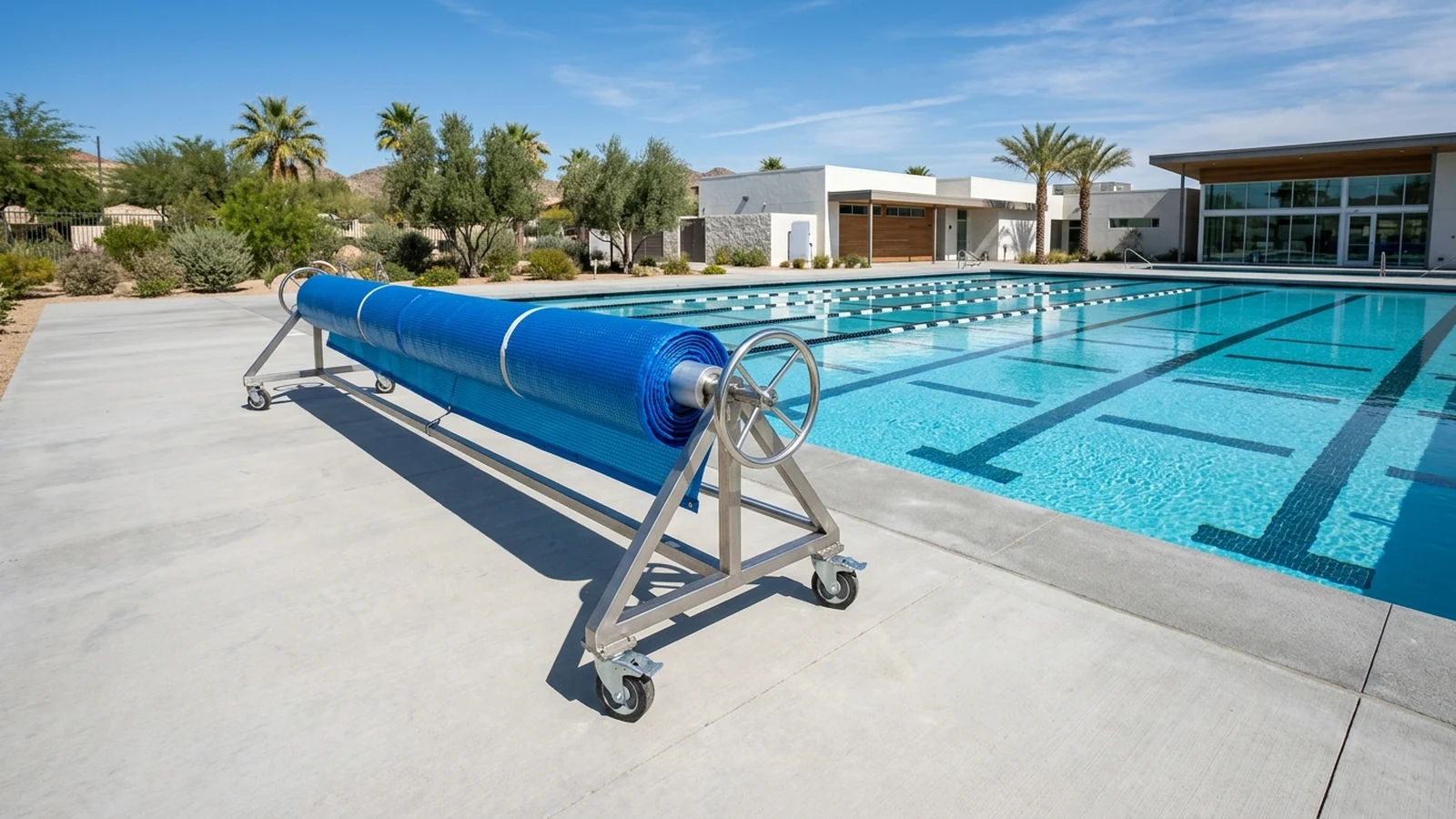
A manual pool cover roller is the hand-turned tube that winds a floating solar cover, bubble cover, or blanket off the water to prevent heat loss, water evaporation, and debris in the pool. A floating blanket is not an ASTM F1346 safety cover, a manually installed pool cover does not relieve the barrier requirement, and public-pool guidelines require the cover to be completely removed, rolled up, and stored at least four feet away from the pool when the pool is opened. On existing or commercial pool decks without space for a recessed pool cover box and housing, sizing a manual pool cover reel depends on bearing span L, uniform wet blanket load W = wL, hollow-tube inner radius r1 and outer radius r2, and mid-span beam deflection 5WL^3/384EI.
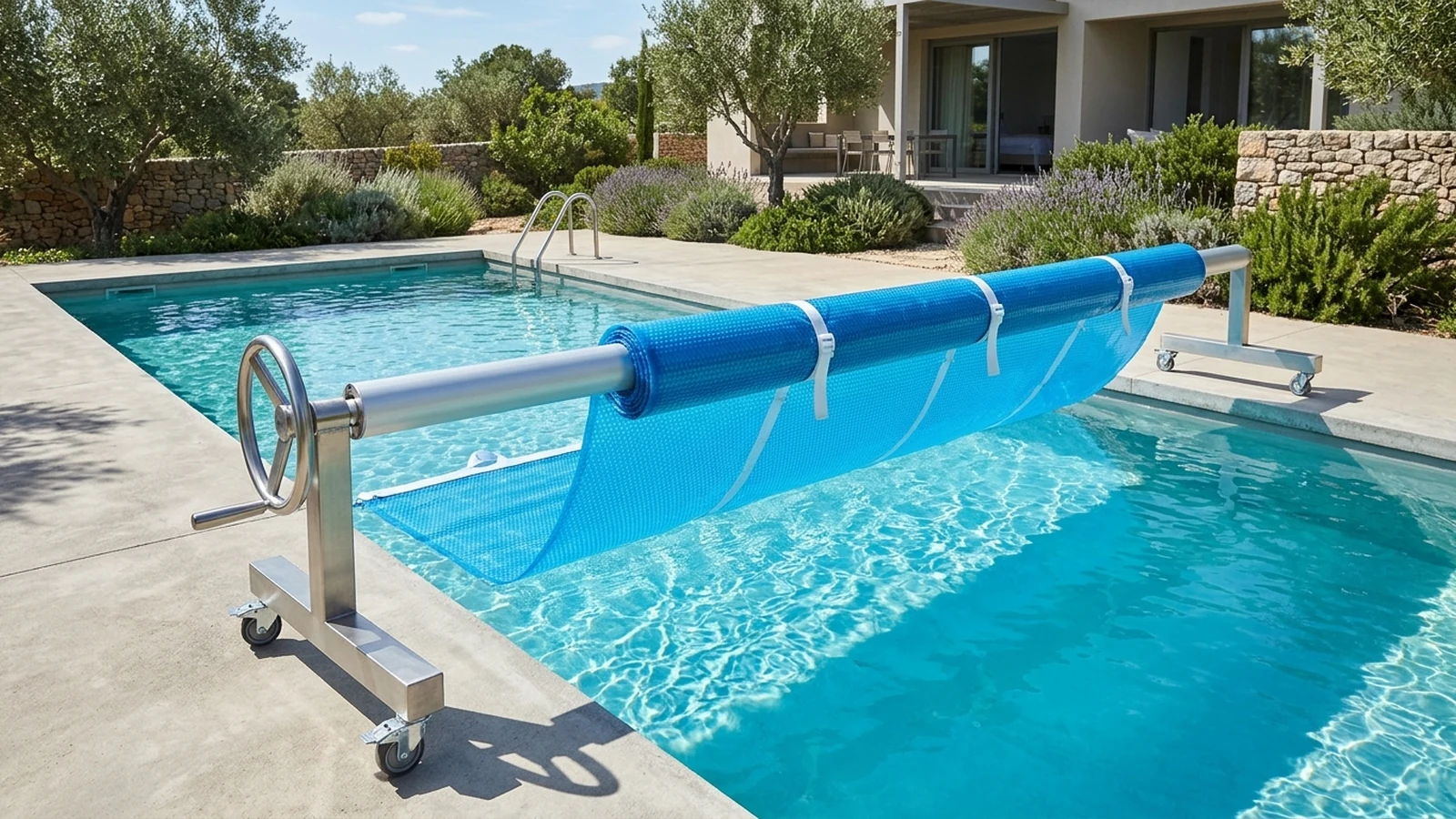
How Do You Check Mid-Span Tube Sag on a Manual Pool Cover Roller?
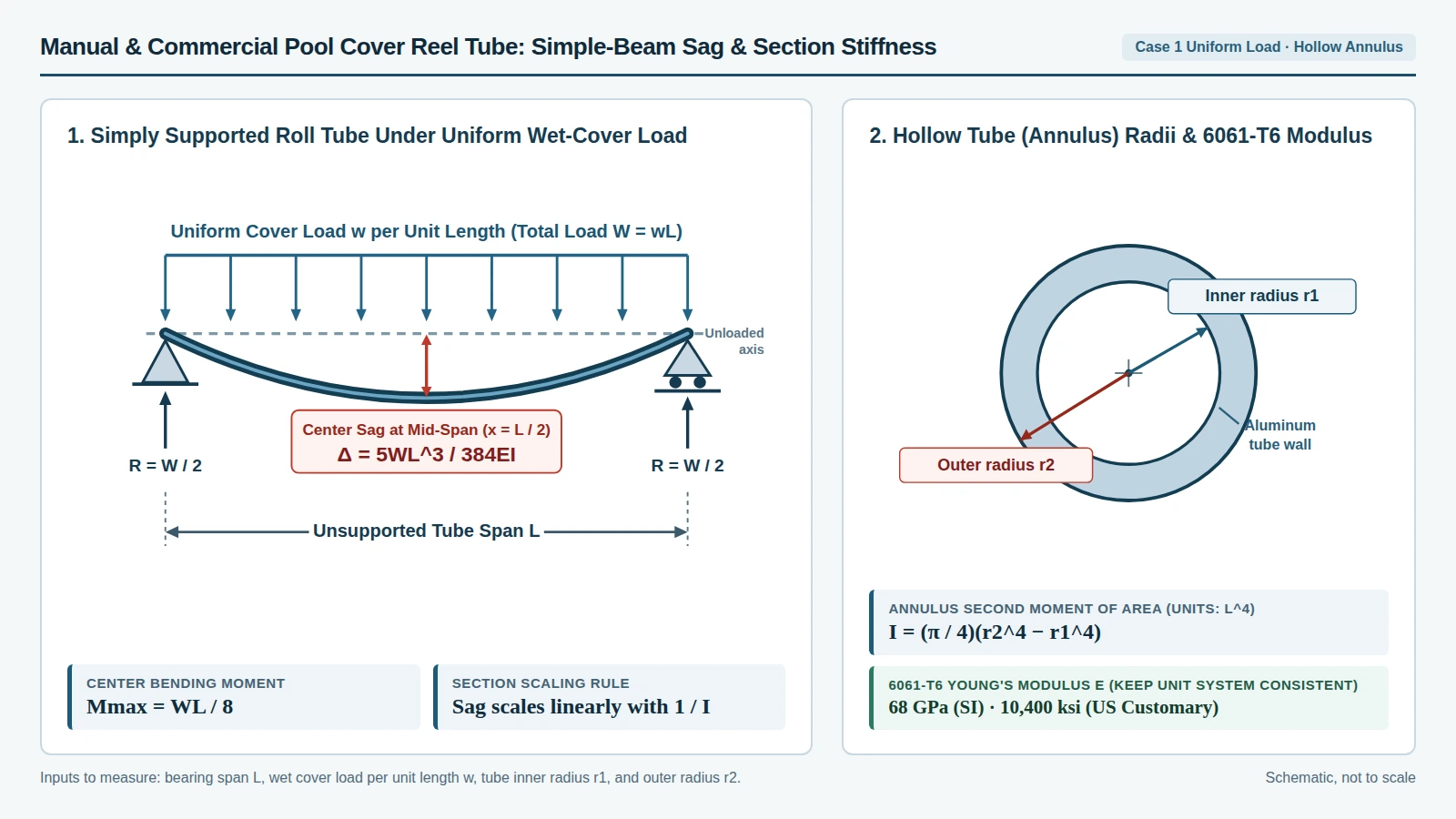
When a commercial pool cover reel or residential manual roller carries the wet blanket between two supports, use the simply supported beam case for that span.
In the University of Illinois simple-beam Case 1 formulas for a uniformly distributed load w across span L, total load on the tube is W = wL, center bending moment is WL/8, and center deflection at mid-span is 5WL^3/384EI.
Those beam notes show that mid-span deflection scales linearly with 1/I, so set I to a candidate tube section and read the deflection directly.
As defined in the second moment of area reference, the second moment of area I (also called area moment of inertia) is a geometric cross-section property with dimension length to the fourth power, L^4, and should not be confused with mass moment of inertia.
For a hollow circular tube (annulus) of inner radius r1 and outer radius r2, the second moment of area is I = (pi/4)(r2^4 - r1^4), evaluated from the supplier's inner and outer tube radii.
Pair I with the elastic modulus E of the selected aluminum alloy in matching units: University of Arizona optical-mechanics notes list aluminum 6061-T6 with Young's modulus E = 68 GPa in SI units, while the Missouri S&T material properties table (from Gere and Timoshenko, Mechanics of Materials, 4th Ed., PWS Publishing, 1997, pp. 888-91) lists 6061-T6 with a modulus of elasticity of 10,400 ksi.
Keep a floating-cover roller tube separate from the front carrier bar on a motorized track cover: as explained in our guide to preventing leading-edge aluminum bar deflection, the aluminum bar across the front of an automatic pool cover is the leading edge, a dip in that bar is a separate fault from fabric sagging, and using a mismatched deflection number lets the leading edge hit the water at mid-span and stall the cover.
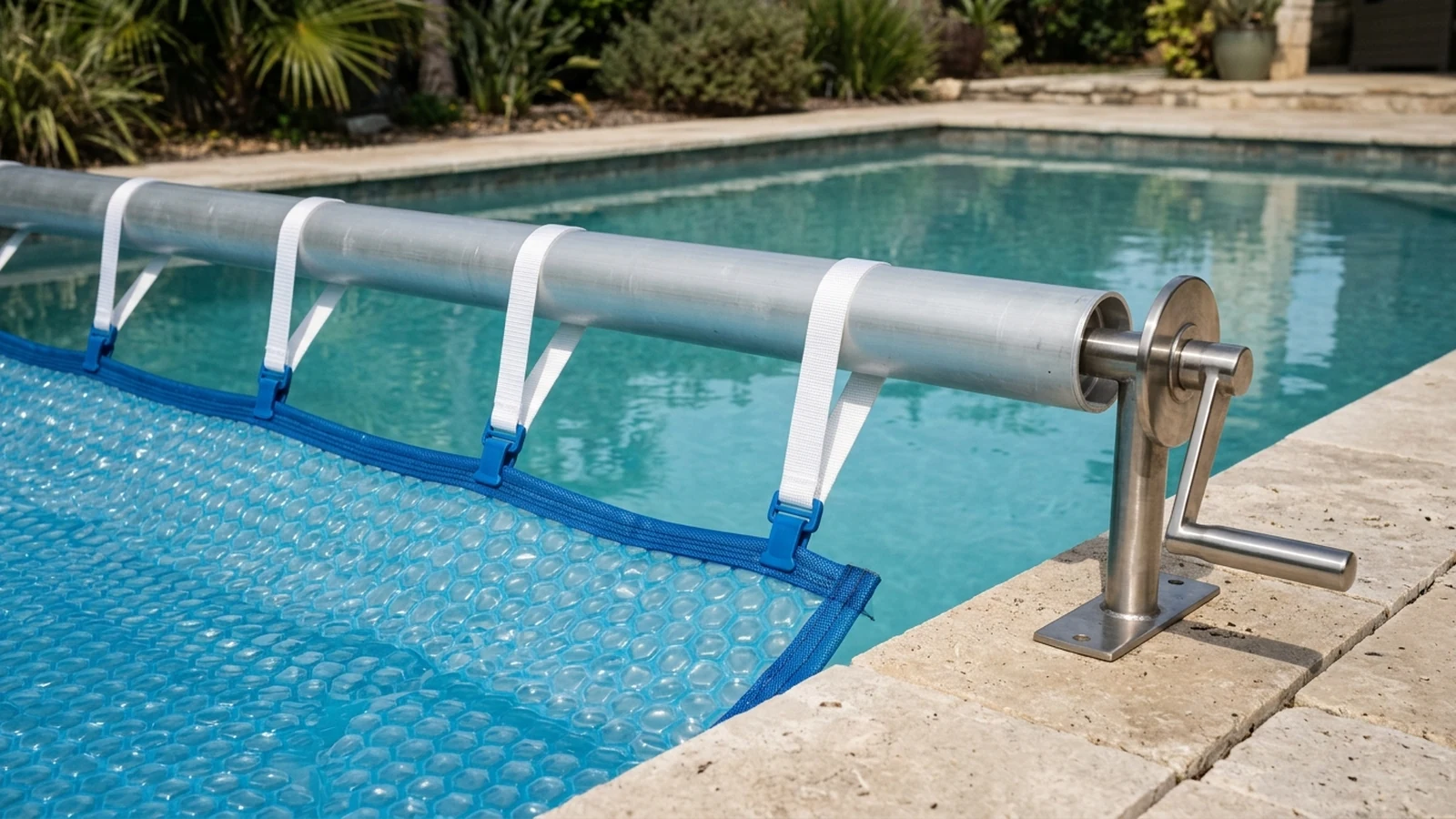
Is a Floating Blanket on a Manual Roller a Safety Cover or Fence?
No: a floating pool cover wound onto a manual roller is a heat-retention and evaporation blanket, not a safety cover or a code pool barrier.
Sacramento County Pool Cover Guidelines state that floating pool covers (referred to as solar covers, bubble covers, or blankets) float on top of the water, can be hazardous, and are not recommended because they can appear as a solid surface to children or animals that may walk onto them and become trapped in the collapsed sheet, and drowning incidents have occurred where bathers swim under a partially removed cover, become disoriented, and cannot come up for air.
Within thermal conservation scope, the U.S. Department of Energy consumer guide Heat Your Water with the Sun notes that a pool cover or blanket reduces heat loss and helps maintain warm temperatures for a longer period, and the DOE FEMP Solar Water Heating Technology Alert states that conservation of generated heat is generally the most cost-effective investment and swimming pool covers should be considered at the same time as a solar water heating system.
When a project requires child-access protection, our pool cover buying guide drops solar blankets immediately: under ASTM F1346 (listed as F1346-91R18 alongside active F1346-23), Section 1.1 establishes safety-cover requirements intended to inhibit water access for children under five years of age, and Section 1.2 includes safety-cover performance tests and marking requirements for all covers.
Safety covers may be manual or motorized (San Bernardino County quotes California Health and Safety Code Section 115921(d), defining an approved safety cover as a manually or power-operated safety pool cover that meets ASTM F1346-91), and our automatic vs. manual safety cover comparison distinguishes an automatic safety cover that opens on tracks with a key from a manual safety cover that stretches on deck anchors with springs and straps.
Even an anchored manual safety cover does not replace a perimeter fence: under ISPSC Section 305.1 Exception 2 in the Horry County pool barrier affidavit and ICC Building Safety Journal commentary on ISPSC Section 305.1, only a powered safety cover complying with ASTM F1346 (with the label on the fabric) exempts a swimming pool from Sections 305.2 through 305.7, including the Section 305.2.1 barrier top height of not less than 48 inches (1219 mm) above grade.
ICC Building Safety Journal commentary on ISPSC Section 305.1 adds that a nonpowered, manually installed pool cover does not provide relief from the barrier requirement because manual installation is time-consuming enough that the cover might not be put back on every time the pool is idle, and voluntary CPSC Safety Barrier Guidelines for Residential Pools likewise specify a power safety cover complying with ASTM F1346-91 when a dwelling wall serves as part of the pool barrier.
Scroll sideways to compare every column.
| Cover Hardware | How the Cover Operates | ASTM F1346 Safety Cover Status | ISPSC 305.1 Barrier Relief |
|---|---|---|---|
| Floating solar or bubble blanket on a manual roller | Floats directly on the water surface and is rolled up by hand | Not a safety cover; can collapse under children or animals and trap bathers swimming underneath | No relief from Section 305.2.1 48-inch (1219 mm) barrier requirements |
| Anchored manual safety cover | Stretches across deck anchors with springs and straps and comes off by hand | Can meet ASTM F1346 (cited edition F1346-91; F1346-23 is listed as Active) | No barrier relief because manually installed covers are nonpowered |
| Powered automatic safety cover | Opens and closes on tracks with a key switch using a housing, tracks, and drive | Complies with ASTM F1346 when labeled on the fabric and installed per instructions | Exempts swimming pools from ISPSC Sections 305.2 through 305.7 where adopted |
Where Must a Rolled Cover Sit Compared With a Cover Box?
On a public or commercial pool, a manual roller cannot leave a floating blanket overhanging the coping or partially rolled on the water while bathers use the pool.
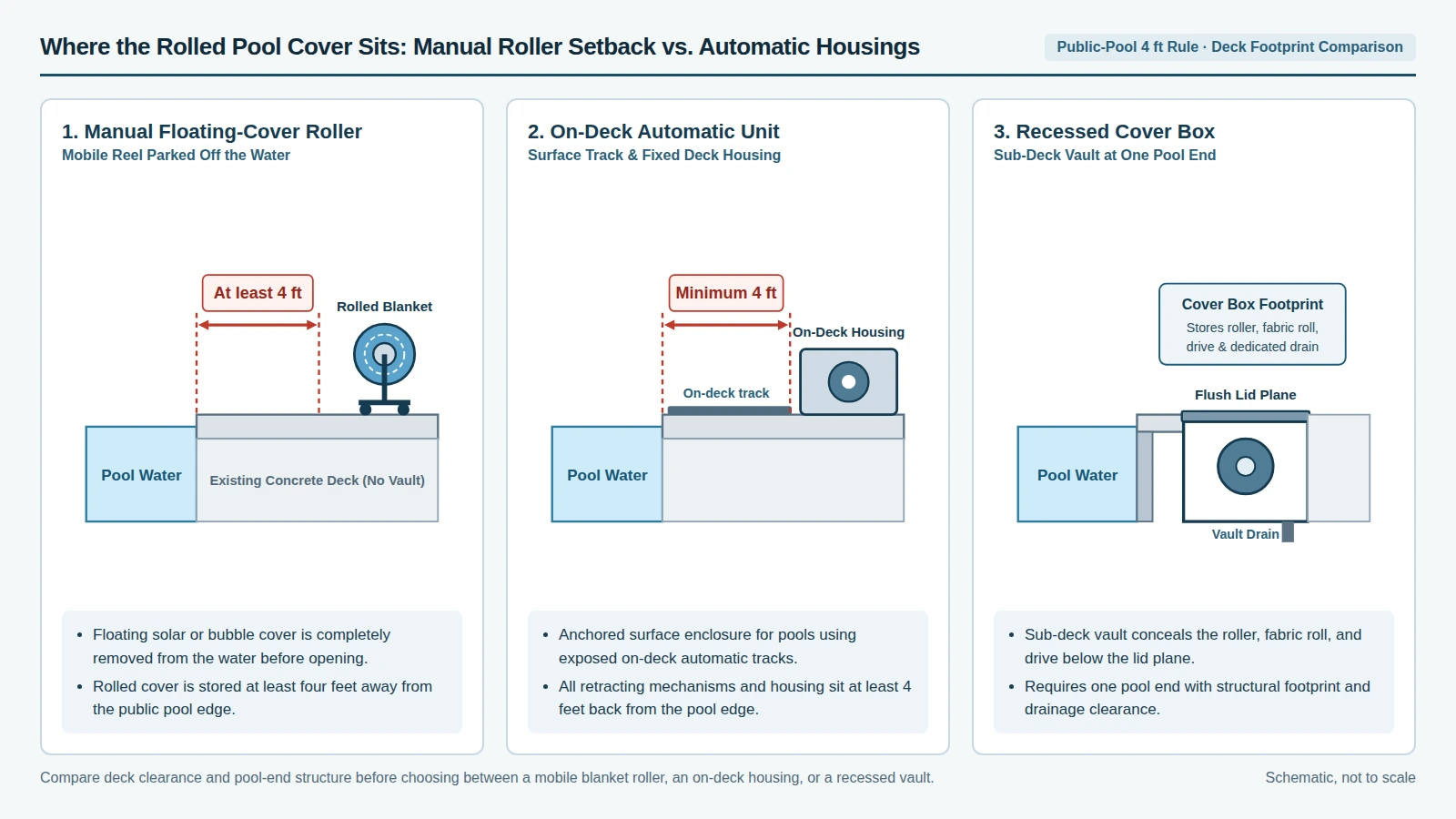
Sacramento County guidelines require that when the pool is opened, and San Bernardino County Guidelines for Pool Covers on Public Pools require that when a floating pool cover is not in use, the cover must be completely removed, rolled up, and stored at least four feet away from the pool.
San Bernardino County applies the same 4-foot clearance to non-floating public-pool hardware: manually removed stretch safety covers must be removed and stored at least 4 feet away before opening the pool, and on an on-deck automatic unit with on-deck track, all retracting mechanisms and their associated housing must sit a minimum of 4 feet back from the pool edge.
By contrast, a recessed automatic cover box is the vault at one end of the pool that stores the roller, fabric roll, and often the drive, under a lid plane whose length follows fabric width plus clearance and whose depth follows roll diameter, lid stack, and drainage.
Scroll sideways to compare every column.
| Storage Hardware | Where the Rolled Cover Sits | Public-Pool Edge Setback | Deck Structure Needed |
|---|---|---|---|
| Manual floating-cover roller (stationary or mobile) | Rolled off the water onto an exposed above-deck tube after complete removal | Stored at least four feet away from the pool when open or not in use | Clear deck parking zone at least four feet back from the pool edge |
| On-deck automatic unit with on-deck track | Inside an anchored surface housing paired with deck-mounted guide tracks | Retracting mechanism and housing located a minimum of 4 feet back from the pool edge | Finished deck anchoring zone for surface tracks and setback housing |
| Recessed automatic cover box | Inside the vault under the lid plane, with the roller, fabric roll, and often the drive | One end of the pool must be able to take that housing footprint | Length follows fabric width plus clearance; depth follows roll diameter, lid stack, and drainage |
What If an Existing Pool Deck Has No Space for a Cover Box?
An automatic cover requires at least one end of the pool to accept the housing footprint and drainage; when neither end of an existing deck can accept a housing and a drain, automatic track layouts are ruled out.
At that decision point, match the hardware to the protection requirement: choose an anchored manual safety cover with springs, straps, and at least 4 feet of off-pool storage clearance when an ASTM F1346 safety cover is required, or use a manual pool cover roller stored at least four feet away from the pool when the goal is strictly winding a floating heat-retention blanket off the pool.
If your deck can accept a housing, drain, and straight leading-edge travel, return to our pool cover track systems hub to compare undertrack guides hidden under coping, top track mounted on the deck, and recessed top track.
Before specifying a manual or commercial pool cover reel tube, verify five site and supplier measurements:
- Span L between the left and right reel supports across the pool or deck storage lane.
- Wet floating-blanket distributed load w per unit length along the tube, giving total load W = wL.
- Supplier tube inner radius r1 and outer radius r2 to compute hollow-annulus stiffness I = (pi/4)(r2^4 - r1^4).
- Tube alloy Young's modulus E in units matching L, w, and I (for 6061-T6 aluminum, 68 GPa in SI units or 10,400 ksi in U.S. customary units) for the 5WL^3/384EI center-deflection check.
- Unobstructed deck parking space at least four feet back from the pool edge so the floating blanket is completely removed and rolled off the water when the pool is opened.
Sources
Public-pool health regulations, pool barrier codes, energy conservation guides, and structural mechanics references cited in this guide:
- U.S. Consumer Product Safety Commission: Safety Barrier Guidelines for Residential Pools
- Sacramento County Environmental Management Department: Pool Cover Guidelines
- San Bernardino County Environmental Health Services: Guidelines for Pool Covers, Public Pools
- Horry County Code Enforcement: International Swimming Pool and Spa Code Section 305.1 Pool Barrier Affidavit
- International Code Council Building Safety Journal: International Swimming Pool and Spa Code Section 305.1 General Compliance Commentary
- ASTM International: Standard Performance Specification for Safety Covers and Labeling Requirements for All Covers for Swimming Pools, Spas and Hot Tubs, F1346-91R18 and Active F1346-23
- U.S. Department of Energy Office of Energy Efficiency and Renewable Energy: Heat Your Water with the Sun Consumer Guide
- U.S. Department of Energy Federal Energy Management Program: Solar Water Heating Federal Technology Alert
- University of Illinois Structural Mechanics Tools: Simple Beams Case 1 Uniformly Distributed Load
- Missouri University of Science and Technology: Mechanics of Materials Property Table (Gere and Timoshenko, 4th Ed., PWS Publishing, 1997, pp. 888-91)
- University of Arizona College of Optical Sciences: Optomechanical Materials Properties Table for Aluminum 6061-T6
- Wikipedia: List of Second Moments of Area (Hollow Circular Annulus Section)
Parent hub: Pool cover track systems