Updated October 2026
Preventing Leading-Edge Bar Deflection Starts by Matching the Chart
Using the wrong deflection number lets the leading edge hit the water at mid-span and stall the cover. The only deflection table read for this page is Cover-Pools 600131 Rel-0007, and it applies to that document's hidden leading edge, not to every aluminum bar.
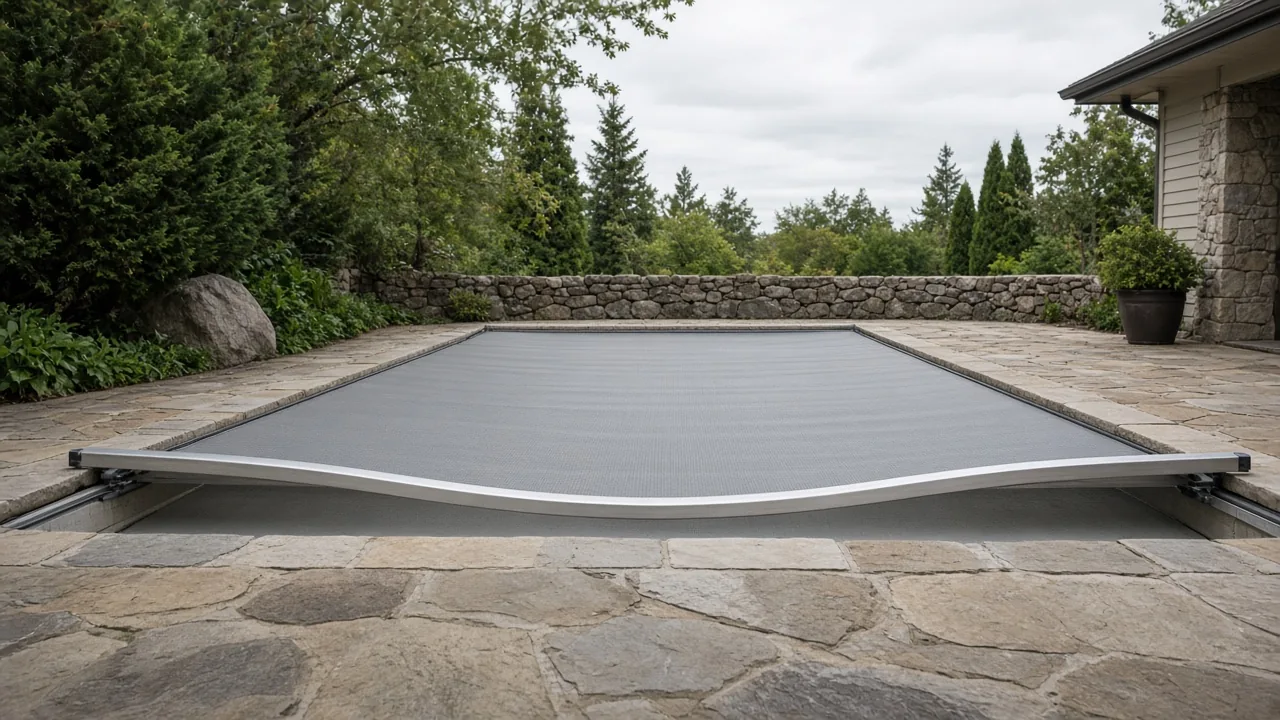
The aluminum bar across the front of an automatic pool cover is the leading edge. A dip in that bar is not the same fault as fabric sagging in the middle of the cover. Cover-Pools lists three aluminum sections, with width limits, on its leading-edge product page and again in a T4 brochure whose file was last modified on 2026-02-23. Only construction sheet 600131 Rel-0007, for its hidden leading edge, gives a deflection table: a no-load column and a 50-pound water-load column. A heavy dash (▬) means that section is not listed at that track space. The product page's 18 percent comparison is not repeated as a percentage in the T4 brochure, and a Priority Electric patent about a composite bar does not replace 600131.
Key points:
- Match the manufacturer, the section name, the track-space width, and the load before you use a cell.
- At 16 feet of track space, 600131 lists five Cover-Pools hidden-leading-edge sections, each with a no-load value and a 50-pound value.
- ▬ means "not listed," not zero deflection.
- "18% less deflection" appears on the product page only. It names no competitor, method, or test date, and the T4 brochure does not state 18%.
- Wheels, gliders, and rope pulleys are end hardware in the documents that mention them. None of those documents describes a prestressed or pre-bent bar.
These are public documents read for this guide. This site did not measure a bar, and the page is not a repair procedure. For how tracks and drives fit together, start with the track mechanisms and drive systems guide. For where a track sits, see pool cover track systems.
Is a bent leading-edge bar the same problem as a sagging cover?
No. In 600131 the leading edge is the bar that deflects, meaning it bends, with track space and with load on the cover. Fabric that sags in the middle of the panel is a different object. If the fabric is holding water and the bar is still up at the tracks, use sagging automatic covers and water on an automatic cover. Those pages do not supply this bar's deflection numbers.
Aquamatic's Hydramatic manual, 2007 Revision, defines its own leading edge as "the 3” aluminum bar holding up the front of the cover fabric." That sentence describes that manual. It is not Cover-Pools section A, B, or C, and it is not the square or the 1 1/2 by 3 1/2 inch rectangle.
Which Cover-Pools bars stop at 16 feet, and which at 25?
Round, square, and a low-profile rectangle. The product page fetched on 2026-10-11 and the T4 brochure do not use the same words, so the table keeps them apart. Neither document is the 600131 deflection table.
| Section | Leading-edge product page, fetched 2026-10-11 | T4 brochure, file last-modified 2026-02-23 |
|---|---|---|
| Round | Standard on all pool and spa covers. The page says it guides the cover across the water. | Standard on each Cover-Pools pool cover. The brochure says it guides the cover and makes a flush seal at the far wall. |
| Square | Adds rigidity, is easier to hide, and makes a better seal at the far wall. Only pools up to 25 feet wide, and only applications that use adjustable gliders. A fabric-wrapped version is described separately. | Says the square shape reduces deflection. Same limits: pools up to 25 feet wide and adjustable gliders. No percentage. |
| Low-profile rectangle, 1 1/2 in. by 3 1/2 in. | Pools up to 16 feet wide. Says the shape resists deflection vertically and horizontally and provides "18% less deflection than competing leading edges of similar form." | Same size and the same 16-foot limit. Says it provides less deflection than competing leading edges of similar form. Does not state 18%. |
The 18 percent sentence is not a measurement by this site, not a T4 claim, and not "less than every competitor." The product page does not name the other bar.
The parts guide, file last-modified 2025-11-21, lists a rectangle 1.5 in. by 3.5 in. by 16 ft, and square bars 2.5 in. by 2.5 in. in a 20 ft length and a 25 ft length. Only the 20 ft square line says "only for use with adjustable glider dowels." Those are catalog lengths in that guide. Do not read a bar's stock length as the pool width. The width limits in the table above are the product-page and T4 statements.
How do you read the 600131 chart?
Use a cell only for a Cover-Pools hidden leading edge built to document 600131 Rel-0007. The footer is ©2020, and the chart is page 7 of 7. That page says the bar will deflect slightly depending on track space and the load on the cover. The table has two cases: no load, and a typical water load of 50 pounds, which the same sentence calls 6 gallons of water. The finished notch depth on page 2 uses the no-load deflection, and each of those dimensions adds about an inch so the bar has 1/2 inch of clearance above and below.
At a track space of 16 feet the chart lists every section. The values are inches.
| Section at 16 ft track space | No load (in.) | Water load, 50 lb (in.) |
|---|---|---|
| Rectangle 1.5 by 3.5 in. | 0.520 | 2.861 |
| A, 1-3/4 in. diameter | 0.733 | 5.518 |
| B, 2-1/2 in. diameter | 0.317 | 1.914 |
| Square 2.5 in. | 0.247 | 1.210 |
| C, 4 in. diameter | 0.113 | 0.416 |
A ▬ in another row means that section is not listed at that track space. It does not mean the deflection is zero. On the 6-foot row, the rectangle is 0.010 in. with no load and 0.134 in. at 50 pounds, and A is 0.014 in. and 0.267 in. B, the square, and C are ▬ on that row.
Page 1 says longer track spaces need larger openings because the bar deflects, and it points to this chart. In the resting position it requires at least 1/2 inch of clearance above the bar and 1/2 inch of clearance with deflection below it. It also says to keep the normal water level 2 to 4 inches below the bottom of the leading edge while the bar is at rest. Decisions about water level beyond that sentence belong on pool water level with an automatic cover. Do not paste a number from another brand onto this bar.
Page 2's finished-dimension charts say to use the Size A charts for a rectangular leading edge and the Size B charts for a square one. That note is about those notch charts. It does not make the rectangle's deflection equal to A's. At 16 feet the deflection table already gives them different cells: 0.520 in. and 0.733 in. with no load.
The caution under the page 2 charts says the chart assumes no load on the leading edge. It strongly recommends more clearance under the bar for a loaded cover, such as rainwater, and says as little as 1/4 inch of water can easily result in hundreds of pounds of load. Rain sitting on a cover is a separate subject in pool cover rain and snow load. The 50-pound column is one case stated in 600131. It is not a snow rating and not a limit for every pool.
Common mistake: Reading 0.520 in., 2.861 in., 5.518 in., or the 18 percent sentence as the bend in any aluminum bar. Each cell belongs to one section, one track space, and one load case in 600131.
| Write this down | Example of a complete entry | Why it changes the cell |
|---|---|---|
| Manufacturer and document | Cover-Pools 600131 Rel-0007, page 7 | Another file can use the same words for a different bar |
| Section name as printed | Rectangle 1.5 by 3.5, not "the square" | At 16 feet those no-load cells are 0.520 and 0.247 |
| Track space | 16 feet | The 6-foot rectangle is 0.010 with no load, not 0.520 |
| Load case | No load, or 50 lb (6 gallons) | On the 16-foot rectangle the water-load cell is 2.861, not 0.520 |
Takeaway: A cell is usable only when the document, the section, the track space, and the load all match. Otherwise it is someone else's number.
Is the hardware at the ends a brace inside the bar?
Not in the documents read here. Three files describe three different end parts. None of them describes a prestressed bar or a camber.
The T4 brochure says the adjustable glider and dowel can move the leading-edge height 3 inches above or below the track, and that the dowel is standard with most undermount track systems. That is a height setting. It is not a procedure for bending the bar, and this page does not give screw turns or a torque.
The parts guide lists Leading Edge Support Assembly A, B, and C by name. It does not say what is inside them. Its wheel-assembly lines say "requires two per leading edge." Two wheels are end hardware on that list. They are not a statement that the bar contains a tendon or was delivered with a pre-bend.
The Hydramatic manual's rope page, numbered 8, says the compensating pulley and pulley brackets "are not to scale" and that the drawing only shows proper rope mounting. Do not treat that sketch as a dimensioned bracket for a Cover-Pools bar. In that manual's rain-removal steps, the operator releases the key switch when the leading-edge bar starts to bow down, waits until the screen mesh comes back up, and then retracts the cover a short distance. That is a Hydramatic instruction while removing rain. It is not the 600131 clearance rule. Naming ropes and pulleys is covered in rope and pulley alignment. Naming the parts you can see is covered in the parts diagram.
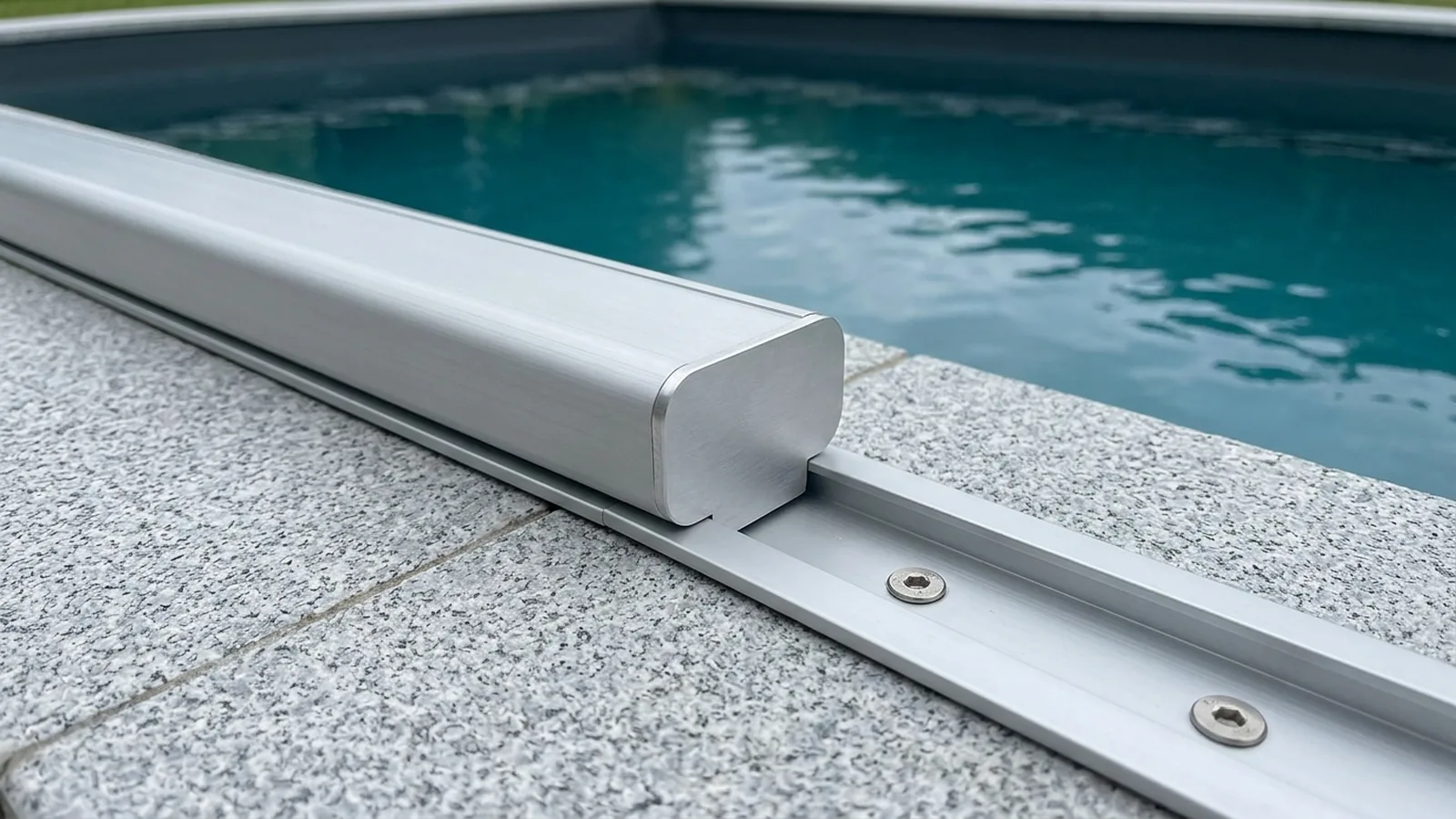
This page does not turn a track spray, grease, or a pressure washer into a step. Lubrication rules differ by manual. They are compared in clearing sand from tracks and checking lubrication rules.
Does patent US11814867B2 replace 600131?
No. The Google Patents page for US11814867B2, fetched on 2026-10-11, lists Priority Electric Inc. as the original assignee. The background says leading edges undergo significant sag and downward deflection on pools or spas of greater than 20 feet in width. One claim describes a fiber-reinforced polymer composite leading edge with a no-load deflection from 0 to less than or equal to 0.10 inches per 10 feet of width, and a linear weight from 4 to 14 ounces per foot of axial length. A text search of that fetched page found neither "camber" nor "prestress." The claim is not a measurement of a Cover-Pools aluminum section, and this site did not test it.
When does 600131 not apply?
It does not apply to another brand, a solar cover, a safety-cover bar, or an anchored winter cover. It does not apply where the chart prints ▬. The page 2 notch chart does not apply to a loaded cover, because that chart says it assumes no load. Fabric sag in the middle of the cover is outside this table. An Automatic Pool Covers specification checked for this topic was an incomplete download and is not used. If your drawing names a document other than 600131, keep that document's numbers with that document.
Frequently asked questions
Is a leading-edge bumper the bar in the deflection chart?
No. On the Cover-Pools product page fetched 2026-10-11, the bumper is a cushioned rubber extrusion that seals between the leading edge and the deck. The round bumper attaches at the end of the pool, and the square bumper wraps the top of the bar. Document 600131 charts the aluminum sections, not that cushion.
Does "pool cover leading edge kit" name one Cover-Pools part or the bar in patent US11814867B2?
Neither, in the documents read here. The phrase is a Google suggestion recorded on 2026-10-11. The Cover-Pools parts guide lists separate bars, support assemblies, and splice kits. US11814867B2 is a Priority Electric composite claim, not a kit number in that parts guide.
Method and sources
Updated October 2026. The numbers above were read from the cited pages of public documents. No bar was bent, loaded, or measured for this guide. A figure from one file is not reused as another brand's result. The FAQ questions come from Google suggestions recorded on 2026-10-11 ("pool cover leading edge bumper" and "pool cover leading edge kit"). They show what people search. They are not measurements.
- Cover-Pools, Hidden Leading Edge construction sheet 600131 Rel-0007, footer ©2020. Saved from the coversafe.com copy of that PDF, fetched 2026-10-11. Page 1 resting clearances and water level; page 2 no-load caution and the Size A / Size B note; page 7 deflection chart, including the 6-foot and 16-foot rows. PDF.
- Cover-Pools leading-edge product page, fetched 2026-10-11. The page copyright line says © 2019 Zodiac Pool Solutions. Round, square, and low-profile rectangle sections, the 25-foot and 16-foot limits, the 18 percent sentence, and the bumper description. Page.
- Cover-Pools T4 family brochure, file last-modified 2026-02-23. Leading Edge and Glider section: round, square, and low-profile rectangle wording, without a percentage, and the 3-inch glider adjustment. PDF.
- Cover-Pools parts guide, file last-modified 2025-11-21. Leading-edge list, including support assemblies A/B/C, the rectangle and square stock lengths, and wheel assemblies that require two per leading edge. PDF.
- Aquamatic Hydramatic operational manual, cover page 2007 Revision. Downloaded from aquamatic.com on 2026-10-11. The exact PDF path was not retained. Reference-guide item 3; rain-removal steps that release the key when the bar bows; rope page 8, pulleys not to scale.
- US11814867B2 as shown on Google Patents, fetched 2026-10-11. Original assignee listed as Priority Electric Inc. Background on sag beyond 20 feet of width, and the composite no-load claim. Page.
Related guides
- Track mechanisms and drive systems: the parent page for how a track, a drive, and a housing are separate decisions.
- Pool cover track systems: where each track type sits, before you treat the bar as a track problem.
- Sagging automatic covers: use this when the fabric panel is low and the bar is not the part that is bending.
- Water on an automatic cover: use this when water is sitting on the fabric.