Updated November 2026
Solar Cover Bubbles Up or Down: Placement, Heat Transfer, and Care Rules
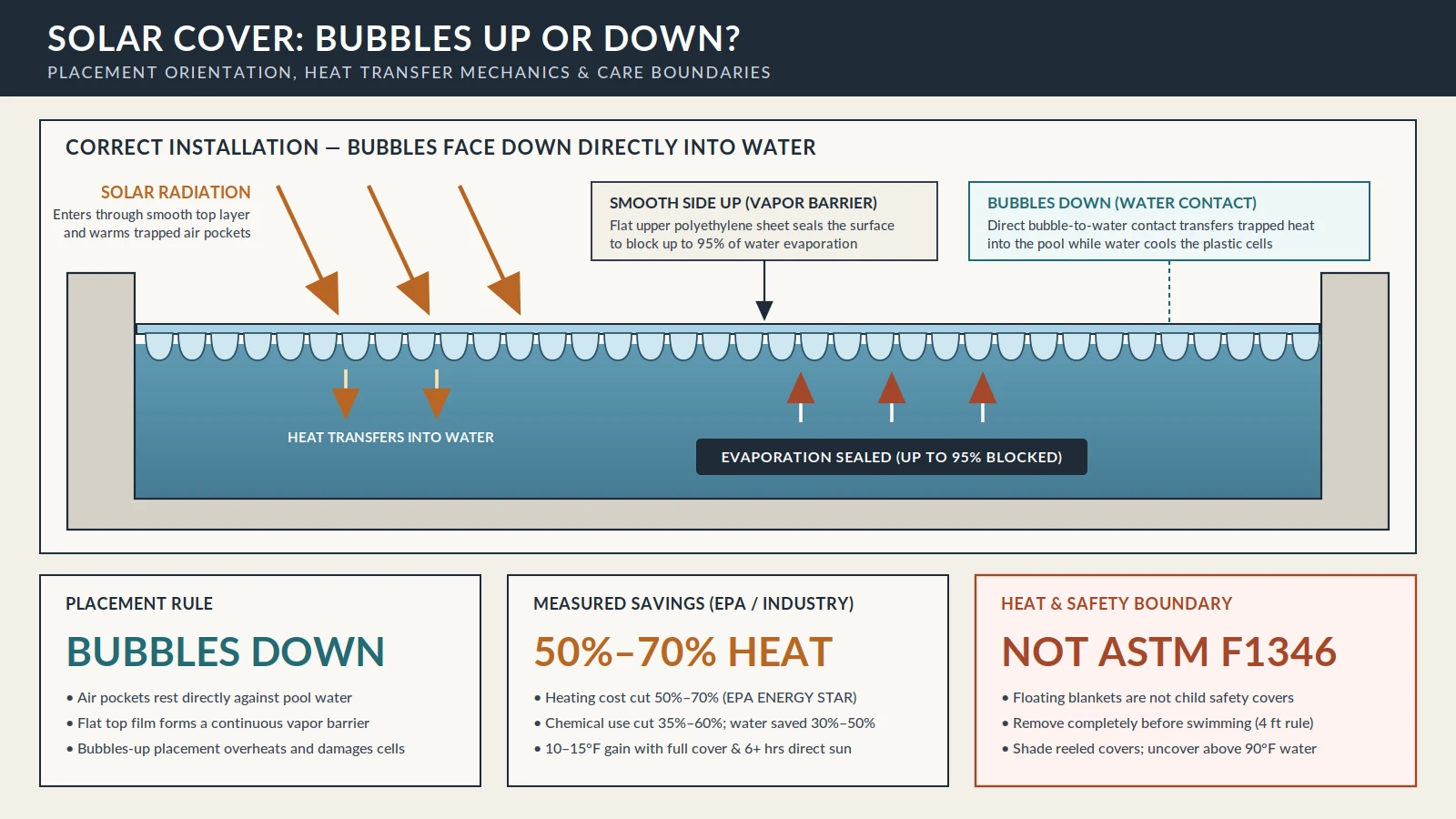
Place a solar pool cover with the bubbles facing down directly against the water and the smooth flat layer facing up. Downward bubbles transfer trapped solar warmth into the pool while the upper sheet blocks up to 95 percent of evaporation, whereas bubbles-up placement traps dry heat and damages the bubbles over time.
Which way up does a bubble pool cover go, and what happens if it is upside down?
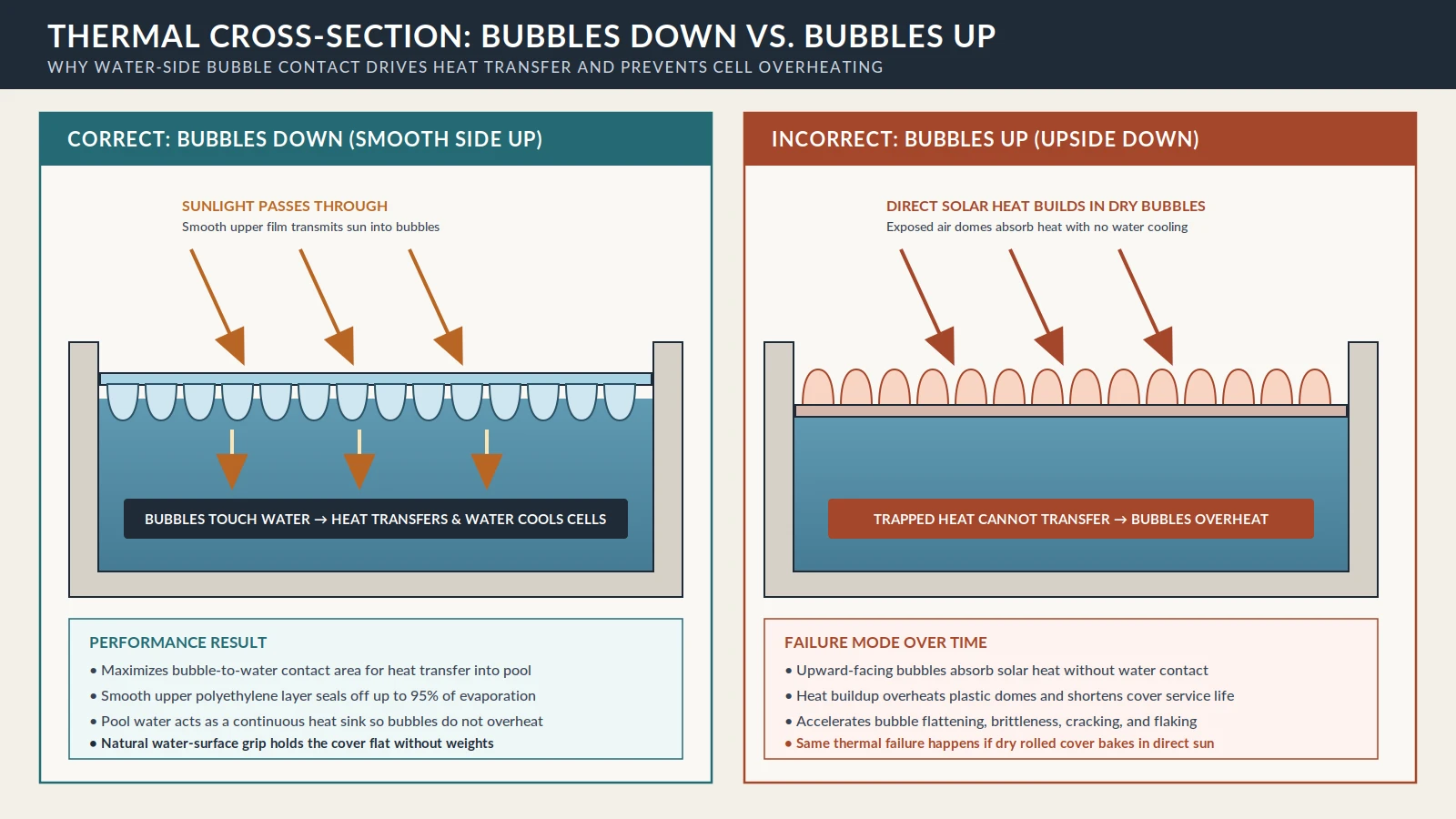
A bubble solar pool cover always goes bubbles down in direct contact with the water surface, leaving the smooth flat film facing the sky. Putting the cover on bubbles up keeps heat trapped inside air-exposed domes that cannot pass warmth into the water, causing the bubbles to overheat and degrade over time.
LinerWorld confirms that the bubble side goes down so heat trapped inside the air cells contacts more water surface area and transfers warmth into the pool. In The Swim likewise directs pool owners to place solar blankets bubble-side down in direct contact with the water to trap solar heat and transfer it efficiently.
Reversing the sheet creates a direct thermal failure mode rather than merely reducing efficiency. Eco Solar Pool Heating explains that placing the bubbles downward lets the blanket trap heat and transfer it through the bubbles into the pool water, whereas laying the blanket bubbles up causes damage to the bubbles over time because they absorb solar heat without being able to transfer it into the water and overheat.
How does a solar pool cover work to heat water and stop heat loss?
A solar pool cover warms and insulates a pool through a two-layer polyethylene structure that pairs downward air pockets with an unbroken top vapor seal. Stopping evaporation matters most, because about 75 percent of a swimming pool's heat loss escapes as vapor rather than through the pool walls or floor.
Aqua Leisure Pools and Spas describes durable solar covers as two layers of high-density polyethylene: the bottom layer forms thousands of tiny air bubbles that focus solar energy into the water by day and act as a thermal blanket at night, while the smooth top layer forms a flat vapor barrier. Sunplay reports that 75 percent of a swimming pool's heat loss comes from evaporation and that the floating barrier seals water away from cooler air on both outdoor and indoor pools.
Federal agency guidance quantifies the resulting savings across water, heat, and chemicals. According to U.S. EPA WaterSense pool cover guidance, consistent and appropriate cover use prevents up to 95 percent of pool water evaporation and helps water retain heat across indoor, outdoor, in-ground, and above-ground pools of almost any size or shape; WaterSense estimates that a typical uncovered U.S. pool loses 12,000 to 31,000 gallons of water per year depending on location, and Eco Solar Pool Heating notes uncovered pools can lose almost 100 litres per day. U.S. EPA ENERGY STAR pool cover guidance adds that covering a pool when not in use cuts heating costs by 50 to 70 percent, lowers chemical use by 35 to 60 percent, conserves water by 30 to 50 percent, and cuts cleaning time by keeping dirt and debris out.
Scroll sideways to compare every column.
| Cover Orientation | Water Contact and Heat Path | Evaporation Barrier | Long-Term Material Impact |
|---|---|---|---|
| Bubbles down, smooth side up (correct) | Air bubbles sit directly in the water to transfer trapped solar heat into the pool | Smooth upper vapor barrier seals the water surface to prevent up to 95 percent of evaporation | Pool water acts as a continuous heat sink, protecting bubbles from dry overheating |
| Bubbles up, smooth side down (incorrect) | Upward-facing bubbles absorb sunlight without water contact to transfer heat downward | Water contact rests on the flat sheet while bubbles remain isolated in open air | Trapped solar heat overheats exposed bubbles and causes damage over time |
How fast does a solar cover heat a pool, and which color heats better?
With full surface coverage and at least 6 hours of direct daily sunlight, a properly placed bubble solar cover commonly raises pool temperature by 10 to 15 degrees F, with clear blankets favoring faster daytime gain and dark blue blankets favoring longer overnight retention. Even without direct sun, evaporation control cuts heating energy substantially.
In The Swim reports that daytime temperature gain depends directly on surface coverage and direct daily sunshine, with a 10 to 15 degree F rise common on completely covered sunny pools, while Sunplay cites up to 5 degrees F of warming per 12 hours of coverage and up to 70 percent lower heating costs. In The Swim notes that as cooler nights widen the gap between water and air temperature, retention efficiency declines, yet covering still remains the best way to curb heat loss. Institutional data summarized by In The Swim confirms meaningful savings even on partial schedules: a 2014 Colgate University study covering the campus Lineberry pool for 7 hours each night measured over 30 percent energy cost savings, and a 2012 Michigan Energy Office case study at Chesaning Union Middle School recorded a 50 percent reduction in energy use alongside lower indoor humidity. For deeper cloudy-day, shade, and liquid-cover comparisons, see our guide on whether solar pool covers work.
Tint shifts the balance between daytime solar entry and overnight thermal hold within that same bubbles-down placement. LinerWorld explains that translucent clear covers admit more light and energy for a larger temperature rise—up to 12 degrees F in clear-cover figures cited by Sunplay—but also let heat escape faster once air cools. Dark blue covers let less solar energy pass through for a smaller daytime spike yet hold warmth longer, while light blue balances absorption and retention. A detailed tint and chemistry breakdown lives in our blue vs clear solar pool cover guide.
Scroll sideways to compare every column.
| Solar Cover Tint | Daytime Solar Heating | Overnight Heat Retention | Best-Fit Use Case |
|---|---|---|---|
| Clear translucent | Allows maximum sunlight and energy into water (up to 12 degrees F clear claim; 10 to 15 degrees F full-sun range) | Blocks up to 95 percent of evaporation, though translucent film lets heat escape faster than dark tints | Sunny pools prioritizing maximum daytime temperature gain |
| Light blue | Moderate sunlight admission paired with blanket warming | Balanced heat retention between clear and dark blue | Residential pools wanting an all-around heating and retention mix |
| Dark blue | Admits less direct solar energy for a more modest daytime rise | Retains existing daytime or heater warmth longer overnight | Heated pools or cool-night yards prioritizing overnight thermal hold |
How do you trim a solar pool cover to fit without losing efficiency?
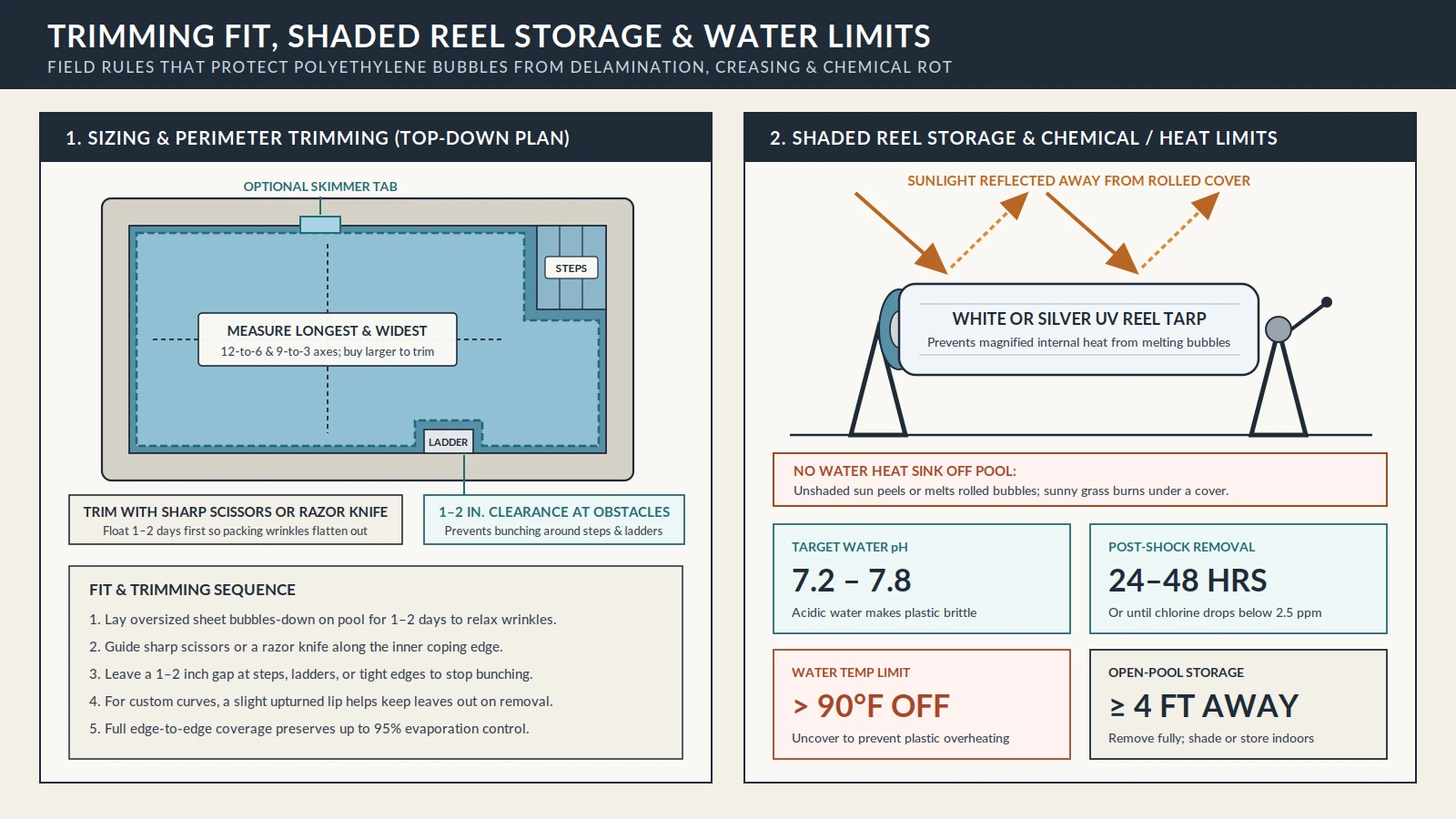
Size a solar blanket slightly larger than your pool, float it bubbles down for a day or two so packing wrinkles relax flat, and trim it cleanly with sharp scissors or a razor knife. Full surface coverage protects evaporation savings, while a 1 to 2 inch gap at obstacles prevents snagging and bunching.
LinerWorld recommends measuring the pool at its longest and widest points—like 12 to 6 and 9 to 3 on a clock face—and choosing a larger standard sheet to trim down so no open gaps let heat escape. Aqua Leisure Pools and Spas advises laying the new blanket on the water for a day or two before cutting so shipping folds flatten out completely, then trimming with sharp scissors or a razor knife using the coping stone edge as a guide.
Match edge details to your pool hardware and shape. In The Swim recommends leaving a 1 to 2 inch gap around steps, ladders, or tight edges to ease removal and prevent bunching, whereas Aqua Leisure notes that on custom shapes letting the trimmed edge turn up slightly around the perimeter helps keep leaves and bugs from dropping into the pool during removal. Sunplay adds that owners can cut tabs into the edge to fit around skimmers. Once trimmed and laid bubbles down, LinerWorld notes that solar blankets grip the water surface naturally and typically do not require edge weights.
How do you prevent bubble overheating, chemical damage, and delamination?
Keep a solar cover shaded whenever it is off the water, roll it onto a reel covered with a white or silver UV-protective tarp rather than folding it, and remove it during shock treatments or whenever water climbs above 90 degrees F. Dry sun exposure and concentrated chlorine cause most premature bubble failure.
Off the pool, a solar blanket loses its water heat sink immediately. Eco Solar Pool Heating warns that a blanket left in sunlight out of contact with water has nowhere to transfer absorbed heat, allowing it to overheat until the bubbles peel away from the base layer; Eco Solar advises covering any outdoor stored blanket with white-colored material, ideally storing it indoors in a garage or shed, and never leaving it on sunny grass where concentrated solar heat burns the turf. Aqua Leisure Pools and Spas adds that folding creates creases that crack over time, whereas rolling onto a reel prevents creasing—provided the reel roll is covered with a white or silver UV-protective tarp so sunlight cannot magnify internal heat and melt the rolled bubbles together. In The Swim likewise recommends keeping a cover in the shade or under a protective sheet whenever it stays off the pool for more than a day, and rinsing, fully drying, and storing it in a cool dry spot without heavy objects stacked on top for winter. Reel hardware options are detailed in our manual and commercial pool cover reel systems guide.
Water chemistry and high water temperatures govern how many seasons the polyethylene lasts. Aqua Leisure Pools and Spas notes that pool pH below 7.2 becomes acidic enough to make plastic brittle and recommends keeping pH between 7.2 and 7.8. During shock treatments, trapped off-gassing oxidizers thin, whiten, and burst bubbles; Aqua Leisure recommends keeping the cover off for at least 24 to 48 hours after shocking or until chlorine drops below 2.5 ppm, and In The Swim advises removing the cover before super-chlorinating and whenever water climbs above 90 degrees F. With regular care, In The Swim estimates most covers last 2 to 5 seasons, while Aqua Leisure lists typical lifespans by gauge as 1 to 2 seasons for 8 mil, 3 to 5 years for 12 mil, and 5 to 10 years for 16 mil. Brittleness, cracking, flattened bubbles, fading, or flaking signal replacement time. For broader sanitizer-damage mechanics, see our pool chemistry and cover damage guide and our pool cover maintenance hub.
| Operating Factor | Verified Target or Limit | Failure Mode If Ignored |
|---|---|---|
| Off-water and reeled storage | Keep in shade, garage/shed, or under a white or silver UV tarp; avoid sunny grass | Magnified dry heat melts rolled bubbles together, peels bubbles off the base layer, or burns grass |
| Pool water pH | 7.2 to 7.8 | Acidic water below 7.2 makes polyethylene plastic brittle |
| Shock and high chlorine | Remove before super-chlorinating; keep off 24 to 48 hours or until chlorine drops below 2.5 ppm | Trapped off-gassing chemicals thin, whiten, and burst bubbles |
| Water temperature limit | Remove cover above 90 degrees F | Overheating accelerates plastic aging and shortens service life |
| Expected lifespan by gauge | 2 to 5 seasons typical; 8 mil (1 to 2 seasons), 12 mil (3 to 5 years), 16 mil (5 to 10 years) | Brittleness, cracking, flattened bubbles, fading, or flaking reduce heat retention |
Are floating solar covers safe around children and swimmers?
No—a floating solar bubble blanket is not a safety cover and can appear as a solid surface to children or animals who may walk onto it and become trapped in the collapsed cover. Remove the entire floating cover completely, roll it up, and store it at least four feet away from the pool before anyone swims.
San Bernardino County public pool cover guidelines define floating pool covers strictly as blankets designed to prevent heat loss, evaporation, and debris, and state explicitly that floating pool covers are not safety covers. Sacramento County pool cover guidelines warn that floating blankets can look like a solid surface to children or animals who may walk onto them and become trapped in the collapsed cover, and note drowning incidents when bathers swim under a partially removed blanket.
Both Sacramento County and San Bernardino County guidelines require floating covers on public pools to be completely removed, rolled up, and stored at least four feet away from the pool whenever the pool is open or the cover is not in use. By contrast, ASTM F1346 (historical edition F1346-91R18 alongside active F1346-23) establishes performance tests for safety covers intended to reduce drowning risk by inhibiting water access for children under five years of age when properly installed and used, along with marking requirements for all covers. If child-access protection is needed, review our ASTM F1346 pool safety cover guide, explore pool safety covers, or compare cover categories in our pool cover buying guide.
What should you verify before placing or storing a solar pool cover?
Run through this six-point check during initial trimming and routine daily use to preserve heat transfer, bubble integrity, and poolside safety:
- Lay the blanket bubbles down against the water with the smooth flat polyethylene layer facing up so trapped warmth transfers into the water while up to 95 percent of evaporation stays sealed.
- Float a new oversized blanket for 1 to 2 days before trimming with sharp scissors or a razor knife, leaving a 1 to 2 inch clearance around steps, ladders, or tight edges to prevent bunching.
- Roll the cover smoothly onto a reel rather than folding creases into the sheet, and drape a white or silver UV-protective tarp over any reeled cover stored in sunlight.
- Do not leave a dry solar blanket on sunny grass, and clean, dry, and store it in a cool dry indoor space without heavy objects stacked on top during the off-season.
- Maintain water pH between 7.2 and 7.8, keep the cover off for 24 to 48 hours after shock treatment (or until chlorine drops below 2.5 ppm), and uncover whenever water rises above 90 degrees F.
- Remove the entire floating blanket completely and store it at least four feet back from the pool edge before anyone swims; do not treat a bubble cover as an ASTM F1346 safety cover.
Sources
Energy savings, evaporation rates, safety boundaries, placement rules, and maintenance thresholds in this guide reference the following public-agency, standards, and industry sources:
- U.S. EPA ENERGY STAR: Pool Pumps and Pool Covers — 50 to 70 percent heating-cost reduction, 35 to 60 percent chemical reduction, and 30 to 50 percent water conservation
- U.S. EPA WaterSense: Pool Covers — Up to 95 percent evaporation prevention and 12,000 to 31,000 gallons annual uncovered pool water loss
- Sacramento County Environmental Management Department: Pool Cover Guidelines — Collapse and under-cover drowning hazards plus complete removal and four-foot storage rule
- San Bernardino County Environmental Health Services: Guidelines for Pool Covers on Public Pools — Non-safety-cover classification for floating blankets and complete four-foot removal rule
- ASTM International: Standard Performance Specification F1346 (F1346-91R18 and Active F1346-23) — Safety-cover performance tests for children under five and marking requirements for all pool covers
- LinerWorld (Everything You Need to Know About Solar Pool Covers) — Bubbles-down placement, clear vs. light blue vs. dark blue tint tradeoffs, clock-face sizing, and natural water-surface grip
- Eco Solar Pool Heating (Pool Blanket Tips and Advice) — Bubbles-down heat transfer, bubbles-up overheating damage, off-water bubble peeling, white outdoor shielding, sunny-grass burn warning, and daily evaporation loss
- In The Swim (Solar Cover Care and Effectiveness Guides) — Bubbles-down placement, 1 to 2 inch trimming clearance, 10 to 15 degree F sunny gain with 6+ hours sun, high-temperature removal limit, and 2 to 5 season lifespan
- Aqua Leisure Pools and Spas (Durable Solar Pool Covers Guide) — Two-layer high-density polyethylene construction, 1 to 2 day wrinkle settling, coping-edge trimming, white or silver UV reel tarps, pH 7.2 to 7.8, 24 to 48 hour post-shock wait below 2.5 ppm chlorine, and 8/12/16 mil lifespans
- Sunplay (Pool Solar Cover FAQs) — Evaporative heat-loss share, up to 70 percent heating-cost reduction, 5 degrees F per 12 hours, and up to 12 degrees F clear-cover gain
Questions
- Do solar pool cover bubbles go up or down?
- The bubbles always go face down touching the pool water, with the smooth flat polyethylene side facing up. Downward bubbles transfer trapped solar warmth into the water and stay cooled by the pool, while placing them bubbles up causes overheating and bubble damage over time.
- What happens if you put a solar pool cover on bubbles up?
- When placed bubbles up, the air-filled pockets absorb solar heat in open air without being able to transfer that heat into the water below. Over time, trapped heat overheats the plastic domes and damages the bubbles.
- How long should you wait before cutting a new solar pool cover?
- Float the oversized cover bubbles down on the pool for a day or two so packing wrinkles flatten out completely, then trim along the coping edge with sharp scissors or a razor knife while leaving a 1 to 2 inch gap around steps, ladders, or tight edges.
- Why do solar cover bubbles peel or melt when rolled on a reel?
- Once lifted off the pool, the cover has no water underneath to absorb heat. Leaving a rolled cover uncovered in direct sunlight magnifies heat between the layers, which can melt bubbles together or cause them to peel away from the base film unless shielded by a white or silver UV tarp or stored in shade.
- When should you take a solar pool cover off the water?
- Remove the cover completely before anyone swims (storing it at least four feet back), before super-chlorinating and for 24 to 48 hours after shock treatment (or until chlorine falls below 2.5 ppm), and whenever pool water temperature climbs above 90 degrees F.
Parent hub: Pool cover maintenance