Updated November 2026
Blue vs Clear Solar Pool Cover: Heat Gain, Retention, and Chemistry Tradeoffs
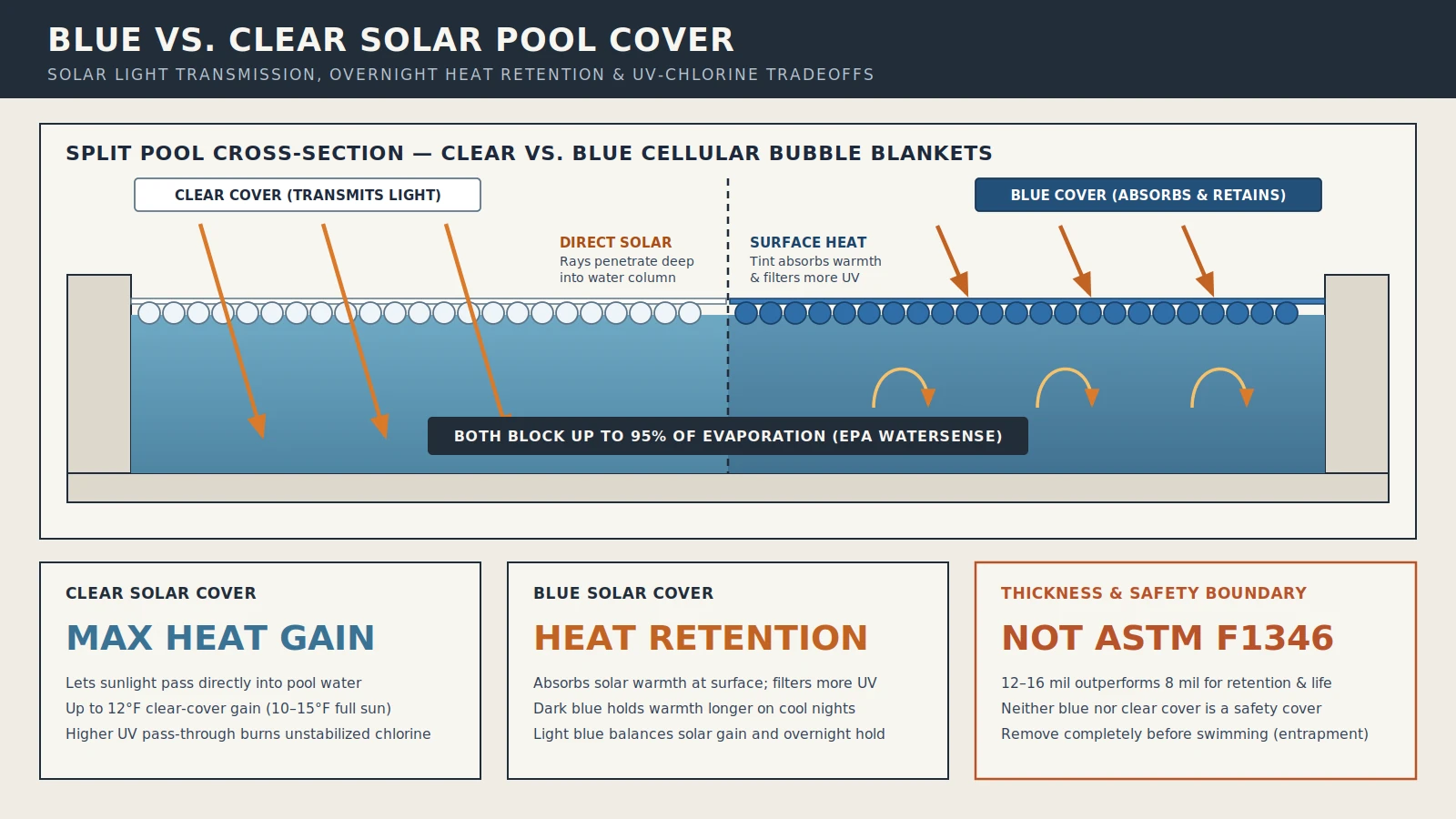
Clear solar pool covers warm sunny pool water faster by letting sunlight pass directly into the water, while dark blue covers absorb heat in the blanket and hold warmth longer overnight. Both full-surface bubble blankets block up to 95 percent of evaporation, so choosing depends on daytime heating versus overnight retention and UV shielding.
Is a blue or clear solar pool cover better overall?
Neither color wins in every backyard: clear solar covers are better when maximizing passive daytime water warming in direct sun, whereas blue covers are better when holding existing warmth overnight or moderating UV exposure matters more. Both colors deliver the same core vapor barrier when trimmed wall-to-wall across the pool.
According to U.S. EPA WaterSense pool cover guidance, using a pool cover consistently prevents up to 95 percent of pool water evaporation and helps water retain heat, curbing water waste on a typical uncovered U.S. pool that can lose 12,000 to 31,000 gallons per year. A 2016 Cal Poly study on 12 test pools reported by In The Swim likewise measured about 95 percent evaporation-control efficiency for full-surface solar bubble covers.
Because Sunplay notes that 75 percent of a swimming pool's heat loss comes from evaporation, stopping that moisture loss matters far more than tint alone. Within that shared 95 percent evaporation seal, color shifts the balance between daytime solar pass-through and nighttime thermal hold. Swim University reports that clear covers heat pool water better than blue covers by letting more solar heat penetrate efficiently, while dark blue covers excel at heat retention. LinerWorld similarly points to light blue as a middle-ground choice that balances solar absorption with overnight retention.
If you are still evaluating whether a floating blanket makes sense for your yard before picking a tint, start with our guide on whether solar pool covers work.
What color solar pool cover heats pool water the best?
Clear bubble covers and clear-top, dark-bottom bubble covers deliver the strongest passive daytime heating, because they maximize the solar energy transferred into the pool rather than reflecting rays away at the top surface. Across full-surface blankets in sunny conditions, In The Swim reports that a completely covered pool receiving at least 6 hours of direct daily sunlight commonly gains 10 to 15 degrees F.
On tint performance specifically, Inyo Pools explains that clear blankets allow sunlight to pass through the sheet to warm the water directly, whereas blue blankets tend to absorb heat in the blanket material itself so the cover warms up more than the water beneath it. Sunplay notes that opaque or two-colored conventional covers reflect part of the sun's rays, whereas clear versions let sunlight pass through the sheeting, magnify and radiate more heat, and can raise pool temperature by up to 12 degrees F.
Historical and federal solar guidance reinforces that passive solar blankets pair best with consistent overnight coverage. In The Swim cites a 1963 Australian study showing that clear plastic film both halted evaporative heat loss and absorbed solar radiation to warm sunny outdoor pools. Sunplay adds that a solar cover can trim pool heating costs by up to 70 percent and warm water by up to 5 degrees F per 12 hours of coverage, while doing most of its work overnight when air cools below water temperature. The U.S. Department of Energy guide Heat Your Water with the Sun confirms that a pool cover or blanket reduces heat loss and maintains warm temperatures longer, and the DOE FEMP Solar Water Heating Federal Technology Alert identifies conserving generated heat with swimming pool covers as generally the most cost-effective investment alongside solar water heating.
Scroll sideways to compare every column.
| Cover Tint | Daytime Solar Heating | Overnight Heat Retention | UV and Chlorine Impact | Best-Fit Pool Scenario |
|---|---|---|---|---|
| Clear bubbled | Highest sunlight pass-through into water (up to 12 degrees F clear claim; 10 to 15 degrees F full sun) | Strong vapor seal (up to 95 percent evaporation blocked), but translucent film lets more heat escape | Transmits UV rays that burn off unstabilized chlorine; maintain cyanuric acid | Cooler climates, shoulder seasons, or sunny yards prioritizing maximum daytime warming |
| Light blue bubbled | Moderate sunlight pass-through balanced with cover absorption | Balanced overnight heat retention between clear and dark blue | Partial tinting moderates direct UV exposure compared with clear film | General residential pools wanting balanced warming and overnight hold |
| Dark blue bubbled | Lower direct sunlight transmission; blanket absorbs heat at surface | Holds existing daytime and heater warmth longer overnight | Reduced light transmission slows UV chlorine degradation while cutting evaporation | Heated pools, windy yards, cool nights, or warm climates avoiding midday overheating |
Are clear solar pool covers better for deeper water warming?
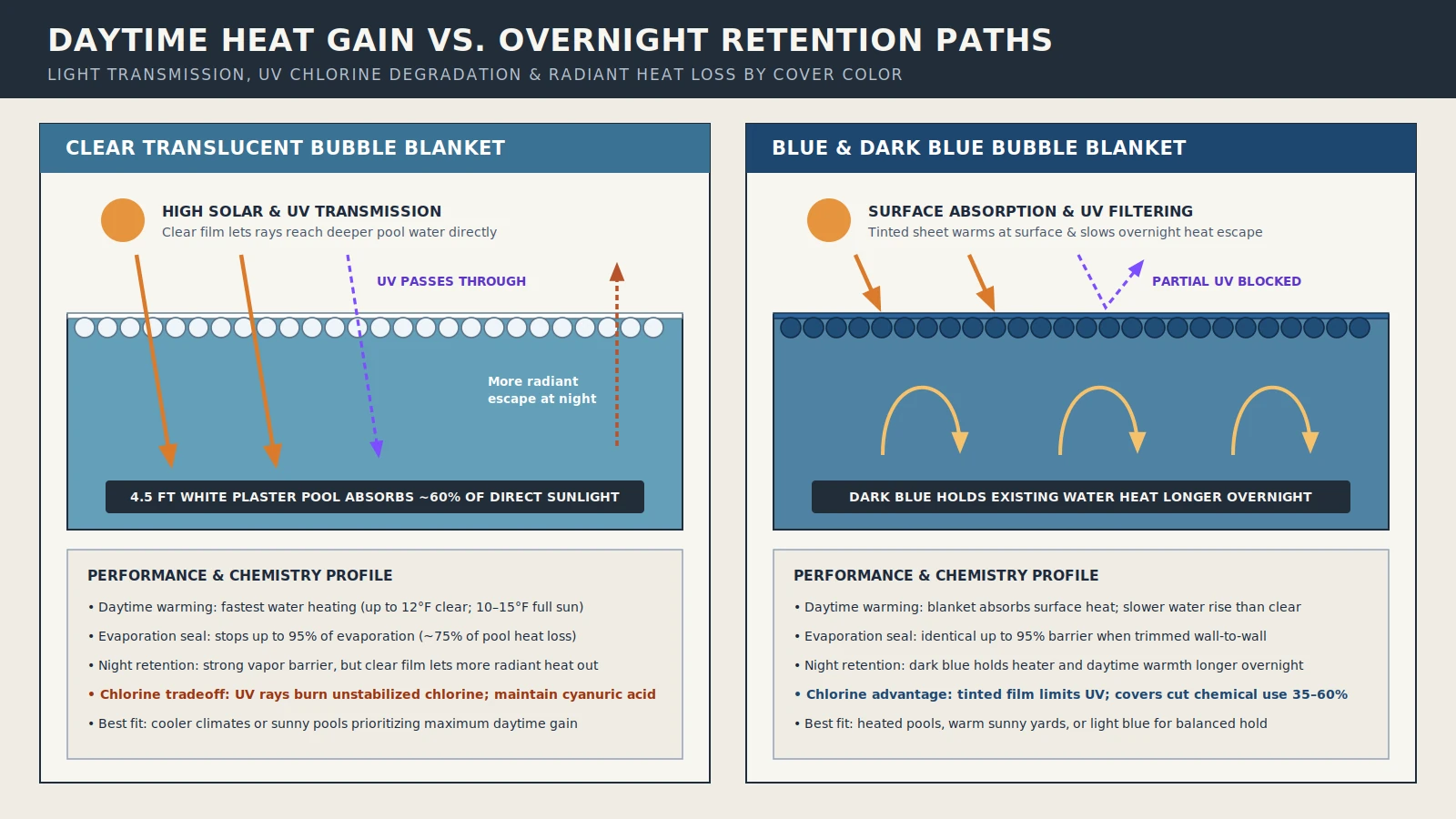
Yes, clear translucent solar covers are better at warming the water column below the top surface because sunlight passes through the film into the pool itself rather than stopping in a tinted top layer. LinerWorld notes that translucent clear covers admit more light and solar energy into the water for a larger temperature rise, though the same translucency also lets heat escape more readily once air temperatures drop.
Direct water-column absorption is substantial even before a cover is added. Swim University notes that an uncovered white plaster pool averaging 4.5 feet deep absorbs roughly 60 percent of incoming solar energy, warming about 0.7 degrees F per hour under noontime sun, while losing about 5 degrees F for every quarter-inch of water that evaporates. Floating a clear bubble sheet over that water keeps direct solar rays entering the 4.5-foot column while sealing off up to 95 percent of evaporative cooling.
That extra clarity brings a clear chemistry tradeoff. Swim University points out that a light-colored, clear cover lets the sun's UV rays pass directly into the pool, whereas a dark, opaque cover transmits far less light even when thin. Because UV radiation burns off unstabilized chlorine, Swim University cautions that owners using a clear solar blanket without stabilized chlorine may need to add cyanuric acid stabilizer to protect sanitizer levels. Even with that adjustment, Sunplay notes that a floating solar blanket cuts overall pool chemical consumption by 35 to 60 percent by curbing evaporation and surface exposure. For sanitizer and stabilizer interactions across cover materials, see our pool chemistry and cover damage guide.
How do clear and blue covers compare to other solar cover colors?
Beyond standard clear, light blue, and dark blue bubble sheets, multi-layer and specialty constructions alter whether solar energy is transmitted, conducted through dark bubbles, or reflected away. Swim University highlights clear-top or white-top covers paired with dark or black bottom bubbles as top performers for conductive heat transfer, because the dark underside absorbs solar warmth and passes it straight into the water it touches while retaining heat well.
Bubble air pockets remain essential regardless of color. Swim University notes that a thin, dark, opaque cover without bubbles absorbs and transfers heat during sunny hours but retains very little heat once temperatures drop. By contrast, a white or reflective bubbled blanket absorbs little daytime solar heat yet still retains existing pool warmth well, making it useful where preserving heater output without overheating midday water is the goal.
Scroll sideways to compare every column.
| Solar Cover Construction | Primary Heating Mechanism | Heat Retention | Key Operational Tradeoff |
|---|---|---|---|
| Clear bubbled | Transmits maximum sunlight and UV directly into pool water | Retains heat well via vapor seal, though translucent sheet lets more radiant heat escape | Requires cyanuric acid stabilizer to counter UV chlorine burn-off |
| Light blue bubbled | Balanced partial sunlight transmission and cover warming | Balanced overnight retention between clear and dark blue | Moderate peak daytime gain compared with clear |
| Dark blue bubbled | Absorbs solar heat at tinted blanket layer with lower pass-through | Retains existing water heat longer overnight | Less dramatic daytime passive temperature rise |
| Clear or white top with dark bottom bubbles | Dark bottom bubbles absorb solar energy and conduct heat directly to water | Retains heat well with cellular air pockets | Higher reliance on direct contact and circulation to mix warmed surface water |
| Dark opaque thin sheet (no bubbles) | Absorbs solar energy in dark film and transfers heat to water | Poor heat retention without insulating air pockets | Loses daytime gains rapidly on cool nights |
| White or reflective bubbled | Reflects sunlight and absorbs little daytime heat | Retains existing warmth well via air pockets and vapor barrier | Minimal passive daytime temperature gain |
Does cover thickness (like 16 mil) matter alongside color?
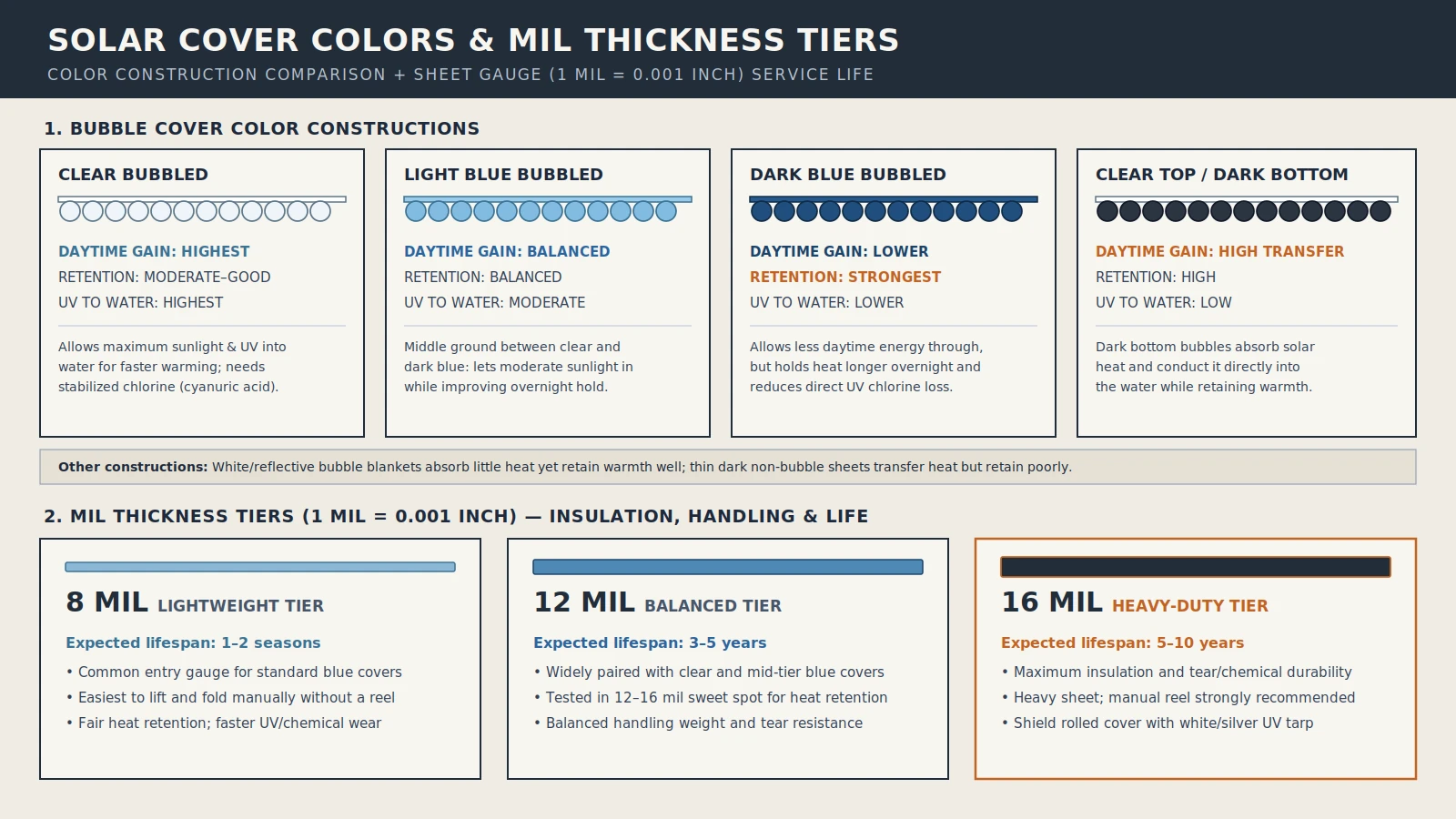
Yes—sheet thickness measured in mils (one-thousandth of an inch) separates durability, insulation, and warranty coverage alongside color. In Swim University testing, solar blankets between 12 mil and 16 mil performed best for heat retention, absorbed more heat, and resisted sun damage, chemical attack, and ripping better than thinner sheets.
Thickness and color are also frequently bundled by retailers. Swim University notes that blue solar covers commonly start at 4 mil (about 1 year of service) and 8 mil (1 to 2 years), whereas clear solar covers are widely offered in 12 mil (3 to 4 years) and 16 mil (5 to 10 years). Inyo Pools gives a concrete product-line example where the clear blanket is 12 mil thick with a 5-year warranty while the matching blue blanket is 8 mil thick with a 3-year warranty. Aqua Leisure Pools and Spas summarizes UV-stabilized polyethylene durability across 8 mil (1 to 2 seasons, lightweight), 12 mil (3 to 5 years, balanced), and 16 mil (5 to 10 years, heavy-duty requiring a reel or extra effort).
Chemical and heat care determine whether either color reaches its rated lifespan. In The Swim reports that most solar covers last 2 to 5 seasons with regular care and should be removed whenever water climbs above 90 degrees F or before super-chlorinating. Aqua Leisure recommends keeping water pH between 7.2 and 7.8, leaving the cover off for 24 to 48 hours after shock treatment or until chlorine falls below 2.5 ppm, and shielding a reeled cover with a white or silver UV-protective tarp so trapped heat inside the dry roll cannot melt the bubbles together. Brittleness, cracking, flattened bubbles, and color fading or flaking signal replacement time. For heavier 12 mil and 16 mil blankets, handling hardware is covered in our manual and commercial pool cover reel systems guide, and routine seasonal care lives on our pool cover maintenance hub.
Scroll sideways to compare every column.
| Thickness Tier | Typical Expected Lifespan | Retention and Durability | Handling and Typical Pairing |
|---|---|---|---|
| 8 mil | 1 to 2 seasons (3-year warranty on some lines) | Fair retention; lower resistance to UV, chemicals, and tears | Lightweight and easiest to fold by hand; common entry tier for blue blankets |
| 12 mil | 3 to 5 years (5-year warranty on some clear lines) | Strong heat retention and medium-high tear and chemical durability | Balanced weight; common sweet spot for clear and mid-tier blue covers |
| 16 mil | 5 to 10 years with balanced chemistry and shaded storage | Maximum insulation and resistance to sun damage, chemicals, and ripping | Heavy-duty weight; pairing with a manual solar reel and white or silver UV tarp is recommended |
Are solar pool covers dangerous or a substitute for a safety cover?
No—neither blue nor clear floating solar blankets are safety covers, and leaving one on or partially pulled back creates serious entrapment and drowning hazards. San Bernardino County public pool cover guidelines define floating covers strictly as evaporation, heat-retention, and debris blankets and explicitly state that floating pool covers are not safety covers.
Sacramento County pool cover guidelines warn that floating blankets can look like a solid surface to children or animals who may walk onto them and become trapped in the collapsed sheet, and note that drowning incidents have occurred when bathers swim under a partially removed cover, become disoriented, and cannot reach air. For public pools, Sacramento County requires floating covers to be completely removed, rolled up, and stored at least four feet away from the pool whenever the pool is open.
Only covers meeting ASTM F1346 (historical edition F1346-91R18 alongside active F1346-23) carry performance-tested safety-cover status intended to inhibit water access by children under five years of age when properly installed and used, alongside marking requirements for all pool covers. If child-access protection is required, review our ASTM F1346 safety cover guide, compare motorized track systems in how automatic pool covers work, or return to the pool cover buying guide.
How do you choose between a blue and clear solar cover for your pool?
Match tint to your climate, heater setup, and sanitizer routine, then verify gauge and safe handling before buying:
- Pick a clear bubble blanket when your pool receives at least 6 hours of direct sun and maximum daytime warming matters most, and maintain cyanuric acid stabilizer to counter UV chlorine loss.
- Pick a dark blue bubble blanket when you already run a pool heater, experience cool nights, or want longer overnight heat retention and lower direct UV penetration.
- Pick a light blue bubble blanket if you want a middle-ground balance between daytime solar gain and overnight retention, or a clear-top, dark-bottom bubble blanket for strong conductive heat transfer with high retention.
- Compare mil thickness side by side rather than color alone: 12 mil to 16 mil UV-stabilized polyethylene blankets outperform 8 mil sheets for heat retention and multi-season durability, with a solar reel recommended for 16 mil rolls.
- Protect blanket service life by keeping pH between 7.2 and 7.8, removing the cover for 24 to 48 hours after shock treatment (or until chlorine drops below 2.5 ppm), uncovering above 90 degrees F, and shielding rolled covers under a white or silver UV tarp.
- Remove any floating solar cover completely before swimming rather than folding it halfway back, and treat it strictly as an evaporation and heat blanket rather than an ASTM F1346 safety cover.
Sources
Evaporation figures, solar-heating guidance, safety standards, tint behavior, and mil-thickness specifications in this comparison draw on the following public-agency, standards, and industry documentation:
- U.S. Environmental Protection Agency WaterSense: Pool Covers — Up to 95 percent evaporation prevention, 12,000 to 31,000 gallons annual uncovered loss, and heat-retention savings
- U.S. Department of Energy EERE: Heat Your Water with the Sun — Pool cover and blanket heat-loss reduction and longer temperature retention
- U.S. Department of Energy FEMP: Solar Water Heating Federal Technology Alert — Conserving generated heat with swimming pool covers as a cost-effective investment
- Sacramento County Environmental Management Department: Pool Cover Guidelines for Public Pools — Collapse and underwater entrapment hazards and complete removal with four-foot storage
- San Bernardino County Environmental Health Services: Guidelines for Use of Pool Covers on Public Pools — Floating blanket definition and non-safety-cover classification
- ASTM International: Standard Performance Specification F1346 (F1346-91R18 and Active F1346-23) — Safety-cover performance tests for children under five and marking requirements for all covers
- Inyo Pools (Solar Blanket Clear vs. Blue Q&A) — Clear sunlight pass-through versus blue surface absorption, plus 12 mil (5-year warranty) clear versus 8 mil (3-year warranty) blue comparison
- Sunplay (Pool Solar Cover FAQs) — Clear cover warming up to 12 degrees F versus opaque/two-colored reflection, 75 percent evaporative heat loss, up to 70 percent heating-cost cut, 5 degrees F per 12 hours, and 35 to 60 percent chemical reduction
- Swim University (Solar Pool Covers Guide) — Clear versus dark blue heat transfer and retention, clear-top/dark-bottom and reflective blanket constructions, UV chlorine burn-off and cyanuric acid tradeoff, 4.5-foot pool solar absorption, and 12 mil to 16 mil testing
- LinerWorld (Solar Pool Covers Guide) — Clear higher gain with faster heat escape, dark blue longer retention, and light blue balanced absorption and retention
- Aqua Leisure Pools and Spas (Durable Solar Pool Covers Guide) — 8 mil, 12 mil, and 16 mil durability tiers, pH 7.2 to 7.8, 24 to 48 hour post-shock wait below 2.5 ppm chlorine, and UV-protective white or silver reel covers
- In The Swim (Solar Cover Effectiveness and Care Guides) — 10 to 15 degrees F gain with 6+ hours of direct sun, 1963 Australian clear-film study, 2016 Cal Poly 12-pool evaporation test, 90 degrees F removal threshold, and 2 to 5 season replacement signs
Questions
- Does a clear or blue solar pool cover heat pool water faster?
- A clear solar pool cover generally heats sunny pool water faster because translucent sheeting allows sunlight to pass directly into the water column, whereas a blue blanket absorbs more solar heat in the cover itself.
- Does a dark blue solar cover hold heat better overnight than a clear cover?
- Yes. Both clear and dark blue full-surface bubble covers block up to 95 percent of evaporation, but dark blue lets less heat escape back out overnight while clear translucency works in both directions.
- Do clear solar pool covers burn off chlorine faster than blue covers?
- Clear blankets let more UV rays pass through into the pool, which breaks down unstabilized chlorine faster than tinted blue covers. Maintaining cyanuric acid stabilizer protects chlorine under a clear cover while the blanket still cuts overall chemical loss by 35 to 60 percent.
- Is a 12 mil or 16 mil solar cover worth upgrading to over an 8 mil cover?
- Testing shows 12 mil and 16 mil covers retain heat better and resist UV, chemical, and tear damage longer than 8 mil sheets, extending expected service life from 1 to 2 seasons up to 3 to 5 years for 12 mil and 5 to 10 years for 16 mil, though heavy 16 mil blankets require a solar reel or extra effort to handle.
- Can a blue or clear solar pool cover replace a pool safety cover?
- No. Floating solar blankets of any color are not ASTM F1346 safety covers; children or pets can become trapped in the collapsed sheet, and swimmers risk drowning under a partially removed cover. Remove the entire cover completely before swimming.
Parent hub: Pool cover buying guide