更新 2026年11月
Pool Cover vs. Pool Fence: Safety Mechanisms, Building Codes, and Layered Barriers
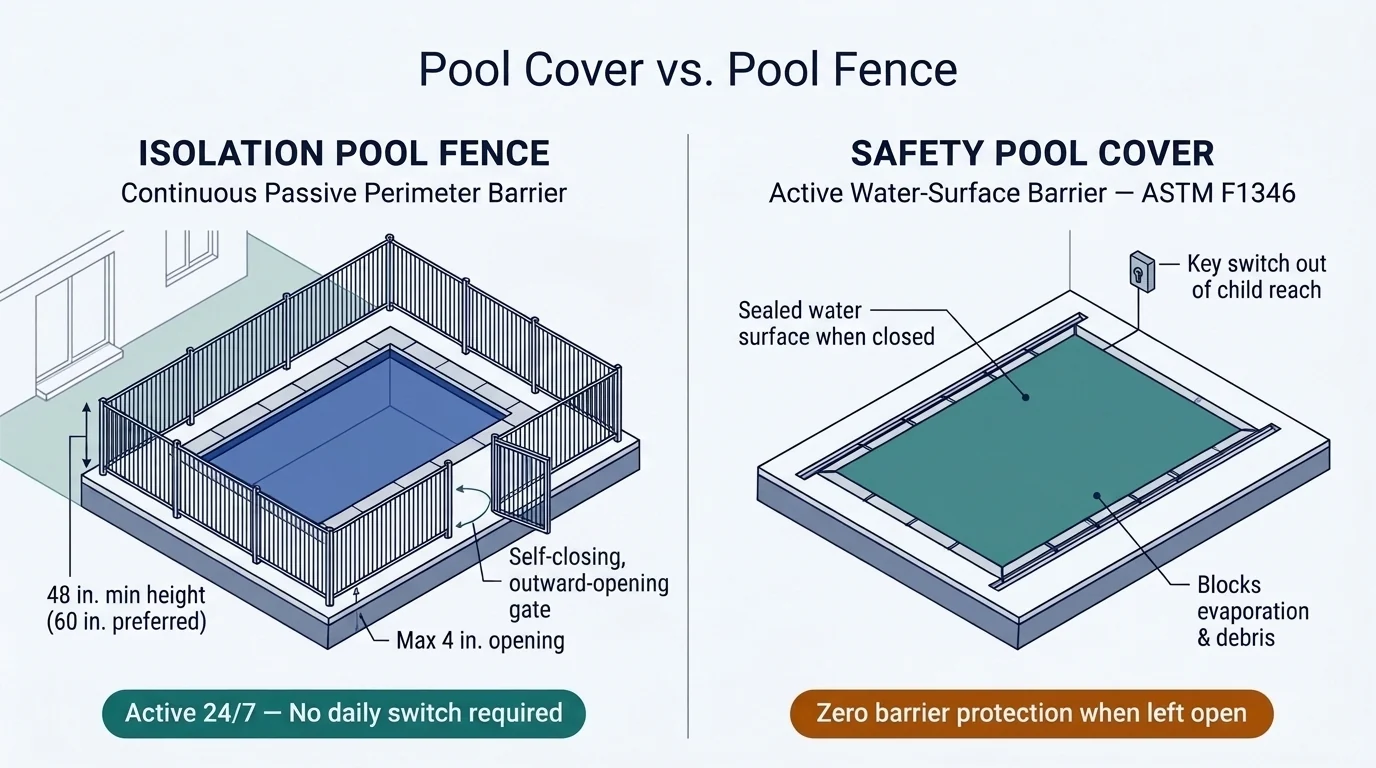
A four-sided isolation pool fence is the safer baseline barrier because it protects a pool continuously without relying on switches, motors, or remembering to close a cover. An ASTM F1346 safety pool cover—especially a powered cover—cuts evaporation and adds a tested water-surface barrier when closed, yet state and local codes determine whether it can replace fencing.
What are the pros and cons of a pool cover vs a pool fence?
The core tradeoff between a pool cover and a pool fence is continuous passive perimeter control versus an active water-surface seal that also saves water and heat. A four-sided isolation fence with a self-closing, self-latching gate stays upright continuously, whereas an automatic or manual safety cover inhibits water access only when someone closes and secures it.
According to U.S. EPA WaterSense pool water efficiency guidance, using a pool cover can prevent up to 95% of pool water evaporation, reduce cleaning requirements and chemical use, help pool water retain heat, and provide a measure of safety when applied consistently and appropriately through manual, semi-automatic, or automatic controls. Yet under ASTM International Standard Performance Specification F1346-23, safety covers reduce drowning risk only when correctly installed and used in accordance with manufacturer instructions, leaving the water open whenever a cover is retracted during gatherings, left unclosed between swims, or out of service for repair. By contrast, a permanent isolation fence remains in place continuously independent of switches, motors, or daily closure habits.
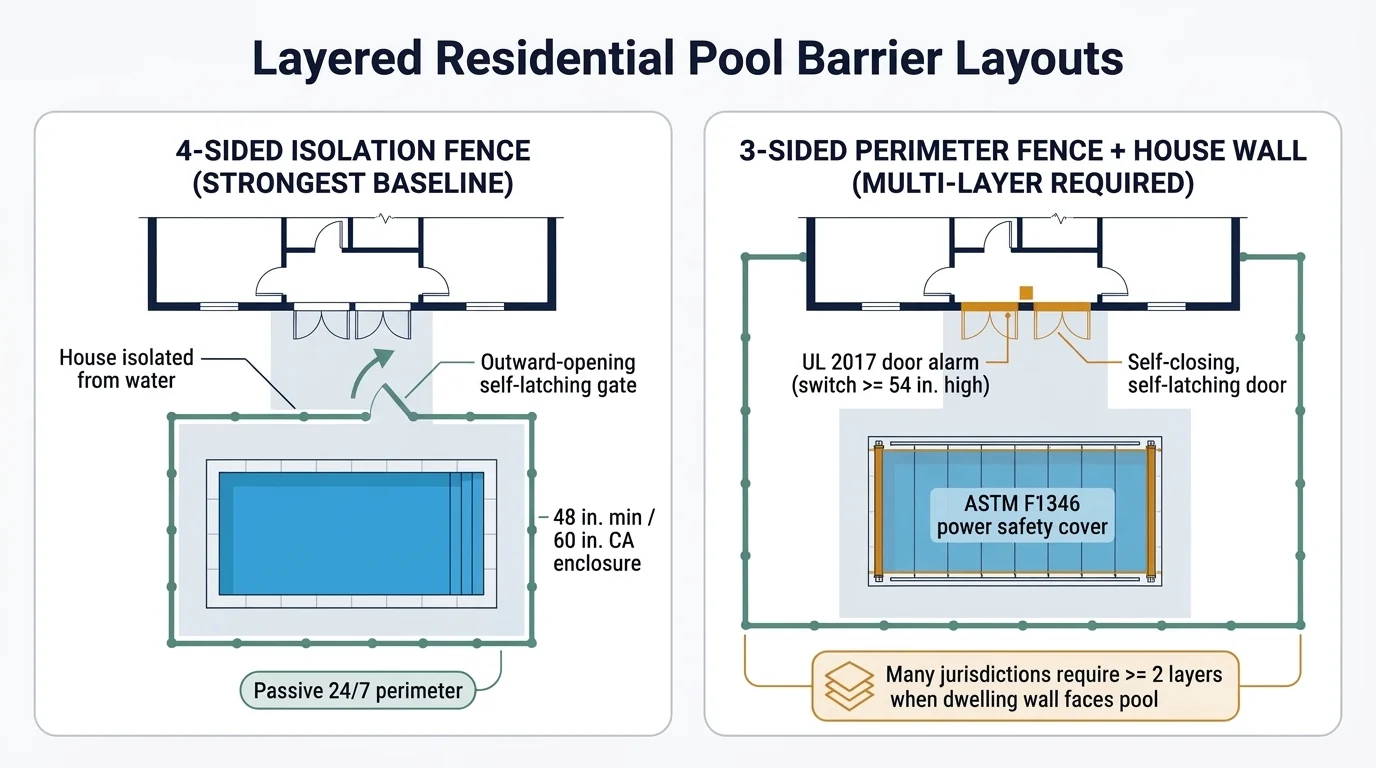
The U.S. Consumer Product Safety Commission Safety Barrier Guidelines for Residential Pools emphasize that barriers are not child proof and cannot replace adult supervision; instead, fences, house door alarms, and power safety covers work together as layers of protection during a lapse in supervision. To explore certified cover families before comparing layouts, start with our pool safety covers hub.
| Comparison Factor | Four-Sided Isolation Pool Fence | Certified Safety Pool Cover (Automatic or Manual) |
|---|---|---|
| Protection mode | Passive continuous perimeter barrier independent of daily operation | Active water-surface barrier that protects only while closed and properly used |
| Primary consensus standard | ASTM F2286-16(2023) for removable mesh fencing; local fence codes for permanent barriers | ASTM F1346-23 for manual and powered safety covers plus cover labeling |
| Core operational weak link | Gate propped open, broken self-closer, or climbable object placed beside fence | Cover left open during gatherings, skipped closure, or mechanical fault |
| Non-safety utility | Separates yard and patio from the pool without covering the water surface | Prevents up to 95% of evaporation, helps retain heat, and reduces cleaning and chemical use |
| Typical code role | Baseline residential enclosure mandated across state and local barrier codes | Exempts perimeter fencing under unamended ISPSC Section 305.1 for powered covers, or serves as one layer in multi-feature and state codes |
Which is safer: an automatic pool cover or a pool fence?
A four-sided isolation pool fence with a self-closing, self-latching gate is safer as a standalone barrier because its protection does not fail when a busy household leaves a switch unpressed. Epidemiological evidence consistently backs four-sided isolation fencing as the strongest single physical intervention against unsupervised child entry.
In the Cochrane Database systematic review on pool fencing covering three case-control studies, fenced pools reduced drowning or near-drowning risk with an odds ratio of 0.27 (95% CI 0.16 to 0.47) compared with unfenced pools. Isolation fencing enclosing the pool alone was markedly superior to three-sided perimeter fencing that allows house access, achieving an odds ratio of 0.17 (95% CI 0.07 to 0.44); the review notes that adequate fencing preventing unsupervised access can prevent about three-quarters of child pool drownings.
National surveillance reinforces why passive protection at home matters. CPSC submersion data show nearly 300 children younger than 5 drown in pools and spas each year (75% of the 390 fatalities under 15), with children aged 1 to 3 years (12 months through 47 months) representing 67% of fatalities and 66% of injuries, and residential locations accounting for 85% of under-5 fatalities and 54% of injuries. Similarly, an Injury Prevention analysis of US drowning mortality recorded 4,509 US drowning deaths (including 840 in swimming pools), estimated that adequate four-sided isolation fencing could prevent 51 child drowning deaths per year using a conservative 19% US effectiveness estimate (compared with 40%–70% in earlier Australia and New Zealand studies), and highlighted the US National Water Safety Action Plan recommendation for four-sided isolation fencing.
An automatic safety cover still strengthens household protection substantially when paired with a fence, because it seals the water surface between swim sessions and CPSC advises keeping covers well-maintained with control devices out of children's reach. When evaluating drive mechanisms and daily closing habits, review our automatic pool covers guide and our comparison of automatic versus manual safety covers.
When can an automatic pool cover replace a pool fence under building codes?
An automatic pool cover can legally replace a pool fence only when the local building authority enforces an unamended code—such as International Swimming Pool and Spa Code (ISPSC) Section 305.1—that explicitly allows a powered ASTM F1346 safety cover in lieu of perimeter fencing. Never assume a cover qualifies without written pre-permit confirmation from your building department.
There is no single nationwide residential pool barrier statute in the United States. CPSC explicitly states that its barrier guidelines are not mandatory federal requirements and directs pool owners to check local building codes, while the Injury Prevention drowning study likewise notes that pool fencing laws for newly installed pools vary by jurisdiction. Similarly, ASTM F1346-23 (the active edition last updated Jul 13, 2023) establishes performance tests in Sections 1.1 and 1.2 intended to inhibit water access by children under five when properly installed and used, plus marking requirements for all covers—yet Section 1.4 explicitly places responsibility on the user to determine applicable regulatory limitations before use.
Model federal and code frameworks treat powered covers differently depending on local adoption. Under CPSC guidelines, where a house wall forms the fourth side of a perimeter fence, three dwelling-wall safeguards apply: UL 2017 Section 77 door alarms (sounding at least 85 dBA at 10 feet for 30 seconds or more within 7 seconds of opening, with auto-reset and a temporary deactivation switch of up to 15 seconds mounted at least 54 inches above the threshold), a power safety cover conforming to ASTM F 1346-91, or equivalent self-closing and self-latching doors—and CPSC warns never to have a pet or doggy door leading directly to a pool without an isolation fence. Under ISPSC Section 305—as published in Prince William County's ISPSC Residential Pool Barrier Requirements and Scottsdale's 2021 ISPSC Section 305 code text—standard barriers require a 48-inch minimum height (raised to 60 inches by local amendments such as Scottsdale Section 305.2.1), 4-inch sphere opening limits (Section 305.2.2), outward-opening self-closing and self-latching pedestrian gates with exterior latch releases at least 54 inches high or pool-side releases at least 3 inches below the top (Sections 305.3 and 305.3.3), and removable mesh fences within 1 inch of the deck and at least 20 inches from water (Sections 305.2.4 and 305.2.4.1), while Section 305.1 exempts swimming pools with a powered ASTM F1346 safety cover and spas or hot tubs with a lockable ASTM F1346 cover from Sections 305.2 through 305.7.
State and municipal amendments frequently remove that fence exemption. For example, North Carolina Office of the State Fire Marshal guidance on NCRC Section AV105.2 emphasizes that North Carolina's Building Code Council deliberately chose not to adopt the ISPSC powered-cover-in-lieu-of-barrier exception; under NCRC AV105.2 Item 9, a powered ASTM F1346 cover substitutes only for UL 2017 dwelling-wall door alarms and does not eliminate the rest of the perimeter barrier. Before signing a contract, inspect our ASTM F1346 pool safety cover verification guide.
横向滑动以对照每一列。
| Code Framework or Jurisdiction | Can a Powered ASTM F1346 Cover Replace a Fence? | Mandatory Enclosure & Gate Baseline | Required Dwelling-Wall or Secondary Layer |
|---|---|---|---|
| CPSC Safety Barrier Guidelines (Advisory) | Not a federal mandate; lists power cover as a dwelling-wall safeguard or added layer | 48 in. minimum height (60 in. preferable); max 4 in. openings; outward self-closing/self-latching gate | UL 2017 Section 77 door alarms (85 dBA at 10 ft), ASTM F 1346-91 power cover, or self-closing doors; no pet doors |
| International Swimming Pool and Spa Code (ISPSC Section 305) | Yes under unamended Section 305.1 for powered ASTM F1346 pool covers (and lockable spa covers), unless locally amended | 48 in. model height (60 in. where locally amended); 4 in. sphere limit; outward self-closing gate (54 in. latch); mesh max 1 in. gap and at least 20 in. from water | States such as North Carolina (NCRC AV105.2) reject the cover-in-lieu-of-barrier allowance and limit powered covers to replacing UL 2017 door alarms |
| California SB 442 / HSC Sections 115922 and 115923 | No on its own; counts as one of two required safety features | 60 in. isolation enclosure (Section 115923, max 2 in. bottom clearance, 60 in. gate latch) or ASTM F2286 removable mesh fence with key-lockable gate | Choose at least 2 of 7 features (enclosure, ASTM F2286 mesh fence, ASTM F1346 cover, exit alarms, 54 in. self-closing doors, ASTM F2208 alarm, or lab-verified equivalent) |
| New York 2020 Residential Code R326.4.2 | No; exempts the ASTM F2208 water-entry pool alarm, not the permanent barrier | 48 in. permanent barrier for pools deeper than 24 in.; max 2 in. bottom clearance; lockable outward self-latching gate | UL 2017 door alarms (54 in. bypass switch; 48 in. Accessible) and 48 in. window latches when house forms barrier |
How do California barrier rules treat pool covers vs pool fences?
California does not allow a safety pool cover alone to satisfy barrier law: under California Health & Safety Code Section 115922 as amended by SB 442, new or remodeled residential swimming pools deeper than 18 inches at private single-family homes must include at least two of seven approved drowning prevention safety features. As the Town of Woodside Building Department notes, even where California Building Code Section 3109.4 exempts a pool with an ASTM F1346 power safety cover from that section's perimeter barrier rule, the homeowner still must provide at least two qualifying features under HSC Section 115922 and SB 442.
As documented in Los Angeles County Public Works Building Code Manual 3109.2 (which enforces ASTM F1346-23 compliance labeling on qualifying safety covers and defines regulated swimming pools as structures holding water over 18 inches deep) and San Joaquin County's California HSC Sections 115922 and 115923 compliance requirements, the seven statutory options are:
- An enclosure isolating the pool from the home complying with Section 115923 (minimum 60 inches tall, max 2-inch bottom vertical clearance, no gaps allowing a 4-inch sphere, climb-resistant exterior surface, and outward-opening self-closing gates with a self-latching release no lower than 60 inches above ground).
- Removable mesh pool fencing meeting ASTM F2286 with a self-closing, self-latching gate that accommodates a key-lockable device.
- An approved manual or power-operated safety pool cover complying with ASTM F1346 (verified by an ASTM F1346-23 compliance label under Los Angeles County BCM 3109.2).
- Exit alarms on private single-family home doors providing direct access to the pool.
- Self-closing, self-latching devices on doors giving direct pool access with release mechanisms placed no lower than 54 inches above the floor.
- An independently certified ASTM F2208 pool alarm that sounds upon accidental or unauthorized entrance into the water (individual wearable child alarms do not qualify).
- Other means of protection independently verified by an approved testing laboratory to ASTM or ASME standards to provide equal or greater protection, subject to Building Official approval.
Why do California researchers still prioritize an isolation enclosure under SB 442?
Even with California's two-feature mandate, emergency medicine researchers found no decline in fatal toddler drownings and caution that only one of the seven statutory options—a four-sided enclosure isolating the pool from the home—represents a true best practice. Relying on two active or alarm-only options leaves households vulnerable to missed closures or muted alarms.
In a Western Journal of Emergency Medicine study of California drownings from 2017–2021, Agran et al. documented 4,166 drowning incidents among young children (234 fatalities, 846 hospitalizations, and 3,086 emergency department visits), with 65% of fatalities occurring in pools and no statistically significant reduction in annual fatality rates (P = 0.88). While the original California Pool Safety Act took effect January 1, 1997, and SB-442 expanded requirements in 2017 to two features plus home-sale and remodel inspections, Agran et al. point out that there is no documentation of ongoing compliance after a one-time inspection and that only an isolation enclosure meeting California Building Standards Code specifications isolates the water passively from the house.
What are the legal pool fence requirements in New York State?
New York requires residential swimming pools deeper than 24 inches to have a permit and a permanent 48-inch barrier with max 2-inch bottom clearance, plus outward-opening, self-closing, self-latching, lockable gates. An automatic ASTM F1346 power safety cover exempts a pool from New York's separate water-entry alarm mandate, not from the permanent enclosure.
As published by the Town of Kent Building Department from New York's 2020 Residential Code Section R326.4.2, residential pool enclosures follow strict geometric and hardware rules:
- Barrier height and bottom gap: Minimum 48 inches above grade measured on the outside of the barrier, with vertical clearance between grade and the bottom of the barrier not greater than 2 inches.
- Gate hardware and locks: All gates must be self-closing and self-latching, pedestrian gates must open outward away from the pool, the latch handle must sit on the pool side at least 40 inches above grade (and if under 54 inches, at least 3 inches below the top with no opening over 0.5 inch within 18 inches), and gates must be locked with a key, combination, or child-proof lock when unsupervised.
- Dwelling-wall protections: Where a house wall forms part of the barrier, direct-access doors shall be equipped with UL 2017 audible alarms activating within 7 seconds for at least 30 seconds (with a temporary manual bypass up to 15 seconds located 54 inches or more above the threshold, or 48 inches in Accessible units) and operable windows shall have latches at least 48 inches above the floor preventing passage of a 4-inch-diameter sphere, unless equivalent approved self-closing and self-latching protection is installed.
- Pool alarm mandate and ASTM F1346 exception: Pools installed, constructed, or substantially modified after December 14, 2006 require an ASTM F2208 water-entry pool alarm, with explicit alarm exceptions for a hot tub or spa with an ASTM F1346 safety cover or a swimming pool equipped with an automatic power safety cover complying with ASTM F1346.
How does a pool safety net compare with a pool fence and safety cover?
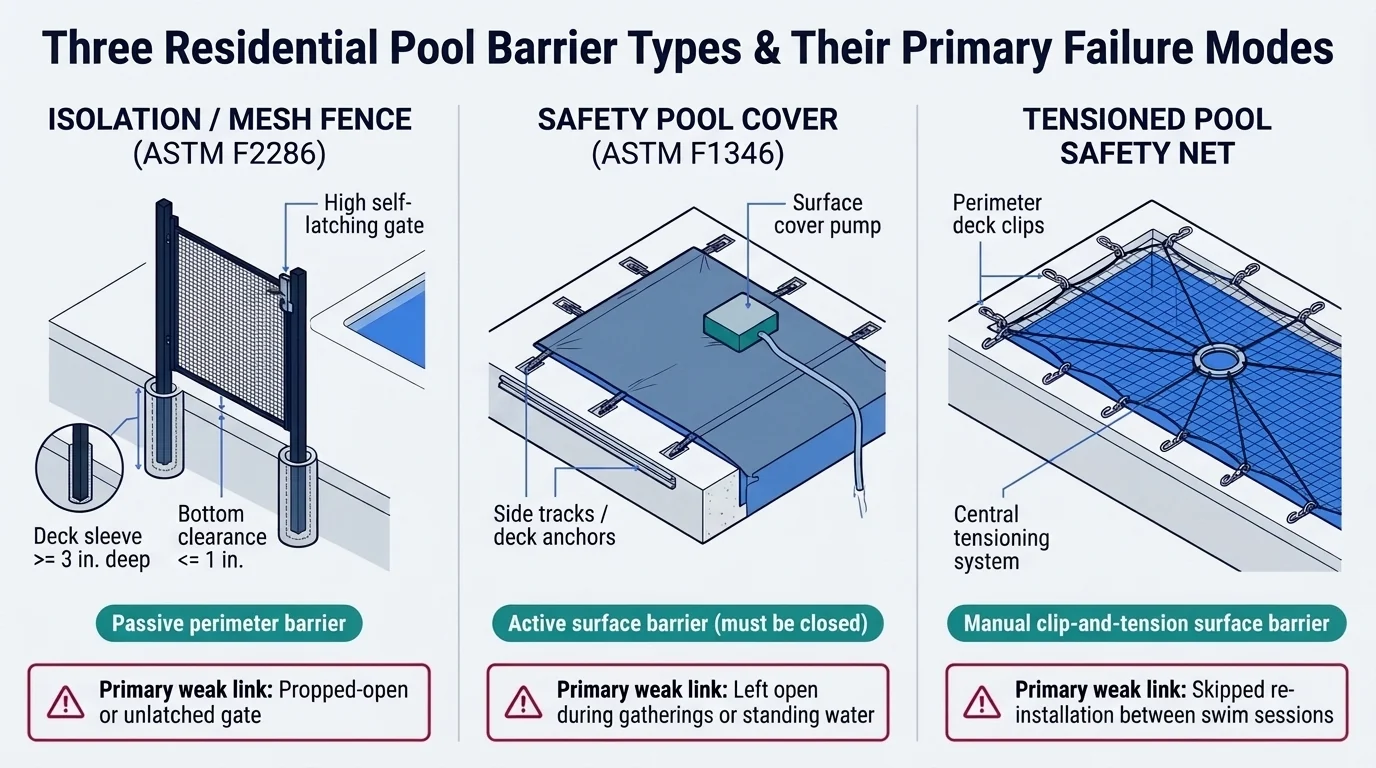
A tensioned pool safety net sits between a fence and a cover in workflow: like a manual cover, it spans the water surface and must be unclipped and re-tensioned every time you swim, so it never delivers the continuous passive convenience of a fenced gate. Unlike an automatic or solid cover, an open-grid net leaves the water exposed to evaporation and fine debris.
Two distinct ASTM specifications govern removable mesh fences versus safety pool covers. ASTM F2286-16(2023) (catalog designation F2286-16R23, Active, last updated Mar 21, 2023) defines design and performance requirements in Scope 1.1 for removable mesh safety barriers for swimming pools, hot tubs, and spas to reduce injuries or death for infants and children up to and including five years of age. CPSC barrier guidelines advise locking removable mesh fences into the deck so removal requires extensive use of tools, standing at least 48 inches tall with posts at least 3 inches below grade spaced no more than 40 inches apart and bottom clearance no greater than 1 inch above the deck (versus up to 4 inches on solid surfaces and 2 inches on grass or pebbles for rigid fences, with barrier openings blocking a 4-inch diameter sphere and vertical spacing capped at 1¾ inches when horizontal rails sit less than 45 inches apart); ISPSC Sections 305.2.4 and 305.2.4.1 add a 4-inch maximum lift limit, 45-inch minimum section-attachment height, nonconductive deck sleeves, and a 20-inch minimum setback from the water's edge.
By contrast, ASTM F1346-23 establishes performance test requirements for safety covers (Sections 1.1 and 1.2) and marking requirements for all covers, while Section 1.4 directs users to verify local regulatory limitations before relying on any product for code compliance. If you are considering a tensioned pool safety net instead of a labeled ASTM F1346 cover or fence, verify in advance whether your Building Official accepts independent laboratory verification under local alternative-means clauses (such as California HSC Section 115922's seventh option requiring independent testing to ASTM or ASME standards and case-by-case approval). Untested leaf or solar debris covers carry no ASTM F1346 safety-cover performance certification and must never substitute for a fence or certified safety cover. For manual anchor layouts on concrete and pavers, read our pool safety cover installation and deck anchoring guide.
横向滑动以对照每一列。
| Barrier System | Governing Standard | Clearance & Geometry Benchmark | Daily Effort & Non-Safety Tradeoff |
|---|---|---|---|
| Permanent four-sided isolation fence | State & local codes; CPSC barrier guidelines; ISPSC Section 305 | 48 in. min height (60 in. CA/amended ISPSC/preferred); max 4 in. sphere opening; max 4 in. solid or 2 in. grass/CA/NY bottom gap | Walk through self-closing outward gate; zero daily setup; no evaporation or debris blocking |
| Removable mesh pool fence | ASTM F2286-16(2023) (F2286-16R23); ISPSC Section 305.2.4 | 48 in. min height; deck posts at least 3 in. deep and max 40 in. apart; max 1 in. bottom gap; at least 20 in. from water; tool-locked nonconductive sleeves | Passive perimeter while installed; removable only with tools; deleted from approvable barriers in some amended codes (e.g., 2024 NCRC) |
| Manual or automatic safety pool cover | ASTM F1346-23 | Sealed perimeter track or deck-anchored tension; compliance label and manufacturer-specified installation | Push-button closure (automatic) or manual anchoring; prevents up to 95% of evaporation, retains heat, and cuts cleaning |
| Tensioned pool safety net | Subject to Building Official review and lab verification under local alternative-means rules (e.g., CA HSC Section 115922 option 7) | Requires written local approval and independent laboratory verification to ASTM or ASME standards before permitting | Manual perimeter unclipping and re-tensioning every swim; leaves water open to evaporation and fine debris |
| Leaf or solar debris cover | Not a safety barrier (marking requirements only under ASTM F1346-23 Section 1.2) | Untested against ASTM F1346 child-access performance requirements and carries no safety-cover compliance label | Cannot satisfy barrier codes and must never substitute for a fence or ASTM F1346 safety cover |
How do pool cover vs pool fence costs and ownership tradeoffs compare?
Comparing ownership commitments without guessing local contractor quotes comes down to scope complexity, expected service life, insurance underwriting, and compliance re-work risk. A perimeter fence is a single structural installation with minimal ongoing mechanics, whereas a powered safety cover adds mechanical drives, tracks, drainage, electrical circuits, and periodic fabric maintenance alongside ongoing water, heat, and chemical savings.
Peer-reviewed public health research highlights three practical ownership factors that buyers often overlook. First, service lifespan varies by construction: a Texas cost-benefit analysis of universal pool fencing modeled a conservative 10-year fence lifespan while noting that many pool safety experts estimate removable mesh fencing lasts 15–20 years. Second, the same study points out that despite AAP and CPSC recommendations, nearly two-thirds of pool-owning parents still lack four-sided isolation fencing and routine post-permit inspections seldom occur—yet homeowners insurance underwriting frequently enforces its own floor. Most Texas home insurance policies require pools to be enclosed by a secure fence at least four feet in height, and noncompliance can lead to denied coverage or policy cancellation, even though insurers rarely distinguish three-sided from four-sided fencing.
Third, buying against national marketing claims instead of verified local code amendments creates avoidable replacement waste. The North Carolina Office of the State Fire Marshal specifically cautions that manufacturer literature contains overly broad statements regarding multi-state compliance—for example, North Carolina does not adopt the ISPSC powered-cover-in-lieu-of-barrier allowance and deleted non-metallic mesh barriers under its 2024 Residential Code—while jurisdictions such as California (HSC Section 115923) and Scottsdale (Section 305.2.1) enforce a 60-inch minimum fence height rather than the 48-inch CPSC and model ISPSC floor. Installing a shorter fence, an unapproved mesh infill, or an unlabeled leaf or solar cover leaves final inspection unresolved. For line-item scope planning on automatic systems without relying on generic price guesses, review our automatic pool cover cost scope breakdown.
What should you verify with your building department before choosing a barrier?
Before ordering a fence, safety cover, or layered combination, get written answers on six compliance points from your local building department, homeowner association, and homeowners insurance carrier so your barrier layout passes final inspection without expensive redesigns, delayed permits, or coverage gaps:
- Adopted code edition and cover rule: Ask which code edition applies (such as ISPSC Section 305, North Carolina NCRC AV105.2, California SB 442 / HSC Section 115922, or New York Residential Code R326.4.2) and whether a powered ASTM F1346-23 cover is accepted in place of a fence, counts as one of two required features, or exempts only door alarms or an ASTM F2208 pool alarm.
- Required fence height and layout: Confirm whether your jurisdiction enforces a 48-inch or 60-inch barrier (as in California HSC Section 115923 and Scottsdale Section 305.2.1), whether non-metallic mesh barriers are permitted, and whether a four-sided isolation enclosure separating house doors from the water is required.
- Clearances and climbability dimensions: Verify bottom clearance limits (4 inches solid surface, 2 inches grass, California, or New York code, 1 inch removable mesh fence), 4-inch sphere opening rules, 20-inch mesh water-edge setbacks, and vertical spacing limits when horizontal rails sit under 45 inches apart.
- Gate swing, latch height, and locking hardware: Confirm outward-opening self-closing and self-latching gate rules, minimum latch height (54 inches under CPSC/ISPSC, 60 inches under California Section 115923, or pool-side 3 inches below top with no opening over ½ inch within 18 inches), and key or child-proof lock mandates.
- Dwelling-wall doors, windows, and pet doors: If a house wall forms one side of the barrier, confirm UL 2017 door alarm specifications (85 dBA at 10 feet, 30-second sound within 7 seconds, bypass switch at 54 inches), operable window latch heights, and local restrictions on pet doors.
- Written compliance packet and insurance check: Confirm that the installed safety cover carries verification of ASTM F1346-23 performance and labeling requirements. Verify that any removable mesh pool fence complies with ASTM F2286-16(2023) design and performance specifications, and confirm your homeowners insurer's minimum four-foot fence requirement in writing.
Sources
Barrier geometry benchmarks, ASTM designations, epidemiological odds ratios, state and model code rules, and pool cover performance tradeoffs in this comparison draw on the following regulatory, standards, peer-reviewed, and municipal code references:
- U.S. Consumer Product Safety Commission: Safety Barrier Guidelines for Residential Pools — Child submersion statistics, layers of protection, 48-inch and 60-inch barrier heights, bottom clearances, 4-inch sphere limits, gate latch geometry, UL 2017 Section 77 door alarms, and pet door warnings
- ASTM International: Standard Performance Specification F1346-23 — Active standard (last updated Jul 13, 2023) establishing safety cover performance tests to inhibit access by children under five, marking requirements for all covers, and Section 1.4 regulatory limitation caveat
- ASTM International: Standard Design and Performance Specification F2286-16(2023) — Active standard (F2286-16R23, last updated Mar 21, 2023) defining removable mesh pool fencing design and performance requirements for infants and children up to five years of age
- U.S. Environmental Protection Agency (EPA) WaterSense: Pool Water Efficiency — Pool cover evaporation prevention (up to 95%), heat retention, cleaning and chemical reductions, and consistent-use safety guidance
- Prince William County, VA Building Development Division: Residential Pools, Spas, and Hot Tubs Barrier and Safety Requirements — ISPSC 48-inch baseline barrier height, 2-inch grass and 4-inch solid clearances, 4-inch sphere opening limit, and ASTM F1346 powered pool cover and lockable hot tub cover barrier exceptions
- City of Scottsdale, AZ: 2021 International Swimming Pool and Spa Code (ISPSC) Section 305 Barrier Requirements — ISPSC Section 305.1 ASTM F1346 cover exemption, Sections 305.2.4 and 305.2.4.1 removable mesh clearances and 20-inch water setback, Sections 305.3–305.3.4 gate latch heights, and local Section 305.2.1 60-inch height amendment
- North Carolina Office of the State Fire Marshal: Common Pool Barrier Questions (NCRC Section AV105.2 and ISPSC 305.1) — State rejection of the ISPSC powered-cover-in-lieu-of-barrier exception, limitation of powered ASTM F1346 covers to replacing UL 2017 door alarms under AV105.2 Item 9, and 2024 NCRC deletion of non-metallic mesh barriers
- Los Angeles County Public Works: Building Code Manual 3109.2 — Enclosure and Safety Features for Swimming Pools — California Swimming Pool Safety Act (HSC 115920–115929) 18-inch depth definition, ASTM F1346-23 safety cover labeling, ASTM F2286 removable mesh fencing, and ASTM F2208 pool alarms
- Town of Woodside, CA Building Department: Swimming Pools, Spas & Hot Tubs (SB 442 / HSC Section 115922) — California SB 442 two-of-seven drowning prevention requirement and interaction with California Building Code Section 3109.4
- San Joaquin County, CA Community Development Department (Swimming Pool Barrier Requirements — California HSC Sections 115922 and 115923) — Complete seven-feature statutory menu under Section 115922 (including lab-verified ASTM/ASME alternative means) and Section 115923 60-inch enclosure, 2-inch bottom clearance, and 60-inch gate latch specifications
- Thompson DC, Rivara FP — Cochrane Database of Systematic Reviews: Pool fencing for preventing drowning of children — Case-control meta-analysis showing OR 0.27 for fenced vs. unfenced pools and OR 0.17 for four-sided isolation fencing vs. three-sided perimeter fencing
- Agran PF et al. — Western Journal of Emergency Medicine: Drowning Among Young Children in California, 2017–2021 — Analysis of 4,166 California pediatric drowning incidents (65% of fatalities in pools), California Pool Safety Act (1997 / SB-442 2017), and isolation-enclosure best-practice review
- Peterson C et al. — Injury Prevention: Unrealised potential of pool fencing and life jackets to prevent US drownings — National US drowning mortality counts (4,509 total; 840 pool deaths; 51 preventable child pool deaths per year), jurisdictional variation in fencing laws, and US National Water Safety Action Plan recommendations
- Rhodes J, Nguyen L, Shenoi RP — Injury Epidemiology: Cost-benefit analysis of universal pool fencing for Texas households with young children — Isolation fencing adoption gaps, 10-year model vs. 15–20 year mesh fence lifespan estimates, post-permit inspection limits, and four-foot homeowners insurance underwriting baselines
- Town of Kent, NY Building Department (Pools — 2020 Residential Code of New York State Section R326.4.2) — New York 24-inch pool permit threshold, 48-inch permanent barrier and 2-inch clearance rules, pool-side gate latch and lock mandates, UL 2017 dwelling-wall door alarms, and ASTM F2208 pool alarm exception for ASTM F1346 automatic power safety covers
常见问题
- Can a solar blanket or leaf cover satisfy a pool safety cover code requirement?
- No. ASTM F1346-23 places child-access performance testing specifically on safety covers and marking requirements on all covers, and state code manuals such as Los Angeles County Building Code Manual 3109.2 require qualifying safety covers to carry a compliance label verifying ASTM F1346-23 performance. Untested solar blankets and leaf covers must never substitute for a fence or certified safety cover.
- Why does a four-sided isolation fence outperform a three-sided yard fence?
- A four-sided isolation fence separates the water directly from house doors as well as the yard, eliminating unsupervised indoor-to-pool exits. In the Cochrane systematic review of case-control studies, four-sided isolation fencing achieved an odds ratio of 0.17 (95% CI 0.07 to 0.44) compared with three-sided perimeter fencing.
- Does an automatic pool cover eliminate the need for a fence in California or New York?
- Not by itself in either state. California Health & Safety Code Section 115922 (SB 442) requires at least two of seven approved safety features for new or remodeled pools over 18 inches deep, so an ASTM F1346 cover counts as only one layer; New York Residential Code Section R326.4.2 requires a 48-inch permanent enclosure for pools deeper than 24 inches and lets an automatic ASTM F1346 cover exempt only the separate ASTM F2208 pool alarm.
- What gate latch and clearance dimensions do CPSC guidelines specify for pool fences?
- CPSC barrier guidelines specify outward-opening, self-closing, self-latching lockable pedestrian gates where any latch release lower than 54 inches from the bottom sits on the pool side at least 3 inches below the gate top with no opening wider than ½ inch within 18 inches, paired with a maximum 4-inch bottom gap on solid surfaces, 2 inches on grass or pebbles, and 1 inch on removable mesh fences.
- Can a home with a pet door rely on a perimeter fence instead of an isolation fence?
- No. CPSC guidelines warn never to have a pet or doggy door leading directly to a pool because locking pet doors is insufficient and young children can crawl through them; an isolation fence separating the pool from the home is the recommended defense whenever pet doors exist.
上级栏目: Pool safety covers