Updated October 2026
Undertrack vs Top Track vs Recessed Pool Cover Tracks
Choosing the track after the coping is fixed can leave costly deck rework. Compare undertrack, top track and recessed deck track by the surface they attach to, the space the moving cover needs and the work still possible on your site.
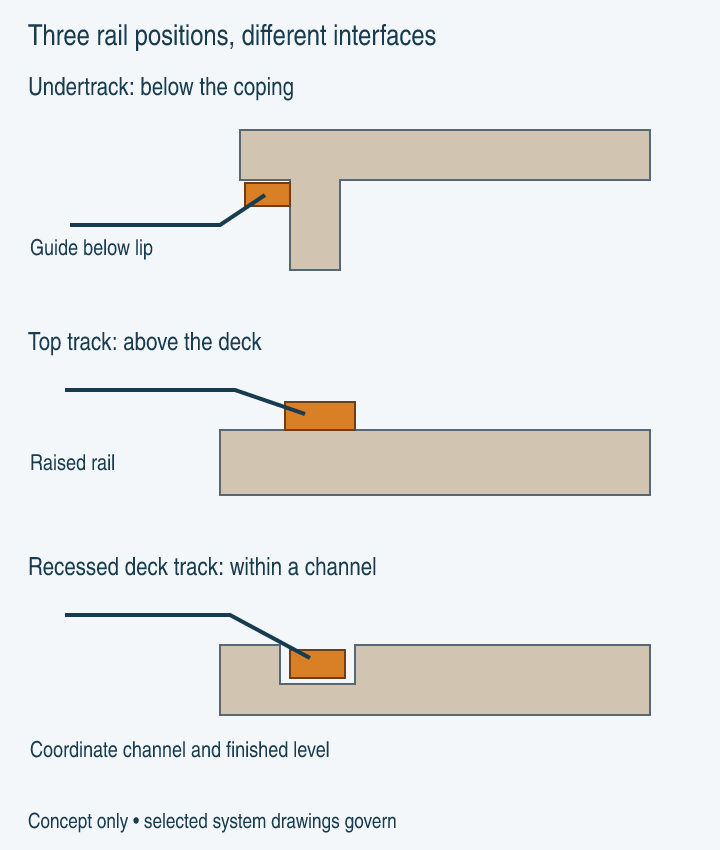
This is a comparison of installation routes from public manufacturer documents, not our product testing or a construction detail. Use it with the pool cover track systems guide. “Recessed” can describe either the guide rail or the roll-up mechanism; ask which one a proposal means.
Quick comparison inputs
| Input or item | Value or source | Why it matters |
|---|---|---|
| Construction stage | New pool, open deck or completed coping | Determines which interfaces can still be coordinated |
| Deck and coping build-up | Section with structural substrate identified | A visible paver does not identify what can support a fixing |
| Track path | Dimensioned plan showing both parallel guides | Defines the moving cover envelope |
| Leading edge | Supplier section in open and closed positions | Reveals clearance beyond the rail itself |
| Mechanism housing | Separate plan and section | Track choice does not settle box and lid details |
| Service access | Installer's removal and maintenance method | Shows what must remain reachable after finishing |
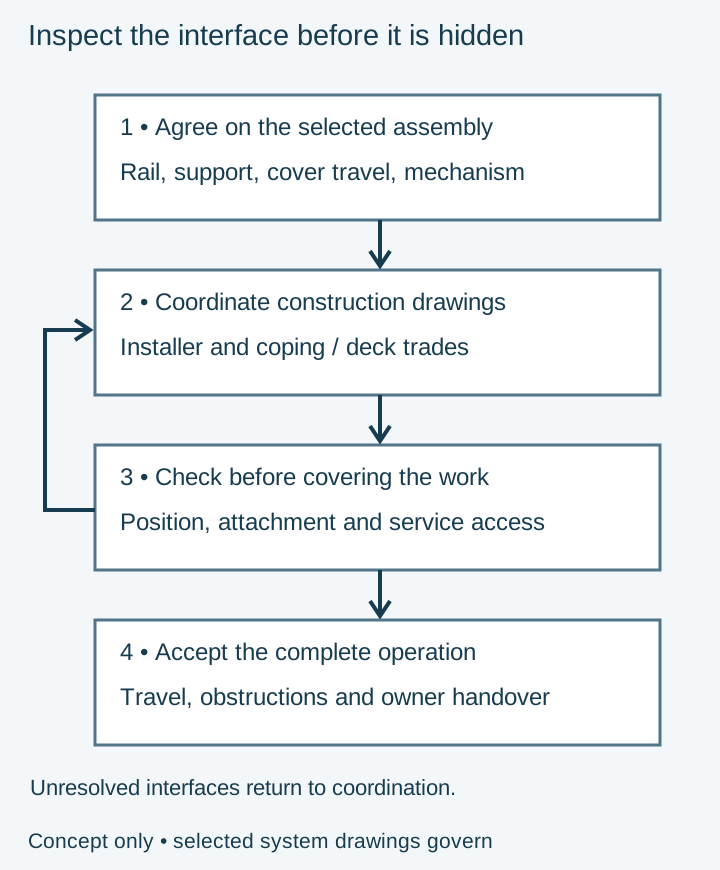
For a new pool installation, obtain these drawings before finalizing coping and deck work. For an existing pool, record what can be removed and restored; a statement that a track “fits” does not define the demolition allowance.
Takeaway: Compare the proposed installation boundary before comparing appearance.
Undertrack, top track and recessed track on the same axes
Undertrack places the guide below the coping line or in a suitable wall channel. Top track sits on the deck. Recessed deck track places the guide within a formed or cut channel at the deck surface. These names identify location; they do not establish compatible fixings, coping dimensions or a complete cover layout.
| Decision | Undertrack | Top track | Recessed deck track |
|---|---|---|---|
| Interface to coordinate | Coping underside or wall-channel assembly | Deck anchorage and exposed rail | Deck channel, anchorage and finished level |
| Construction opportunity | Before coping, or a specifically assessed alteration | Existing deck when substrate and path are suitable | New deck or renovation that allows the required channel |
| Visible feature | Guide below edge; leading edge and housing still need review | Rail remains visible above deck | Rail is lowered into deck; moving components may remain above it |
| Evidence to request | Selected attachment detail and service route | Substrate, edge profile and full travel drawing | Channel section, retained access and leading-edge clearance |
Cover-Pools illustrates under-coping guides and wall channels as different ways to integrate an underside track. Its flush-track documentation describes a channel poured into the deck and identifies deck renovation as an installation opportunity. These are configuration examples, not universal permissions to install any rail in any recess.
For the detailed alternatives, see undertrack integration, deck-mounted top track and recessed top track. The practical choice is the assembly your installer can document for the pool, rather than a general ranking of three names.
Takeaway: Require the proposed rail location, support and service access to be shown together.
Undertrack does not imply one coping detail
Identify whether the track is fastened to the coping or sits inside an encapsulated channel supported by the wall assembly. That distinction changes which part of the construction carries the attachment and what has to be installed before the coping closes the edge.
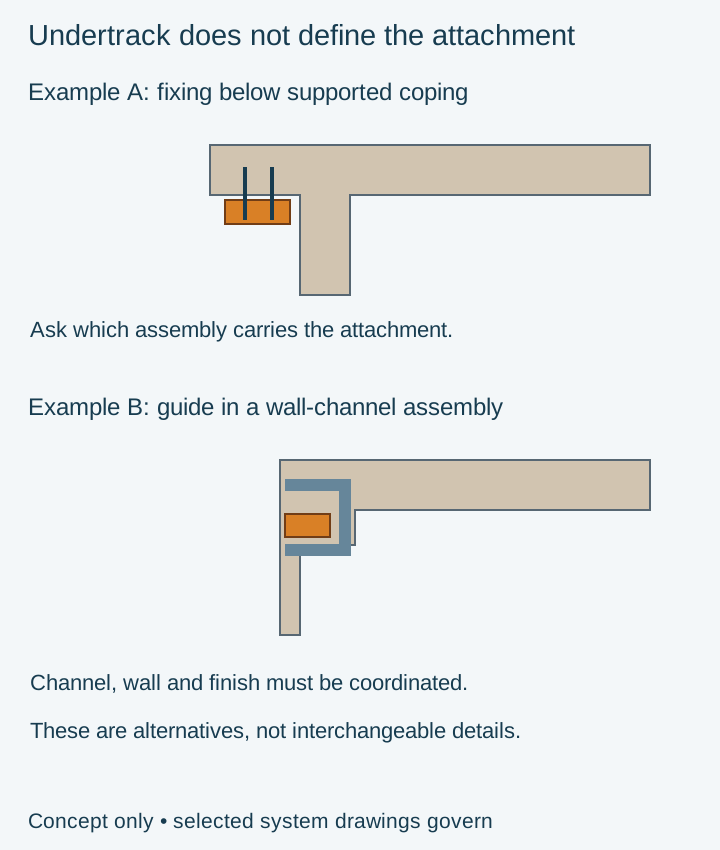
The Coverstar Gunite Pools Photo Guide distinguishes screw-on track from encapsulated track. In the illustrated screw-on route, the connection depends on the coping, its anchorage and its bond to the pool wall. The encapsulated route locates the track in a sleeve attached at the wall. Do not copy a coping overhang from one route into the other or assume that a thin decorative finish can carry the proposed attachment.
Request the actual coping integration detail, including any channel, tile line, joint and removal access. On a remodel, an installer needs to establish the existing condition before promising hidden track. “Undertrack is impossible on every existing pool” is too broad; equally, “we will hide it later” is not a buildable scope.
Common mistake: choosing coping for appearance, then asking the cover installer to make an unrelated fastening detail work underneath it.
Takeaway: Identify the load-supporting assembly before agreeing the coping profile.
A flush rail does not hide the whole moving cover
Review the leading edge, its support hardware and the entrance to the roll-up housing separately from the guide. A rail flush with the deck does not establish that the leading edge will also sit flush or disappear completely when retracted.
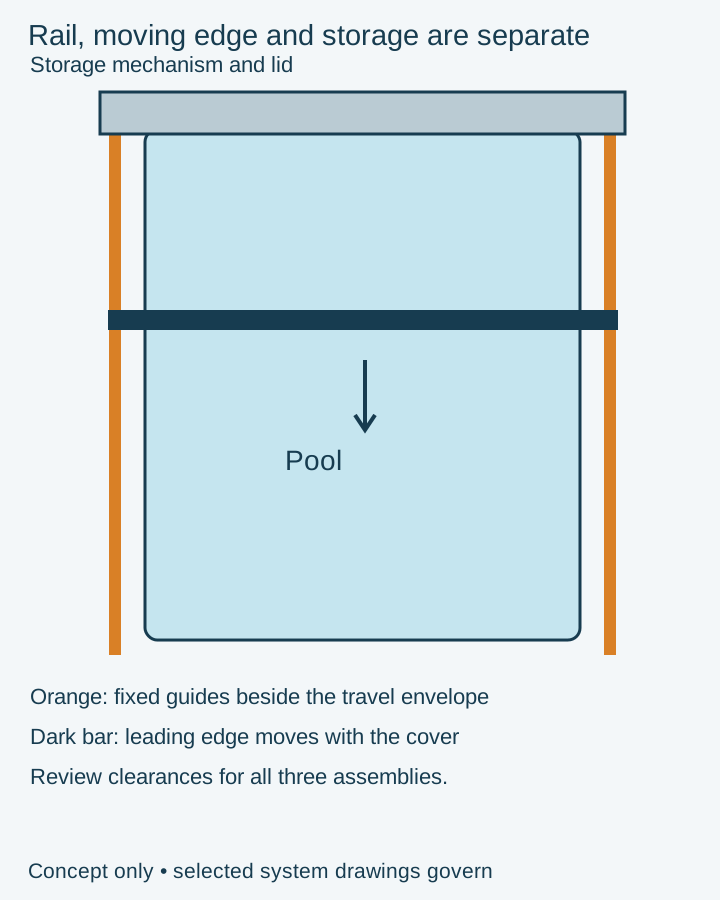
The Coverstar photo guide illustrates different leading-edge support arrangements for underside and top or recessed horizontal tracks. It also shows that a recessed-top-track housing can need a raised lid front or a coordinated deck transition at the cover entrance. Those details explain why a rendering with an invisible rail is insufficient to approve all clearances.
Cover-Pools separately describes deck-mounted tracks with either a recessed mechanism or one housed on the deck. Compare the cover box and housing and lid options as their own decisions. Ask how the lid opens for service and whether its documented load rating permits the intended use; visual continuity with paving does not establish that a lid is walkable.
Takeaway: Ask for the cover both fully extended and fully retracted on the drawing.
Check the cover envelope around an irregular pool
Draw the two parallel track paths and the rectangular moving cover envelope over the entire pool plan. This identifies steps, benches and deck areas crossed by the cover before a rail position is accepted. The pool outline and the cover outline need not be the same.
For a freeform pool, the installer must assess the complete geometry, including the deck the fabric crosses. The manufacturer photo guide calls attention to deck drag: part of the cover travels across a solid surface rather than directly over water. That is a reason to review the layout and material interfaces, not to assume every freeform pool can be covered by moving the rails farther apart.
A raised wall, an attached spa or a water feature introduces another interface. Show it in the construction coordination drawing. A recessed rail cannot resolve a leading edge that collides with a projection or a water feature discharging onto the closed cover.
Takeaway: Approve the full moving envelope, not only two straight lines at the pool sides.
Compare construction and maintenance scope before ordering
A useful proposal states who prepares each interface, when the cover supplier checks it and what remains accessible after the finish is complete. Keep the same cover area, housing assumption and site condition across quotes so that a difference in scope is visible.
| Work item | Record before ordering | Check before acceptance |
|---|---|---|
| Substrate and anchorage | Actual supporting construction and approved attachment detail | Installed support matches the accepted detail |
| Coping or deck channel | Responsibility for forming, cutting and reinstatement | Rail position and finish interfaces remain as drawn |
| Moving clearance | Full travel envelope and retracted leading-edge position | Installer demonstrates unobstructed operation |
| Housing and drainage | Separate enclosure, lid and drainage scope | Required access and drainage route are available |
| Cleaning and replacement | Supplier's service instructions and removal route | Owner receives the instructions and a demonstration |
The Coverstar guide's illustrated top-track and recessed-track applications exclude anchoring those systems to dry-laid pavers. That is a manufacturer-specific substrate restriction, not a basis for inventing an alternative fixing. If the proposed deck uses pavers, identify the supporting construction and request a detail the selected supplier accepts before drilling or ordering.
Use the project specification checklist to capture these responsibilities. For day-to-day care, use the selected equipment manual alongside the track cleaning guide. Hidden track is not maintenance-free, and exposed track is not automatically easier to service in every configuration; access depends on the actual detail.
Common mistake: comparing a surface-rail price with an undertrack price while one quote excludes the deck work and the other includes it.
Takeaway: Put demolition, finish restoration and future service access into the comparison.
When this comparison does not apply
The diagrams do not specify coping strength, rail dimensions, fixings, electrical work or a drainage design. This article does not certify a safety cover, replace the selected manufacturer's installation instructions or establish compliance with local requirements. Rail appearance alone says nothing about the completed system's certification.
If a cover binds, rubs, leaves its guide or will not move, stop using the selection table as a repair instruction. Have the system assessed using its actual product information. Do not alter fasteners, brackets, torque settings or the cover fabric from a conceptual sketch.
Takeaway: Use the comparison to define an installation scope, not to improvise one.
Frequently asked questions
Can a cover be added without damaging much coping or tile?
The installer first needs to identify the available support and travel path. Ask for a written separation between work to existing finishes, new anchorage and any housing excavation. A surface route may preserve some interfaces, but the site survey determines what can actually remain.
Can an automatic cover work with a freeform pool?
Sometimes, using a cover envelope and guide arrangement suited to the entire plan. Ask the supplier to show the deck areas crossed by the fabric, clearance around features and the retracted position. A curved pool outline does not make the fabric follow that curve.
What holds the track screws in a paver deck?
That must be answered by the specified supporting substrate and attachment detail. The presence of paving on top does not identify what a fastener engages underneath. Do not adopt screws or anchors from a video of a different installation.
Why is the leading edge still visible after the cover retracts?
A recessed rail, a recessed housing and a concealed leading edge are separate features. Compare the installed position with the approved drawing and supplier instructions. Visibility alone cannot diagnose an installation error, but the promised retracted position should be documented.
What if the leading-edge bracket rubs under the lid?
Ask the installer to assess the complete clearance and support arrangement. Do not remove a bracket or a supporting plate merely to create space; that component may have another structural role in the assembly. Record the location and operating condition without forcing another cycle.
Why will an undertrack cover not open after winter?
Track type alone cannot identify the cause. Follow the owner's manual for safe checks and contact the qualified service provider with the model, observed behavior and current pool condition. Do not force travel or bypass a control while trying to reproduce a forum solution.
Takeaway: Turn a symptom or appearance concern into a request for the relevant installation or service record.
Method and sources
Updated October 2026. We compared public manufacturer descriptions and installation illustrations; we did not install or test the systems. The drawings are original concepts, with no dimensional recommendations. Source terminology is retained where it identifies a specific configuration, without treating marketing claims as independent evidence.
- Cover-Pools Track Systems: underside/channel and deck/flush track locations and construction interfaces.
- Cover-Pools Covers for Existing Pools: mechanism housing is a separate choice from deck-mounted guide location.
- Coverstar Gunite Pools Photo Guide, distributed by Coverstar Central: printed pages 1–3 and 10–12, support arrangements, cover envelope and illustrated substrate restrictions. Product-specific numeric dimensions are deliberately not generalized here.
The questions above were adapted from actual owner discussions about coping disruption, freeform pools, paver fasteners, retracted position, bracket clearance and winter opening. Comments supply questions, not engineering or repair authority.
Takeaway: Keep the selected supplier's current drawings with the accepted construction scope.
Related guides
- Coping integration: coordinate the selected attachment before the edge is finished.
- Cover box and housing: compare the enclosure independently of rail position.
Takeaway: Resolve the edge and housing as connected parts of one installation.